L16 Metabolism III
 Watch on YouTube →
Overview
The lecture traces glucose through the Embden-Meyerhof pathway, explaining how glycolysis yields two pyruvate, a net two ATP, and two NADH, then compares pyruvate conversion to lactate with entry into aerobic metabolism. It connects NAD recycling and the lactate shuttle to lactate threshold, exercise fatigue, and endurance performance, before outlining how acetyl-CoA enters the Krebs cycle and supplies electrons to the electron transport chain for much larger ATP production.
Key takeaways
- One molecule of blood glucose yields two pyruvate, four ATP produced, two ATP consumed, and therefore a net two ATP plus two NADH through glycolysis.
- Muscle glycogen enters glycolysis as glucose-6-phosphate, bypassing hexokinase and its ATP cost; the lecture gives a net yield of three ATP per glucose unit from glycogen.
- NAD recycling is essential to glycolysis: LDH transfers electrons from NADH to pyruvate to form lactate and regenerate NAD.
- Lactate threshold marks the exercise intensity where blood lactate begins to rise because production exceeds the body's ability to shuttle and clear it; it can help estimate sustainable pace or power.
- Lactate itself can be reused as fuel: the lactate shuttle carries it through the blood to other tissues, where it can enter oxidative metabolism.
- Endurance training can raise lactate threshold relative to VO2 max; the lecture cites a competitive runner whose threshold reached 93 percent of her VO2 max.
Chapters
0:00
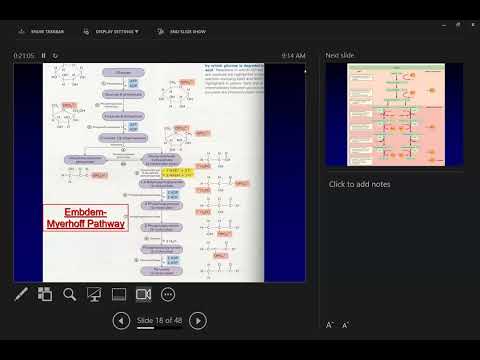
Embden-Meyerhof Glycolysis: Glucose Becomes Two Pyruvate
- Glycolysis starts with one six-carbon glucose and ends with two three-carbon pyruvate molecules.
- Hexokinase uses one ATP to add a phosphate to blood glucose, trapping it inside the muscle cell as glucose-6-phosphate.
- The pathway's initial ATP investment is recovered later, so the lecture tracks both ATP used and ATP produced.
5:00
PFK, NADH, and Glycolysis's Net ATP Yield
- Phosphofructokinase (PFK) converts fructose-6-phosphate to fructose-1,6-bisphosphate and is identified as glycolysis's rate-limiting, allosterically regulated enzyme.
- Substrate-level phosphorylation produces four ATP per glucose, while the pathway initially consumes two, for a net yield of two ATP.
- Glycolysis also produces two NADH; these electron carriers must be recycled so the pathway can continue.
10:00
Muscle Glycogen and Glycolysis's Anaerobic Location
- Glucose released from muscle glycogen enters glycolysis as glucose-6-phosphate and bypasses the ATP-consuming hexokinase step.
- That bypass raises the lecture's net yield to three ATP per glucose unit from muscle glycogen, compared with two from blood glucose.
- Glycolysis uses no oxygen and takes place in the cytoplasm.
13:00
Pyruvate's Two Fates: Lactate or Aerobic Metabolism
- Pyruvate can be converted to lactate by lactate dehydrogenase (LDH), or converted to acetyl-CoA by pyruvate dehydrogenase (PDH) for aerobic metabolism.
- The LDH route transfers electrons from NADH back to pyruvate, regenerating NAD so glycolysis can keep running.
- The lecture notes that fast-twitch, type II muscle fibers tend to have more active LDH than slow-twitch, type I fibers.
20:00
NAD and FAD: Electron Carriers That Sustain Metabolism
- NAD accepts electrons during glycolysis; FAD serves a similar electron-carrier role during the Krebs cycle.
- Without free NAD, glycolysis cannot continue, so cells must recycle NADH back to NAD or shuttle its electrons elsewhere.
- The lecture introduces lactate threshold as the exercise intensity where blood lactate begins rising above its resting level.
23:00
Lactate Threshold, Acidity, and Exercise Fatigue
- At low exercise intensities, lactate production and clearance remain balanced; threshold occurs when production outpaces the body's ability to clear or shuttle it.
- The lecture links the rise in hydrogen ions associated with lactic acid dissociation to increased acidity and interference with metabolic and muscle-contraction processes.
- Lactate threshold helps predict sustainable running speed or cycling power, making it a practical endurance-performance measure.
30:00
The Lactate Shuttle and Blood-Lactate Testing
- Lactate is a three-carbon fuel that can leave the muscle where it was produced, travel through the blood, and be taken up by other tissues for oxidation in the Krebs cycle.
- A cycling test measures blood lactate from finger or earlobe samples as power output increases; resting levels are typically about 1 to 2 millimoles per liter.
- In the example, lactate remains near baseline until roughly 225 watts, then rises as production exceeds the body's capacity to shuttle and clear it.
35:00
Training Raises Lactate Threshold Relative to VO2 Max
- The lecture places lactate threshold for many relatively untrained people around 50 to 60 percent of VO2 max, while highly trained endurance athletes may exceed 90 percent.
- A cross-country runner with a lower VO2 max than teammates won races with a lactate threshold at 93 percent of her VO2 max.
- Threshold testing can guide training and compare athletes; raising it requires training near the intensity where lactate begins to accumulate.
39:00
Aerobic Metabolism: Acetyl-CoA, Krebs Cycle, and ATP
- Aerobic metabolism occurs in the mitochondria and uses glucose-derived pyruvate, fat-derived acetyl groups, and some amino-acid carbon to generate energy.
- The lecture describes three stages: pyruvate-to-acetyl-CoA transition, the Krebs cycle, and the electron transport chain, which uses collected electrons to produce much of the ATP.
- The Krebs cycle releases carbon dioxide and generates NADH, FADH2, and a small amount of ATP; the lecture says the electron transport chain can yield roughly 30 to 32 ATP.
- Fat breakdown depends on aerobic pathways; their high total energy capacity is offset by a slower maximum rate than glycolysis or immediate phosphate systems.
Summary, takeaways, and chapters were generated by AI from the video's transcript and may contain errors. The video belongs to its creator, Exercise Physiology with Dr. Chris Black.