L13 Resistance Training IV
 Watch on YouTube →
Overview
Chris Black explains how genetics, muscle loading, and effort shape resistance-training outcomes, emphasizing that genetic variation—including myostatin-related differences—strongly affects hypertrophy potential. He connects the physiology to practical training: reach muscular failure with an appropriate load, distinguish strength from muscle growth, and understand why disuse causes rapid atrophy; he also addresses blood-flow-restriction training, rehabilitation, weight loss, and GLP-1 medications.
Key takeaways
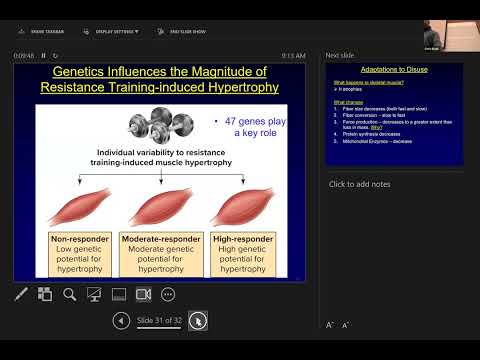
- Genetic variation strongly influences muscle-size potential: Chris Black cites about 80% of variation in muscle mass and roughly 50 identified muscle-mass-related genes, including pathways linked to mTOR.
- Resistance training must be sufficiently challenging to drive adaptation; two to three sets of six to 12 repetitions at least twice weekly is a practical guideline, with sets taken close to failure.
- Muscle loss from severe disuse begins quickly: bed rest can produce measurable changes within a week, and a month of unloading one leg was associated with about 15% quadriceps and 18% calf-muscle size reductions.
- Blood-flow restriction can support hypertrophy with lighter loads when sets reach failure, which may help when a joint cannot yet tolerate heavy resistance, but it produces a less robust strength response.
- Spot reduction does not work: abdominal exercises strengthen the trunk, but reducing fat over the abdomen or arms requires overall fat loss rather than targeted exercises.
- Weight loss can improve cardiometabolic risk but also reduces muscle; resistance training is therefore relevant when weight is lost through diet or GLP-1 medication.
Chapters
0:00
Course Updates and the Resistance-Training Wrap-Up
- Students who submit the Canvas post-test-one assessment by Monday receive two percentage points of bonus credit.
- Chris Black plans to finish resistance training, take questions, and begin metabolism in the next class.
3:09
Myostatin, Genetic Potential, and Muscle-Size Responses
- Myostatin limits muscle growth; low myostatin activity can permit greater muscle-size potential, as illustrated by unusually muscular dogs and mice.
- Black estimates that genetics account for about 80% of variation in muscle mass, while noting that this figure concerns mass rather than strength.
- Researchers have identified roughly 50 genes related to muscle mass, many connected to cellular pathways that activate mTOR.
- People can be described as high, moderate, or low hypertrophy responders; Black says most people fall in the moderate-response range.
9:35
Disuse Atrophy: How Quickly Unloaded Muscles Lose Mass
- Without regular loading, muscle fibers shrink, force production falls, protein synthesis declines, and some training adaptations—including mitochondrial enzyme changes—are lost.
- Strict bed rest can produce measurable muscle-size reductions within a week; spaceflight can show fiber atrophy within three to five days.
- In a one-month study using crutches to unload one leg, quadriceps size fell about 15% and gastrocnemius/soleus size about 18%; roughly 10% losses were seen by two weeks.
- Neural adaptations to strength can begin declining within a day or two, but return faster after retraining than they were initially acquired.
15:45
Training to Failure, ACSM Guidelines, and Spot-Reduction Myths
- Black gives the American College of Sports Medicine guideline as two to three sets of six to 12 repetitions for most muscle groups, at least twice weekly.
- For strength, prioritize heavier loads and fewer repetitions; for hypertrophy, use a load that brings the target muscles close to failure.
- Sets of about six to 12 make reaching failure more practical than very high-repetition sets, though lighter loads can also build muscle if taken to failure.
- Abdominal exercises strengthen the core but cannot selectively remove belly fat; fat loss requires an overall energy deficit, not targeted crunches or curls.
24:00
Blood-Flow Restriction for Hypertrophy with Lighter Loads
- Blood-flow-restriction training uses a cuff to partially restrict circulation, accelerating fatigue and allowing lighter loads to reach failure.
- When sets reach failure, Black says light-load blood-flow-restriction training can produce hypertrophy similar to heavier training under normal blood flow.
- The method can be useful during rehabilitation when an ACL or another joint is not ready for heavy loading.
- Its strength gains are less robust than heavy-load training because the lighter resistance produces a smaller neural-strength stimulus.
27:35
Drop Sets, Heated Classes, Pilates, and Exercise Specificity
- Drop sets reduce the load after a set so a person can continue working; Black says differences from conventional sets are likely small when training effort is comparable.
- Heated workouts do not provide a special fat-loss effect; sweating can reduce plasma volume, raise heart rate, and accelerate fatigue, while dehydration adds risk.
- Pilates and yoga improve skill and capacity in their own movements, but becoming stronger at heavy squats requires practicing heavy squats.
- Resistance exercise burns relatively few calories compared with many endurance activities, and dietary changes are usually central to creating a calorie deficit.
34:55
Failure Training in Rehabilitation and Metabolic Conditions
- Training every set to failure may not suit rehabilitation when joints or tissues are not ready for that level of fatigue; Black distinguishes general training advice from physical-therapy decisions.
- For type 2 diabetes, increased muscle mass can improve insulin sensitivity and provide more capacity for glucose uptake; type 1 diabetes involves different risks, including hypoglycemia.
- Peripheral arterial disease can limit exercise tolerance, so lower-intensity activity may be needed and exercise should remain within individual limits.
- Black notes that some passive physical-therapy modalities have limited evidence for added benefit, while exercise-based treatment is a key active component.
41:00
Repeated-Bout Effect, Cross-Education, and Drop-Set Tradeoffs
- The repeated-bout effect reduces muscle damage from a familiar exercise: neural adaptation spreads the load across more motor units and muscle fibers.
- Training one arm can reduce damage susceptibility in the other arm, demonstrating that some protective neural adaptations cross over.
- Drop sets are mainly a way to reach failure sooner; they may be less suitable when the primary goal is maximizing strength with heavy loads and neural adaptation.
43:16
Weight Loss, GLP-1 Medications, and Preserving Muscle
- Black describes GLP-1 medications as effective weight-loss treatments with encouraging trial evidence, while distinguishing medical use from taking them for vanity-related weight loss.
- He links weight loss with improvements in risks such as high blood pressure, cardiovascular disease, and type 2 diabetes, while noting that medication evidence can evolve.
- Weight loss—including weight loss with GLP-1s—can reduce both fat and muscle, making resistance training an important topic when designing weight-loss programs.
- Black argues that obesity combined with sedentary behavior substantially raises chronic-disease risk and that losing weight can improve several cardiometabolic risk factors.
Summary, takeaways, and chapters were generated by AI from the video's transcript and may contain errors. The video belongs to its creator, Exercise Physiology with Dr. Chris Black.