L12 Resistance Training III
 Watch on YouTube →
Overview
Chris Black explains muscle growth as the long-term balance between protein synthesis and degradation, distinguishing the 2–3-day synthesis response after resistance exercise from muscle gain accumulated over weeks. He connects training and dietary protein to transcription, translation, mTOR signaling, and satellite-cell activity, while reviewing why fiber splitting and acute hormone spikes are not established explanations for human hypertrophy.
Key takeaways
- Muscle size changes according to the accumulated balance of protein synthesis and degradation, not the size of a single post-exercise synthesis spike.
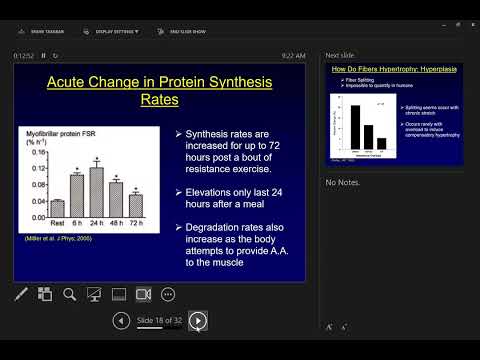
- One resistance-training bout can elevate measured muscle protein synthesis for up to 72 hours, while a protein-rich meal elevates it for about 24 hours.
- Human hypertrophy is primarily explained by existing muscle fibers growing larger; fiber splitting is not well supported under ordinary human training conditions.
- mTOR is a central signaling regulator: rapamycin blockade prevented hypertrophy in the animal model discussed, although exactly how exercise activates mTOR is still unknown.
- Satellite cells help supply myonuclei that support enlarging fibers; experiments that disable these cells sharply limit hypertrophy in animal and isolated-fiber models.
- Acute post-workout increases in testosterone, growth hormone, and IGF-1 are not required for resistance-training hypertrophy, even though normal resting hormone levels can influence muscle-growth potential.
Chapters
0:00
Protein Synthesis: How Training and Dietary Protein Work Together
- Muscle growth requires making additional proteins such as actin and myosin through protein synthesis, also called anabolism.
- Resistance exercise promotes transcription: DNA genes are copied into messenger RNA blueprints for muscle proteins.
- At ribosomes, translation uses amino acids from dietary protein to build the proteins specified by messenger RNA.
- Training and protein intake address different parts of the process; protein supplements are most useful when regular dietary intake is insufficient.
6:30
Muscle Size Reflects the Long-Term Balance of Synthesis and Breakdown
- Muscle protein is in continual flux: synthesis and degradation both occur, and hypertrophy results when synthesis exceeds degradation over time.
- A fasted or calorie-deficit state can increase reliance on tissue protein, illustrating why muscle breakdown is part of normal metabolism.
- Protein intake, mechanical loading, stretch, metabolic stress, hormones, and nervous-system activity can all influence muscle protein balance.
- A brief post-workout rise in synthesis should not be projected directly into weeks of muscle growth; the long-term net balance is what matters.
11:15
Measuring Exercise-Induced Protein Synthesis and Its Duration
- Researchers estimate protein flux using arterial and venous catheters, labeled dietary protein, blood sampling, and muscle biopsies.
- Data discussed from researchers at the University of Texas Medical Branch in Galveston show synthesis rising after one resistance-training session and remaining elevated for as long as 72 hours.
- A protein-rich meal elevates synthesis for roughly 24 hours; combining exercise and protein can raise the response further.
- Exercise raises both synthesis and degradation, but shifts their relative balance toward synthesis; the duration of the response helps explain recommendations for regular weekly training.
16:04
Why Human Hypertrophy Usually Enlarges Existing Fibers
- Hyperplasia—the creation of additional muscle fibers through fiber splitting—has little supporting evidence in humans under ordinary resistance-training conditions.
- Animal models using chronic muscle stretch or removal of synergist muscles can produce extreme growth and some fiber splitting, but they do not represent typical human training.
- The leading account of human hypertrophy is enlargement of existing myofibrils and fibers through added contractile proteins.
- Satellite cells can contribute new myonuclei; Black presents fiber number, starting fiber size, and myonuclear capacity as possible sources of genetic differences in growth potential.
23:49
mTOR Links Mechanical Loading to Muscle-Protein Production
- Black identifies mTOR—mammalian target of rapamycin—as a central regulatory pathway connecting signals such as mechanical loading and amino-acid availability to protein production.
- The pathway includes signaling through AKT and downstream p70S6 kinase, which helps regulate processes involved in gene expression and translation.
- Leucine, insulin-related signals, and mechanical stress are among the inputs discussed in the broader muscle-cell signaling network.
- The signaling diagram is presented as an incomplete snapshot of a complex process, not a pathway students need to reproduce in full.
27:05
Testosterone, Growth Hormone, IGF-1, and the Limits of Acute-Spike Theory
- Testosterone, growth hormone, and insulin-like growth factor 1 (IGF-1) have anabolic roles; restoring testosterone in men with low levels can increase muscle mass.
- Black notes that growth hormone can affect body composition, including fat metabolism, but says adding it to resistance training does not reliably produce extra training gains.
- Mechano-growth factor (MGF), a local IGF-1 variant, is discussed as a signal that can activate satellite cells in the muscles being worked.
- Although larger exercises such as squats can produce larger acute hormone responses than curls, Black says current evidence does not require post-workout hormone spikes for resistance-training hypertrophy.
35:52
Satellite Cells Supply Myonuclei Needed to Support Fiber Growth
- Satellite cells contribute myonuclei that help muscle fibers support additional protein production as they enlarge.
- In animal and isolated-fiber experiments, disabling satellite cells prevents or sharply limits hypertrophy, including in models that overload a muscle.
- These experiments support an important cellular role for satellite cells, while their results should not be treated as direct proof of every detail in human training.
- Black identifies mTOR signaling as one route involved in satellite-cell activity as well as muscle-protein synthesis.
38:17
Rapamycin Experiments Show mTOR Is Necessary in Animal Hypertrophy Models
- Research associated with muscle physiologist Sue Bodine used rapamycin to inhibit mTOR in an animal compensatory-hypertrophy model.
- When rapamycin blocked mTOR, the overloaded muscles did not gain mass, unlike muscles in the training model with functioning mTOR.
- The experiments support mTOR as a necessary component of hypertrophy in these models, but the precise way exercise activates mTOR remains unresolved.
- Black closes by noting that the next lecture will begin metabolism.
Summary, takeaways, and chapters were generated by AI from the video's transcript and may contain errors. The video belongs to its creator, Exercise Physiology with Dr. Chris Black.