L11 Resistance Training II
 Watch on YouTube →
Overview
Dr. Chris Black explains how resistance training improves strength through neural adaptations—especially better motor-unit recruitment and reduced antagonist co-activation—and why these changes are specific to the practiced task, speed, and movement. He then covers muscle hypertrophy, noting that visible growth often takes 6–8 weeks, average gains are far smaller than many expect, and protein supplements add little for people already eating enough protein; long-term growth depends on sustained net protein synthesis driven primarily by resistance training.
Key takeaways
- Twelve weeks of one-leg knee-extension training increased quadriceps voluntary activation from about 82% to 90%, showing how neural adaptation can improve force without requiring larger muscles.
- Strength gains transfer most strongly to the practiced movement and contraction speed: slow training favors slow contractions, while fast training favors fast contractions.
- Reduced antagonist activity can improve force output; in knee-extension training, hamstring EMG fell within the first week, reducing opposition to the quadriceps.
- Noticeable hypertrophy often takes 6–8 weeks, and a 12-week biceps study found average muscle-size gains of about 20% in men and 18% in women—not equivalent gains in total body weight.
- A 100–150% post-workout increase in protein synthesis is an acute measurement, not a prediction of equivalent muscle growth; long-term change depends on net protein balance across weeks.
- For people already eating adequate protein, supplementation is unlikely to add much muscle growth; resistance training is the primary driver, while supplements are most useful when intake is inadequate.
Chapters
0:00
Motor-Unit Recruitment Drives Early Strength Gains
- Dr. Chris Black identifies improved voluntary activation—the ability to recruit more motor units—as a major neural contributor to increased strength.
- After 12 weeks of one-leg knee-extension training, quadriceps voluntary activation rose from about 82% to 90%; the untrained control leg showed little change.
- These gains reflect better use of existing muscle, not necessarily an increase in muscle size.
8:00
Training Speed and Movement Shape Task-Specific Strength
- Studies comparing training near 96°/s with training near 240°/s show that strength gains are greatest at velocities similar to the practiced speed.
- Training slowly improves slow-contraction strength more, while fast training better transfers to fast contractions; gains do not transfer equally across speeds.
- Over 12 weeks, practiced dynamic lifting loads can rise much more than isometric strength, illustrating the specificity of the trained movement.
12:39
Reduced Hamstring Co-Activation Helps Knee Extension
- During knee extension, the hamstrings act as antagonists to the quadriceps; hamstring electromyography (EMG) decreased within the first week of an eight-week training period.
- Lower hamstring co-activation means the quadriceps face less opposing force while extending the knee.
- Other neural adaptations include increased motor-unit recruitment, reduced activation at some submaximal loads, and greater descending neural drive through reduced spinal inhibition.
21:06
Hypertrophy Takes Weeks and Has Genetic Limits
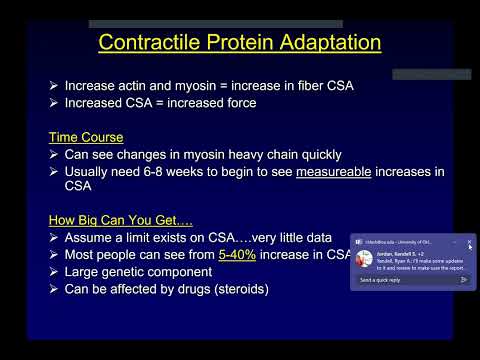
- Visible, measurable muscle growth commonly takes about 6–8 weeks under ordinary conditions, making consistency important for adherence.
- Black estimates natural muscle-growth potential varies widely—roughly 5% to 40–50%—with genetics accounting for much of the difference.
- He cautions that anabolic steroids can substantially increase muscle growth, while also explaining that exogenous testosterone can suppress the body's own production.
25:52
Study Results Put Muscle-Gain Expectations in Perspective
- In a 12-week biceps study, most participants gained about 10–25% in measured muscle size, while some showed little growth and a small number gained around 50–55%.
- Average gains were about 20% for men and 18% for women in that study; these percentages refer to muscle size, not total body weight.
- As an illustration, making every muscle in a 160-pound person 15% larger would add only about 8–10 pounds, even before accounting for muscles that were not trained.
28:46
Protein Supplements, Net Protein Balance, and Long-Term Growth
- For people already consuming adequate protein on a typical diet, supplements are unlikely to produce a large additional muscle-size gain; they may help when dietary protein is insufficient.
- A protein supplement can increase measured protein synthesis after one workout by roughly 100–150%, but that acute response does not translate into 100–150% more muscle over 8–12 weeks.
- Hypertrophy requires net positive protein balance over time: resistance training raises both protein synthesis and breakdown, with growth occurring when synthesis predominates across weeks.
Summary, takeaways, and chapters were generated by AI from the video's transcript and may contain errors. The video belongs to its creator, Exercise Physiology with Dr. Chris Black.