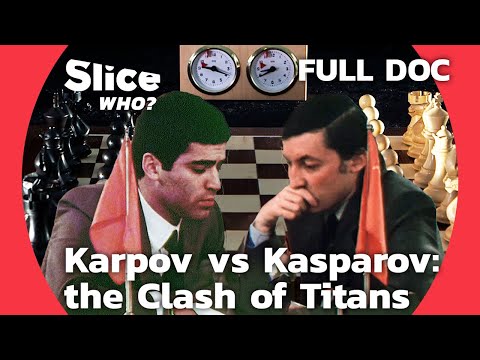
Karpov vs. Kasparov: Epic Rivalry of Chess Titans Amid USSR Collapse | SLICE WHO | FULL DOCUMENTARY
 Watch on YouTube →
Overview
Anatoly Karpov and Garry Kasparov’s five world-championship matches from 1984 to 1990 became both an epic sporting rivalry and a public drama shaped by Soviet political power during Mikhail Gorbachev’s reforms and the USSR’s collapse. Their contrasting styles—Karpov’s patient control and Kasparov’s energetic, attacking preparation—drove the contests, while match stoppages, surveillance suspicions, media battles, and Kasparov’s eventual victories made the chessboard a symbol of political change.
Key takeaways
- Karpov became world champion in 1975 after Bobby Fischer forfeited rather than play, so Karpov’s legitimacy was questioned even though he had defeated other leading contenders.
- Kasparov changed his approach in the 1984 match after falling behind: drawing games helped him recover psychologically and exploit Karpov’s fatigue, but FIDE stopped the contest at 5–3 without declaring a winner.
- Kasparov’s 1985 title victory followed public criticism of Soviet chess authorities and came at age 22, making him the youngest world champion at the time.
- The 1986 match showed how political and psychological pressure extended beyond the board: Kasparov’s team suspected information leaks and removed hotel telephones during a spy hunt.
- The 1990 match’s dispute over flags reflected the USSR’s weakening authority: Kasparov refused to play under the Soviet flag, and organizers ultimately removed all flags.
- Despite opposing political positions after the USSR’s collapse, Karpov’s 2007 message of support to imprisoned Kasparov helped repair their personal relationship.
Chapters
0:00
Bobby Fischer’s Forfeit Makes Anatoly Karpov World Champion
- Bobby Fischer’s 1972 victory over Boris Spassky ended decades of Soviet dominance of the world championship.
- The Soviet chess establishment selected 20-year-old Anatoly Karpov to challenge Fischer in 1975, but Fischer forfeited over match conditions.
- Karpov became champion without playing the reigning titleholder, leaving a disputed mark on his career despite his record against other leading players.
3:30
Karpov’s Soviet Rise and Kasparov’s Early Chess Talent
- Born in 1951 in Zlatoust in the Urals, Karpov learned chess from his father and entered Moscow’s prestigious Botvinnik chess school at age 12.
- Karpov’s controlled temperament and intellectual discipline suited the Soviet Union’s preferred image of a champion; he held the title for a decade after 1975.
- Garry Kasparov was born in Baku in 1963 to an Armenian mother, Clara, and Jewish father, Kim Weinstein; after his father died, he adopted his mother’s surname.
- Kasparov’s early talent drew attention from coach Alexander Nikitin, who identified him as a future champion after seeing him in junior competition.
10:00
The 1984 Moscow Match Opens with Karpov in Control
- On September 10, 1984, 21-year-old Kasparov began a world-title match against 33-year-old Karpov in Moscow’s Pillar Hall.
- The original format had no time limit and required six game wins; Karpov took a 4–0 lead as Kasparov struggled to hide his emotions.
- Karpov’s patient, constricting style contrasted with Kasparov’s preference for aggressive attacks and tactical risk.
- The match also reflected Soviet power dynamics: Karpov had strong federation backing, while Kasparov’s support included Azerbaijani official Heydar Aliyev.
13:55
Kasparov Changes Tactics as the 1984 Match Reaches 5–3
- After Karpov led 4–0 and later 5–0, Kasparov shifted toward drawing games to build confidence and make the long match last.
- Karpov missed a chance to finish the contest in game 31, then lost game 32; Kasparov’s wins brought the score to 5–3.
- After months of play, Karpov had lost about 10 kilograms and was visibly exhausted as Kasparov gained momentum.
- FIDE president Florencio Campomanes stopped the match without a winner, prompting Kasparov to denounce the decision publicly in a break with Soviet sporting protocol.
22:10
Gorbachev’s Reforms Clear the Way for a 24-Game Rematch
- The Soviet authorities and the Karpov camp disputed why the first match ended; Karpov’s supporters argued Kasparov feared losing at 5–3.
- Mikhail Gorbachev became Soviet leader in March 1985, and reform advocate Alexander Yakovlev helped prevent Kasparov from receiving a proposed two-year suspension.
- Kasparov’s interview with the Western magazine Der Spiegel criticized the match stoppage and Soviet chess governance, intensifying conflict with Karpov’s camp.
- The rematch began in September 1985 under a 24-game limit; Kasparov won the final game and became the youngest world champion at age 22.
29:00
Karpov’s 1986 Challenge and the Spy Scandal in Leningrad
- FIDE required Kasparov to defend his title against Karpov again within months; the 1986 match split its first 12 games between London and its next 12 in Leningrad.
- Karpov adopted a more aggressive approach and improved his preparation, including attention to training routines and nutrition.
- Kasparov’s team suspected that information was leaking; after a telephone was found in an assistant’s room, the camp removed hotel phones and pursued a spy hunt.
- Kasparov recovered from three consecutive losses in Leningrad and won the match, preserving his title in the third world-championship contest between them.
38:00
Kasparov Retains His Title Against Karpov in Seville
- The 1987 match in Seville was the first of their championship contests played entirely outside the USSR, allowing broader media access and live Spanish television coverage.
- Kasparov’s autobiography portrayed Karpov as a representative of an old Soviet system, adding a public and political dimension to their competition.
- Karpov led much of the 24-game match and needed only a draw in the final game to regain the title.
- Kasparov won the decisive final game and retained the championship, demonstrating his ability to deliver under maximum pressure.
42:20
The 1990 Match Turns the Rivalry into a Contest of Political Symbols
- The fifth and final championship match between Karpov and Kasparov took place in 1990 in New York and Lyon.
- American coverage framed Karpov as a Communist Party insider and Kasparov as an anti-Communist symbol of change.
- Kasparov rejected the Soviet flag and displayed a handmade Russian flag, leading to protests and a compromise in which the match venue removed the flags.
- Kasparov retained his title with a 12½–11½ score; the contest was their last world-championship final before the Soviet Union collapsed.
48:30
After the USSR: Political Divide and a Gesture of Solidarity
- The Soviet Union dissolved in 1991, and Kasparov later described his victory as a symbol of Russia overcoming the USSR.
- Karpov entered Russian politics as a Duma deputy and supporter of Vladimir Putin, while Kasparov became an opposition activist and was arrested during demonstrations.
- When Kasparov was imprisoned for five days in 2007, Karpov sent him a chess magazine through an intermediary after being unable to visit.
- Kasparov later said the gesture softened his view of Karpov and showed that their shared history as world champions could transcend decades of rivalry.
Summary, takeaways, and chapters were generated by AI from the video's transcript and may contain errors. The video belongs to its creator, SLICE Who?.