ISE 754 (Fall 2026) 4.3 Prod-Inv: Single Product
 Watch on YouTube →
Overview
Michael G. Kay models single-product production and inventory planning as a time-expanded, multistage network, where production, inventory carryover, and demand are balanced across periods in a rolling horizon. He compares linear programming with a backward greedy procedure for cases without storage limits, then shows how inventory limits and setup costs require optimization models, including a mixed-integer formulation, and closes with demand forecasting and planning-horizon decisions.
Key takeaways
- A time-expanded network represents production and inventory as flows across stages and periods, with each period's demand satisfied before surplus carries forward.
- When inventory has no upper bound and only production is capacity constrained, a single-product plan can be solved backward using the as-late-as-possible greedy procedure.
- Adding storage capacity limits breaks the greedy method and requires a linear program to choose production and inventory flows.
- Fixed setup costs require an integer setup variable that gates production capacity, making the formulation a mixed-integer linear program.
- Near-term demand planning relies primarily on booked orders, while forecasts become more important farther into the rolling horizon.
- A planning horizon should extend far enough to capture consequences of present decisions, including inventory buildup before scheduled production outages.
Chapters
0:00
Time-Expanded Production Network and Rolling-Horizon Demand
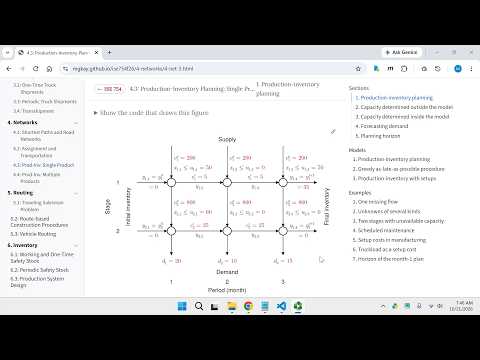
- The example network has 2 production stages across 3 periods, with production and existing inventory flowing into each stage.
- Stage 2 output first satisfies period demand, such as 20 units in period 1, and any surplus can carry forward as inventory.
- Periods 2 and 3 combine booked orders with forecasts; a monthly rolling horizon advances each period and adds a new future period.
5:35
Production Costs, Inventory Costs, and the Linear Program
- The example assigns production costs of $200 per ton at stage 1 and $800 per ton at stage 2, with a 50-ton stage 1 capacity limit.
- Carrying inventory costs $5 per ton for stage 1 and $25 per ton for stage 2, favoring storage before the product gains value through further processing.
- The production-inventory formulation is a linear program with nonnegative continuous production and inventory variables; storage capacity limits can be added to the model.
10:26
Backward Greedy Planning with Production-Only Capacity Limits
- Flow balance lets planners infer missing quantities: 19 units entering stage 2, 7 used for demand, and 12 carried as inventory.
- The greedy as-late-as-possible procedure starts at the final stage and period, producing demand as late as capacity allows to avoid unnecessary inventory.
- Working backward through the example yields a need for 15 units of stage 2 inventory in period 3, 25 units carried into period 2, and 45 units of stage 2 production in period 1.
- The procedure works for a single product when capacity limits apply only to production and inventory is unlimited; storage bounds instead require a linear program.
18:07
Setup Costs Turn Capacity Decisions into a Mixed-Integer Model
- When production availability is chosen outside the model, capacities can be set to zero or an available limit by stage and period; choosing availability inside the model requires integer variables.
- The setup variable Z represents the number of setups, bounded by available resources, and gates production capacity so that a zero setup count forces zero production.
- The objective adds setup cost to production and inventory costs; the resulting model is a mixed-integer linear program.
- Because setup costs are fixed rather than per-ton, the inventory-cost calculation approximates their per-ton contribution by dividing setup cost by production capacity.
25:26
Demand Time Fences and Choosing a Planning Horizon
- Within the demand time fence, near-term production uses orders on hand; farther-out periods combine booked orders with forecasts, eventually relying entirely on forecasts.
- The rolling horizon advances by one period at a time, updating the mix of actual orders and forecast demand.
- The planning horizon should include future events affected by current decisions, such as a two-month maintenance outage that requires building inventory during the preceding three periods.
Summary, takeaways, and chapters were generated by AI from the video's transcript and may contain errors. The video belongs to its creator, Michael G. Kay.