ISE 754 (Fall 2026) 3.4 Transshipment
 Watch on YouTube →
Overview
Michael G. Kay explains how full-truckload assumptions make distribution-center location costs precomputable, then develops transshipment models that compare stocked inventory with cross docking. The lecture also shows how to optimize shipment intervals and facility location, compares example costs of $64,000 for stocking and $55,000 for perfect cross docking, and closes with warehouse operations including Amazon Robotics’ Kiva system.
Key takeaways
- Full-truckload shipping makes location costs precomputable because truckload quantities do not change with candidate distance; without that assumption, every candidate location requires new shipment-size calculations.
- A distribution center can reduce outbound cost by combining products A and B into fuller loads, but minimum-delivery-frequency constraints can reverse the result and move the best location from Statesville to Winston-Salem.
- The transshipment inventory factor accounts separately for supplier and customer cycles, with an added one-half inbound fraction for inventory held at the DC.
- Perfect cross docking requires a shared shipment interval across all products; the lecture’s Example 1 compares $64,000 for stocking, $55,000 for perfect cross docking, and a $44,000 allocated full-truckload benchmark.
- Numerical location optimization can miss zero-distance cost dips at existing facilities because the dips are extremely narrow; explicitly evaluating each existing site can reveal the true best candidate.
- Warehouse design links storage and picking equipment to order size: pallet racks hold inventory, A-frames and carousels support smaller picks, and Kiva robots move shelves to picking locations.
Chapters
0:00
Full-Truckload Assumptions and Distribution-Center Location
- Assuming full truckloads makes monetary weights calculable in advance, allowing standard one-dimensional location methods to be applied.
- Without full truckloads, optimal shipment size depends on distance, so changing a candidate facility location requires recalculating shipment quantities and costs.
- In Example 1, suppliers provide products A and B and customers receive demand shares; combining products on outbound trucks changes the monetary weights.
- The one-dimensional solution is Statesville; monthly delivery requirements increase outbound costs and shift the optimum to Winston-Salem.
5:30
Transshipment Inventory and the Distribution-Center Alpha Factor
- A distribution center enables inbound loads of products A and B to be rearranged into combined outbound loads for customers.
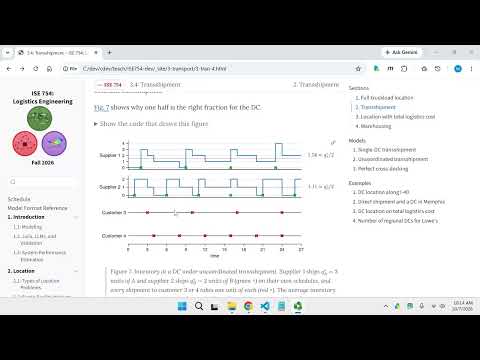
- The inventory factor separates supplier-side and customer-side shipment cycles; continuous production or use has α = 1/2, while batch operation has α = 0.
- The model assigns an additional α = 1/2 to inbound shipments for inventory held at the DC, and zero DC inventory fraction to outbound shipments.
- The inventory timeline illustrates supplier loads arriving in batches and customer trucks drawing product down between arrivals.
11:00
Stocked Inventory, Cross Docking, and Shipment-Interval Models
- Stocked products remain in uncoordinated inventory at the DC; cross-docked products move from receiving to outbound shipping, generally within hours or the same day.
- Products can be divided into multiple cross-docking groups because each group needs compatible inbound and outbound shipment intervals.
- The uncoordinated-stock model solves each product’s periodic truck-shipment problem independently using total logistics cost.
- Perfect cross docking puts every product in one group and selects a shared shipment interval t that minimizes combined logistics cost.
20:00
Cost Comparisons for Stocking, Cross Docking, and Direct Shipping
- In Example 1, uncoordinated stocking costs $64,000, while perfect cross docking costs $55,000; the allocated full-truckload benchmark is $44,000.
- The lecture presents $55,000 and $44,000 as upper and lower cost bounds for the implementable solution, with product grouping offering more flexibility than either extreme.
- In the two-dimensional example, the Memphis DC serves three suppliers and four customers; perfect cross docking has the lowest logistics cost among the compared DC options.
- Direct shipment can beat uncoordinated DC storage because smaller loads may qualify for LTL service, and the comparison excludes the fixed cost of operating a DC.
23:20
Numerical Facility Location and Zero-Distance Cost Discontinuities
- Without the full-truckload assumption, a computer can evaluate each candidate location by recalculating optimal inbound and outbound shipment sizes.
- The closed-form cost calculation can be optimized numerically in Julia or a spreadsheet, but shipment quantities must be recomputed as distance changes.
- A distance threshold below 10⁻⁴ sets transport cost and shipment size to zero when a facility coincides with an existing site, avoiding the minimum truckload charge.
- These zero-distance cases create narrow cost dips that Nelder–Mead can miss; checking every existing facility directly found mile marker 150 as the lowest-cost candidate.
26:30
Warehouse Flows, Cross-Dock Operations, and Amazon Kiva Robots
- A warehouse flow runs from inbound receiving to pallet-rack storage, then to shipping; whole pallets may move directly, while A-frames and carousels support carton or piece picking.
- Picked cartons and individual items are consolidated, typically onto pallets, before leaving the shipping area.
- Cross docking bypasses storage by moving received products across the dock into outbound staging for prompt shipment.
- Amazon’s Kiva robots move shelves through multi-agent control; Kiva Systems was founded in 2003 by a team including NC State computer-science professor Peter Wurman and was acquired by Amazon in 2012.
Summary, takeaways, and chapters were generated by AI from the video's transcript and may contain errors. The video belongs to its creator, Michael G. Kay.