Introducción a la luz
 Watch on YouTube →
Overview
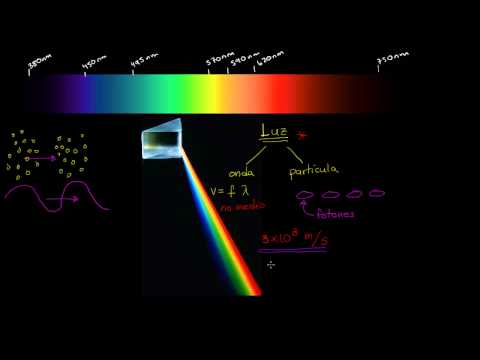
Light shapes how we perceive objects, yet it has counterintuitive quantum behavior: depending on the experiment, it acts as a wave or as particles called photons, a concept associated with Einstein's work on the photoelectric effect. Light needs no medium and travels through a vacuum at about 3 × 10^8 meters per second; visible light spans roughly 400 to 750 nanometers within the electromagnetic spectrum, whose frequencies also include radio waves, microwaves, infrared, ultraviolet, X-rays, and gamma rays.
Key takeaways
- Light exhibits wave-particle duality: experiments reveal wave properties such as frequency and wavelength or particle behavior as photons.
- Unlike sound, which propagates through pressure changes in air, light can travel through a vacuum without a medium.
- Light's vacuum speed is about 3 × 10^8 meters per second, and current physics identifies it as the universe's maximum travel speed.
- Visible light occupies an approximate wavelength range of 400 to 750 nanometers; shorter-wavelength violet and blue light refract more through a prism than red and yellow light.
- Higher-frequency electromagnetic radiation carries more energy per photon, while the electromagnetic spectrum extends from radio waves through gamma rays.
- Human vision covers frequencies that overlap with strong solar emission, which helps explain why visible light is useful for sensing reflected energy on Earth.
Chapters
0:00
Light's Wave-Particle Duality and Photons
- Objects become visible when light reflects from them, bends near them, or diffracts, and the eyes and brain use those signals to model the surroundings.
- Light can appear wave-like or particle-like depending on the experiment, unlike familiar examples such as ocean waves or a basketball.
- As particles, light consists of photons, a concept connected to Einstein's work on the photoelectric effect.
- As a wave, light has frequency and wavelength, and its speed is calculated as frequency multiplied by wavelength.
4:00
Vacuum Propagation, Light Speed, and Visible Colors
- Sound travels through air as pressure variations passed between molecules, but light does not require a material medium.
- In a vacuum, light travels at approximately 3 × 10^8 meters per second, or 300 million meters per second, enough to circle Earth about seven times in one second.
- Current physics treats the speed of light as the maximum possible speed for anything to travel.
- A prism separates white sunlight because different wavelengths refract by different amounts: violet and blue bend more than red and yellow; visible wavelengths range from about 400 to 750 nanometers.
8:00
The Electromagnetic Spectrum and Why Humans See Visible Light
- Higher-frequency light has more energy per photon and can transfer enough energy to knock electrons out of their orbits.
- Visible light is only one part of electromagnetic radiation: the broader spectrum also includes radio waves, microwaves, infrared, ultraviolet, X-rays, and gamma rays.
- The spectrum's different regions have familiar uses and effects: microwaves heat food, infrared detects body heat, ultraviolet can cause sunburn, and X-rays reveal bones.
- Human vision likely adapted to frequencies where the Sun emits much of its electromagnetic radiation, though organisms on Earth and hypothetical life elsewhere may detect other ranges.
Summary, takeaways, and chapters were generated by AI from the video's transcript and may contain errors. The video belongs to its creator, KhanAcademyEspañol.