How to Speak
 Watch on YouTube →
Overview
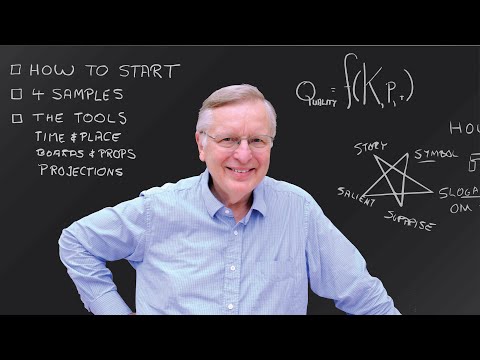
Patrick Winston argues that effective communication depends more on knowledge and practice than innate talent, and teaches practical techniques for making ideas clear, memorable, and persuasive. He covers audience engagement, boards and props, slide design, inspiring instruction, oral exams, job talks, and the “Winston’s star” framework—symbol, slogan, surprise, salient idea, and story—for helping work get recognized.
Key takeaways
- Winston’s communication formula prioritizes knowledge and practice over innate talent, so speakers can improve substantially by building subject expertise and rehearsing deliberately.
- An opening empowerment promise gives listeners a reason to pay attention by specifying what they will learn or gain by the end of the talk.
- Repetition, verbal signposting, clear distinctions from related ideas, and carefully chosen questions help audiences recover when attention lapses.
- Use blackboards and physical props for teaching because they support visual reasoning and proceed at an absorbable pace; reserve slides primarily for exposing ideas.
- Reduce slide text and clutter, use large readable type, and avoid laser pointers that turn the speaker away from the audience.
- A strong job talk establishes both vision and accomplishment within about five minutes, then ends with a concise list of contributions.
Chapters
0:00
Knowledge and Practice Outweigh Speaking Talent
- Winston frames communication success as a combination of knowledge, practice, and talent, with talent the smallest factor.
- He compares his skiing ability with Olympic gymnast Mary Lou Retton’s: his knowledge and practice helped him outperform her despite her exceptional athletic talent.
- He promises that even one presentation technique could improve a listener’s chances of having ideas valued and accepted.
- Winston asks the audience to close laptops and phones, arguing that people have one language processor and device use distracts both users and nearby listeners.
4:16
Open with an Empowerment Promise and Use Four Speaking Heuristics
- Winston advises against opening with a joke because audiences are still settling in and adjusting to the speaker’s voice.
- An empowerment promise tells listeners what they will know or be able to do by the end of the talk.
- Cycling means revisiting a central idea: Winston estimates that about 20% of listeners may be fogged out at any given moment.
- Build a fence around an idea by distinguishing it from similar work; use verbal punctuation and carefully chosen questions to help listeners rejoin the talk.
10:17
Choose a Lively Time and Inspect the Speaking Room
- Winston recommends 11 a.m. as a strong lecture time because most MIT students are awake and the audience is less likely to be fatigued after a meal.
- Keep the room brightly lit; dim lighting signals sleep, and slides are no use to an audience with closed eyes.
- Visit and “case” the venue in advance to identify unusual conditions and plan for them.
- Choose a room that is appropriately sized and more than half full, rather than one that appears nearly empty.
13:24
Use Boards and Physical Props to Make Ideas Concrete
- Winston favors a blackboard for informing and teaching because it supports graphics and moves at a pace audiences can absorb.
- A board gives speakers a useful target for their hands; visible hands also avoid gestures that can seem rude in some cultures.
- Seymour Papert used a bicycle wheel and duct tape to show how to reason about the wheel’s motion by tracking one small section at a time.
- Alan Lazarus demonstrated conservation of energy with a pendulum that gently returned to his nose, making the physics memorable through a physical prop.
23:47
Why Props Work—and When Slides Should Be Used
- Winston attributes the effectiveness of boards and props partly to “empathetic mirroring”: audiences can mentally simulate writing or a moving object.
- He distinguishes teaching from exposing ideas: boards suit instruction, while slides are more useful for job talks and conference presentations.
- A Logan Airport anecdote introduces his rule of thumb that presentations usually contain too many slides and too many words.
- Slides should support what the speaker says, not compete with it or turn attention into a back-and-forth “tennis match.”
25:26
Simplify Slides: Remove Words, Clutter, and Pointer Distractions
- Winston demonstrates progressively removing background decoration, excess words, logos, titles, and bullets to make slide content easier to follow.
- He cites an experiment in which students remembered material they read on slides better than material delivered orally; one participant even found the speaker distracting.
- Use a legible font—Winston suggests roughly 40–50 points, with 35 points already a warning sign that too much text may be packed in.
- Avoid laser pointers that make speakers turn away from the audience; place an arrow on the slide and direct listeners to its endpoint instead.
32:17
Balance Slide Density and Use Rare Complex Slides Sparingly
- Print a presentation and lay out its slides to judge whether it is too text-heavy, lacks white space, or needs more imagery.
- Winston contrasts a dense presentation with a more visual talk that used only a few text slides and paused to let the audience read them.
- A slide excerpt from the 1957 Dartmouth AI conference proposal demonstrates how historical text can support a specific point.
- He calls an intentionally incomprehensible, highly complex slide a hapax legomenon: an effect to use only once per presentation.
36:18
Inspire Through Passion, Fresh Perspectives, and Clear Promises
- Winston’s survey found that incoming students were inspired by teachers who told them they could succeed, while senior faculty valued people who revealed a problem in a new way.
- Across career stages, people responded to visible passion for the subject.
- In an AI lecture, he introduces resource allocation through U.S. state coloring and contrasts a computation that would outlast the Sun with one that finishes in seconds.
- He describes thinking as working with stories: teach learners the stories, questions, analysis methods, and reliability checks needed to reason well.
41:31
Prepare for Oral Exams with Context and Unfamiliar Audiences
- Winston identifies failure to situate research and insufficient practice as common causes of oral-exam failure.
- Situating research means explaining the problem’s broader context, what has happened over time, and why the work matters.
- Practice with friends who do not know the research; supervisors may unconsciously fill in gaps because they already understand the project.
- He recommends realistic, demanding practice so committee questions feel manageable by comparison.
44:02
Make a Job Talk’s Vision and Accomplishments Clear in Five Minutes
- Navy Science Board colleagues Delores Etter and Bill Weldon told Winston that faculty candidates must show vision and demonstrate that they have done something.
- They estimated candidates have about five minutes to establish both points.
- A vision combines a consequential problem with a distinctive approach; Winston’s example asks what makes human intelligence different from that of chimpanzees and Neanderthals.
- Explain a technical plan through its steps, then close by enumerating concrete contributions that mirror those steps.
48:12
Use Winston’s Star to Make Research Recognizable
- Winston’s five-part framework for memorable work is symbol, slogan, surprise, salient idea, and story.
- His arch-learning research supplied a visual symbol—the arch—and the slogan “one shot learning.”
- The surprising claim was that a program could learn something definite from a single example; its salient concept was the “near miss.”
- Tell the story of how the work was done, how it operates, and why it matters so the audience can remember and explain it.
53:06
End with Contributions and a Deliberate Closing Line
- Winston says the final slide should list contributions, not a long collaborator roll, a blank “Questions?” screen, or generic conclusions.
- Put collaborators on the opening slide; keep the contribution slide visible while the audience asks questions and leaves.
- A closing joke can work after the audience has adjusted to the speaker, but “thank you” alone is a weak ending because it can imply listeners stayed only out of politeness.
- Alternative endings include a benediction, a conventional signal that the event is over, or a direct salute to the audience; Winston closes by acknowledging and valuing the MIT audience.
Summary, takeaways, and chapters were generated by AI from the video's transcript and may contain errors. The video belongs to its creator, MIT OpenCourseWare.