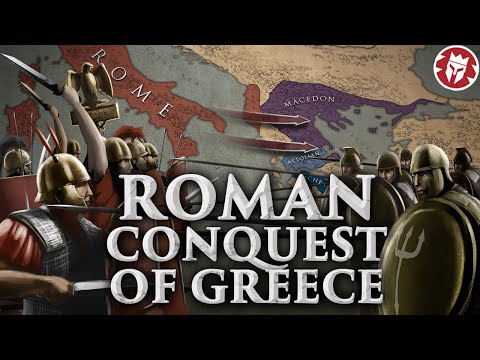
How Rome Conquered Greece - Roman History DOCUMENTARY
 Watch on YouTube →
Overview
Rome’s expansion into Greece unfolded through alliances, diplomacy, and successive wars: from the Illyrian conflicts and Philip V’s defeat at Cynoscephalae to the defeat of Antiochus III at Magnesia and Perseus at Pydna. Roman legions, naval power, and alliances with Greek states and Pergamon dismantled the Macedonian monarchy, defeated the Achaean League, and brought Greece under Roman control, while Greek culture remained influential across the Roman world.
Key takeaways
- Rome repeatedly used local rivals to contain stronger powers: Aetolia helped counter Philip V, while Pergamon, Rhodes, and the Achaean League supported Rome against Antiochus III.
- At Cynoscephalae in 197 BC, Roman manipular flexibility exploited the Macedonian phalanx’s difficulty fighting when disordered, contributing to about 8,000 Macedonian deaths and 5,000 captures.
- Antiochus III’s Greek campaign failed in part because he lacked broad local support and naval security; Rome’s victory at Thermopylae and allied naval successes left him unable to hold Greece or stop the Roman crossing into Asia.
- At Pydna in 168 BC, Paullus avoided attacking Perseus’s phalanx on favorable flat ground; uneven terrain opened gaps that Roman legionaries exploited at close range.
- Rome dismantled Macedonian independence in stages, first imposing client status on Philip V, then dividing Macedon into four districts after Pydna, and finally making it a province after defeating Andriskos.
- The destruction of Corinth in 146 BC and dissolution of Greek leagues completed Roman political domination, even as Greek culture remained central to Roman life and later European intellectual history.
Chapters
- In 231 BC, Macedon, Ptolemaic Egypt, and the Seleucid Empire competed for influence while smaller Greek states sought protection.
- Rome’s victory over Carthage in the First Punic War had established its naval strength and set the stage for intervention east of the Adriatic.
- King Agron’s Ardiaei expanded into Epirus and seized Phoenice; after his death, Queen Teuta ruled as regent.
- Roman complaints about Illyrian piracy culminated in a murdered envoy and war in 229 BC.
- A Roman force of 22,000 soldiers and 200 ships defeated the Illyrians, and the 228 BC settlement restricted piracy and fragmented their power.
- Rome made Demetrius of Pharos a client ruler after he defected during the First Illyrian War.
- Demetrius married into the Ardiaean royal family and raided Roman allies, then launched a 90-galley campaign in 220 BC.
- In 219 BC, Rome captured Dimallum and Pharos; Demetrius escaped and found refuge at Philip V’s court.
- Antigonus II Gonatas secured Macedonian rule with a fleet and strategic fortresses, including Demetrias, Chalcis, and Corinth.
- After Demetrius II died in 229 BC, Antigonus Doson became regent for the young Philip V and drove back Illyrian and Aetolian threats.
- Doson’s victories restored Macedonian stability before his death in 221 BC, leaving Philip V a stronger kingdom.
- After Roman defeats at Trebia and Lake Trasimene in 217 BC, Demetrius of Pharos urged Philip V to attack Rome’s Adriatic interests.
- Philip’s treaty with Hannibal was exposed when Roman forces captured the returning Macedonian envoy Xenophanes.
- Rome worked through the Aetolian League and other allies to contain Philip, and the First Macedonian War ended with the Peace of Phoenice in 205 BC.
- After Rome defeated Carthage at Zama in 202 BC, Philip seized Aegean islands and attacked Greek cities and territories around Asia Minor.
- Rhodes and Pergamon resisted Macedonian expansion, then appealed to Rome and warned of a pact between Philip and Antiochus III.
- The Roman assembly initially rejected war, but consul Publius Sulpicius Galba persuaded it to authorize the Second Macedonian War.
- Philip V rejected Roman demands to stop attacking Greek states and compensate Pergamon, committing Macedon to war.
- Abydos fell after its inhabitants chose mass suicide rather than submit to Philip.
- Roman commander Publius Villius Tappulus faced a mutiny by 2,000 veterans who had been away from their farms and families.
- Titus Quinctius Flamininus took command in 198 BC and demanded that Philip relinquish Thessaly and free the Greeks.
- At the Aous River, Flamininus used missile troops to distract the Macedonians while 4,300 legionaries took a mountain route.
- The Roman flank maneuver forced Philip to retreat and weakened support for Macedon among Greek states.
- At Cynoscephalae in 197 BC, Flamininus fielded about 32,000 troops against Philip’s roughly 26,000 Macedonians and allies.
- Philip’s phalanx initially pushed back the Roman left, but its uneven deployment left Nicanor’s troops vulnerable to the Roman right.
- An unnamed Roman tribune led 20 maniples against the phalanx’s rear, helping turn the battle into a rout; Macedonian losses included about 8,000 dead and 5,000 captured.
- The settlement at Tempe required Philip to evacuate Greece and his Asian and Thracian conquests, pay an indemnity, surrender his fleet, and send his son Demetrius to Rome as a hostage.
- At the Isthmian Games in 196 BC, Flamininus proclaimed Greek states free, ungarrisoned, untaxed, and autonomous.
- Rome warned Antiochus III to withdraw from Greek cities and stay out of Europe, opening a new confrontation with the Seleucid king.
- After the Fifth Syrian War, Antiochus III took Ptolemaic holdings including Coele-Syria and Ephesus.
- He crossed the Hellespont, captured territory in Thrace, and rebuilt Lysimacheia, prompting Roman concern that he was violating their demands.
- Pergamon’s Eumenes II rejected a marriage alliance with Antiochus and instead strengthened ties with Rome.
- The Aetolian League invited Antiochus to Greece in 192 BC, presenting him as a liberator from Roman influence.
- Antiochus landed at Demetrias with a limited force and was elected leader of the Aetolian League, but most Greek states declined to join him.
- The Achaeans remained allied to Rome, and the Aetolians’ attempt to seize Sparta failed before the Achaeans incorporated the city.
- In 191 BC, Antiochus placed about 12,000 infantry at Thermopylae while Roman consul Manius Acilius Glabrio attacked the narrow pass.
- Roman detachments under Marcus Porcius Cato and Valerius Flaccus targeted mountain routes around the Seleucid defenses.
- Cato’s force broke the Aetolian position on Mount Callidromus and threatened the Seleucid rear, forcing Antiochus’s army to flee.
- After Thermopylae, Rome’s allies included the Achaean League, Pergamon, and Rhodes, while Philip V joined Rome against Antiochus.
- The Roman and Pergamene fleets defeated Polyxenidas at Cissus; Hannibal’s separate fleet was beaten by the Rhodians at Eurymedon.
- At Myonessus, Roman boarding tactics and heavier ships inflicted further losses, leaving the Seleucid fleet unable to prevent a Roman crossing into Asia.
- Lucius Cornelius Scipio and his brother Scipio Africanus crossed into Asia in 190 BC with Roman, Italian, Pergamene, Achaean, and Macedonian forces.
- At Magnesia, the armies may have numbered about 70,000 each; Antiochus fielded phalangites, cataphracts, elephants, and scythed chariots.
- Pergamene cavalry broke the Seleucid left after the chariots lost cohesion, while the Roman center encircled the phalanx.
- Antiochus escaped, but the Seleucid defeat forced him to accept severe terms and withdraw from lands north and west of the Taurus Mountains.
- The Treaty of Apamea imposed a 15,000-talent indemnity, limited the Seleucid navy to 10 ships, took the king’s elephants, and required hostages including his son Antiochus.
- Rome’s settlement divided former Seleucid lands in Asia between Rhodes and Pergamon, while the territory in Europe went to Thrace.
- After fighting resumed in Greece, Rome defeated the Aetolians, who surrendered territory and lost the right to conduct an independent foreign policy.
- Philip V’s son Demetrius returned from Rome as a Romanophile, but court rivalry with his older brother Perseus led to his poisoning in 181 BC.
- Perseus became king in 179 BC and built ties with Greek states, Bithynia, and the Seleucid dynasty.
- Pergamon’s Eumenes II warned Rome that Macedon was regaining strength, helping drive the Senate toward another war.
- Rome used a supposed truce to buy time to prepare for war against Perseus, then sent consul Publius Licinius Crassus to Greece in 171 BC.
- At Callinicus near Larissa, Thracian cavalry under Cotys IV broke the Roman right and Perseus’s elite troops routed the Roman center.
- Perseus withdrew instead of pressing for a decisive victory, despite Roman losses of about 2,000 infantry and 200 cavalry.
- Rome’s destruction of Haliartus and enslavement of 2,500 inhabitants strengthened Perseus’s image as a defender of the Greeks.
- Perseus raided the Roman fleet at Oreus, damaging ships and grain supplies, while the Molossians of Epirus defected to Macedon.
- Consul Lucius Aemilius Paullus took command in 168 BC with about 22,000 Roman and allied heavy infantry, 4,000 cavalry, and 22 elephants.
- Perseus positioned his army near Mount Olympus, where the Elpeus River and surrounding terrain protected his defenses.
- Paullus sent Publius Cornelius Scipio Nasica with 8,500 troops through a mountain pass to outflank the Macedonians.
- A Cretan auxiliary revealed the plan, but Nasica defeated the force sent to block him, compelling Perseus to abandon his position.
- At Pydna in 168 BC, Perseus fielded about 44,000 infantry and 4,000 cavalry, including 21,000 phalangites with sarissa pikes.
- Paullus first withdrew from the flat ground, then used Roman discipline to regroup on uneven terrain where gaps opened in the phalanx.
- Roman elephants and cavalry broke the Macedonian left, while legionaries attacked exposed sections of the phalanx.
- Macedonian losses reached about 20,000 dead and 11,000 captured; Perseus was taken prisoner.
- Rome divided Macedon into four districts, barred independent diplomacy and trade between them, and restricted mining, logging, and shipbuilding.
- In 150 BC, Andriskos claimed to be Philip, son of Perseus, and raised support in Thrace before taking Macedon as Philip VI.
- Quintus Caecilius Metellus landed directly in Macedon and defeated Andriskos near Pydna in 148 BC; Rome then made Macedon a province.
- Sparta sought to leave the Achaean League, and Rome backed its independence while also demanding that Argos, Corinth, and Orchomenus be detached.
- The Achaeans rejected the Roman demands and declared war in 146 BC, joined by Boeotian and Euboean forces.
- Roman governor Metellus defeated Critolaos at Scarpheia and beat the Argives at Chaeronea before advancing south.
- Achaean commander Diaeus assembled about 16,000 troops to defend the Isthmus of Corinth.
- At Leukapetra, Roman forces under Lucius Mummius numbered about 27,000, supported by a Pergamene detachment.
- Roman cavalry routed the Achaean horsemen on both flanks, then attacked the Greek infantry from the sides and broke the army.
- After the Achaean defeat in 146 BC, Rome razed Corinth, killed its men, enslaved its women and children, and burned the city.
- Rome dissolved the Achaean and Aetolian Leagues and incorporated Greece into the province of Macedonia.
- The conquest relied on dividing Greek states and building alliances, while Greek culture continued to shape Roman society and later intellectual traditions.
Transcript excerpt
0:06 History of the human race has thousands of different conquests across ages, regions, and cultures, but it is difficult to find one that played such a decisive role in the future events as the conquest of Greece by the Roman Republic, as its effects echoed through the millennia. Welcome to our video that will cover the first Roman involvement in the Greek affairs, four Macedonian Wars, Seleucid War, Aetolian War and Achaean War. These long videos take forever to make, so please kindly consider sharing it in your social media. The year is 231BC and the Mediterranean world is a land of continuous warfare and political upheaval. Just ten years before, the burgeoning power of the Roman Republic had defeated Carthage in the First Punic War, establishing naval dominance on the sea.
1:01 In the east, the Hellenistic kingdoms - Macedon, Ptolemaic Egypt and the Seleucid Empire vie for dominance over their border territories. Sandwiched between these greater polities are a number of smaller states, such as Pergamon and the nominally independent Greek city-states. This is the world of the late 3rd century BC, but soon a series of conflicts between two rising powers - Rome and Macedon, will change the fate of the region forever. The which was Illyria - currently modern Albania and Dalmatia, was regarded in the mid to late third century as a thoroughly barbarian region, only half civilised by contact with its Greek and Macedonian neighbors. Though contact with the Greek world had led to a degree of urbanisation in the south and along the coast, the region in a political sense was still made up of many small tribal
1:55 chieftains. The population of Illyria had been regarded since their initial encounters as turbulent and warlike by the more traditionally civilised peoples who came to know them.
This is the start of the transcript. Save this video free for the whole transcript, searchable and time-coded.
Summary, takeaways, and chapters were generated by AI from the video's transcript and may contain errors. The video belongs to its creator, Kings and Generals.