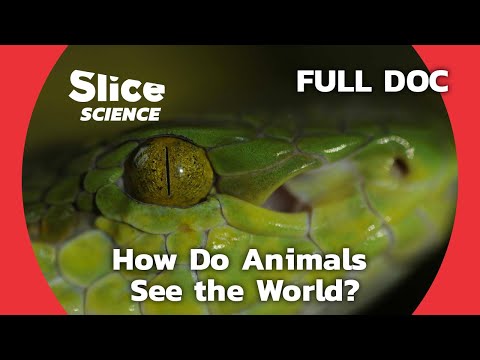
How Do Animals See the World? | SLICE SCIENCE | FULL DOCUMENTARY
 Watch on YouTube →
Overview
Animal vision is shaped by ecological needs: eye placement, retinal receptors, sensitivity to light, and brain processing produce very different ways of sensing space, color, heat, and motion. Researcher Simon Potier tests raptor acuity, bee experiments reveal ultraviolet color vision and flower constancy, and demonstrations of bat echolocation, snake heat sensing, visual illusions, and retinal implants show both the range of animal perception and the limits of human vision.
Key takeaways
- Eye placement reflects survival strategy: prey animals such as rabbits gain near-360° awareness, while forward-facing eyes give predators stronger binocular depth cues for judging distance.
- Visual acuity is task-dependent rather than universally superior: high-flying raptors need long-distance detail, while ground-feeding species may have lower acuity than humans.
- Bumblebees perceive ultraviolet, blue, and green rather than human-style red, and experiments show that they can learn a flower’s color and repeatedly forage on that color.
- Bats construct detailed three-dimensional spatial maps from ultrasound echoes, while pit vipers detect infrared radiation to locate warm prey in darkness.
- Dragonflies resolve about 175 images per second versus roughly 25 for humans, giving them a substantial advantage in tracking fast movement.
- Vision is an active brain process: context and learned expectations shape perception, and retinal implants demonstrate that electrical signals can support a new—but not normal—form of sight.
Chapters
0:00
Eye Placement Sets Each Species’ Visual Field
- Artists create animal-vision headsets that let volunteer Leah experience altered fields of view, including a chameleon-like view of front and behind.
- Forward-facing human eyes provide a roughly 120° field of view, while a rabbit’s side-positioned eyes approach 360°.
- Horse eyes provide broad lateral vision but leave a blind zone of about 12° directly in front.
5:30
Raptor Eyes Trade Field of View for Hunting Precision
- Researcher Simon Potier explains that a rigid brow helps some raptors, such as Harris’s hawks, avoid glare while spotting prey below.
- Northern goshawks have a wider field of view and smaller brows, helping them follow prey that appears above them.
- A two-screen conditioning test measures Harris’s hawk visual acuity by rewarding approaches to a gray screen as the bars on the alternative screen become finer.
- Raptor acuity varies with hunting behavior: high-flying species such as the wedge-tailed eagle need to see distant prey, unlike ground-feeding birds.
10:00
Retinas, Bee Color Vision, and Ultraviolet Flower Guides
- Human retinas use rods for low-light and movement vision and cones for central and color vision; three cone types respond to blue, green, and red.
- Raptors also have a violet-sensitive cone, while bumblebees detect green, blue, and ultraviolet but do not perceive red as humans do.
- Bee experiments show flower constancy: after associating one color with sugar water, a forager repeatedly visits flowers of that color, prioritizing color over shape.
- Ultraviolet photography reveals flower patterns that can guide insects toward pollen and nectar; modified cameras remove filters that normally block UV.
19:50
Night Vision Depends on Light-Gathering Anatomy
- Many vertebrates have a tapetum lucidum that reflects light through the retina again, making eyeshine visible when light hits the eye.
- Nocturnal raptors gather more light with large eyes and pupils and rely on rod photoreceptors.
- Cats see about six to eight times better than humans in the dark, while human rod sensitivity can take up to 45 minutes to reach its maximum.
- Even highly adapted eyes cannot see in complete darkness because vision still requires light.
23:05
Bat Echolocation Builds a Three-Dimensional Sound Map
- Bats emit ultrasound, mainly through the mouth or nose, and interpret returning echoes to locate prey and navigate.
- A bat detector makes ultrasound audible; changes in calls, including a hunting buzz, can reveal when a bat is pursuing or capturing an insect.
- Horseshoe bats can detect a thread thinner than a human hair and navigate quickly through cluttered spaces.
- Some bats produce exceptionally intense ultrasound, while horseshoe-shaped nose structures and independently moving ears help direct and receive calls.
28:00
Pit Vipers Detect Infrared Heat from Prey
- Rattlesnakes, boas, and pythons use pit organs between the eyes and nostrils to sense infrared radiation.
- These organs respond to wavelengths around 5–30 micrometers; human body heat radiates near 10 micrometers.
- Thermal sensing helps snakes locate warm-blooded prey at night and find places to warm themselves; a rattlesnake can detect a mouse about 40 cm away.
- A thermal camera renders hotter regions yellow or white and cooler areas blue or black, illustrating how different this sensory view is from ordinary color vision.
30:30
Dragonflies Process Motion Faster Than Humans
- Human vision perceives fluid movement at roughly 25 images per second, compared with about 175 images per second for dragonflies.
- The higher temporal resolution helps dragonflies track prey and predators with greater precision.
- Artist-engineer Lorenz Potthast’s headset captures camera footage, slows it with a computer, and displays it in video glasses.
- Delayed visual feedback makes ordinary tasks such as pouring, catching a ball, or lighting a candle difficult because sight no longer synchronizes with other senses.
35:50
The Brain Adapts to Shifted Vision Through Action
- Prism glasses shift Leah’s visual field, initially making her miss a target basket when she throws toward its apparent position.
- With practice, movement recalibrates perception: after adapting to the glasses, removing them can make her aim at the opposite basket.
- The experiment shows that action provides a reality check for visual input and that the brain adjusts how it maps seen objects to movement.
39:00
Tilted Rooms and Optical Illusions Reveal Visual Context
- In a room tilted 15°, Leah’s brain favors misleading visual cues about vertical despite information from the inner ear and pressure receptors in her feet.
- The demonstration shows how strongly the brain trusts vision when estimating orientation and gravity.
- Context alters perceived color, size, depth, and motion; examples include equal-sized circles appearing unequal and a stationary sequence seeming to move.
- The retina delivers a degraded signal, so the brain interprets context and fills in or removes information to construct a usable image.
44:40
Retinal Implants Restore a New, Limited Form of Vision
- Retinal surgeon Thomas Wolfensberger describes an implant for retinitis pigmentosa that electrically stimulates surviving retinal circuitry when light-sensitive cells have failed.
- A camera in the patient’s glasses sends images through a handheld computer, which reduces them to 60 gray-scale pixels before transmitting signals to the implant.
- Patient Charlotte learns to interpret outlines and silhouettes through months of therapy, gaining orientation and independence without recovering ordinary sight.
- The documentary closes by considering whether future implants could deliver ultraviolet, infrared, or thermal information, while noting that technology remains far from reproducing biological vision.
Summary, takeaways, and chapters were generated by AI from the video's transcript and may contain errors. The video belongs to its creator, SLICE Science.