[HD] EECS4302 F26 - 2026-10-22 (Thursdsay) - Lecture 11
 Watch on YouTube →
Overview
Jackie Wang explains DFA minimization as the final step in the lexical-analysis pipeline from regular expressions through epsilon-NFAs and DFAs, emphasizing that each representation recognizes the same language. Using a seven-state DFA for FEE and FIE, he iteratively refines state partitions until five states remain, then shows how those partitions define the minimized DFA; he also previews scanner implementation and course assessment preparation.
Key takeaways
- DFA minimization preserves the recognized language while merging states that cannot be distinguished by their transition behavior.
- The partition-refinement algorithm begins by separating accepting from nonaccepting states, then repeatedly splits groups until the previous and current partitions match.
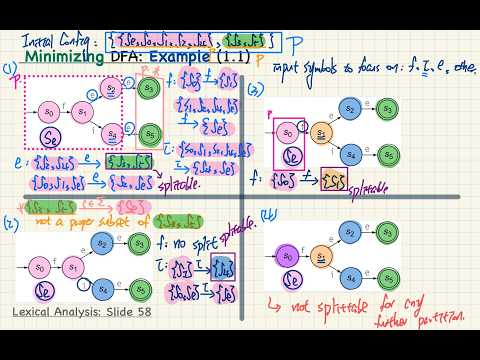
- In the FEE/FIE example, E first separates {S2, S4}, I or E then separates S1, and F finally separates S0 from the error state.
- The seven-state DFA becomes a five-state DFA with groups {S0}, {S1}, {S2, S4}, {S3, S5}, and {SE}, a reduction of about 30 percent.
- Unspecified transitions in a simplified DFA diagram represent transitions to an implicit error state, which must be included when analyzing or minimizing the machine.
- ANTLR 4 automates conversion from user-written regular-expression token patterns through epsilon-NFA and DFA construction to minimization.
Chapters
- Jackie Wang reminds students about November 5 and November 19 assessment dates and promises a programming-test guide and practice test.
- The 80-minute programming test will ask students to build a small compiler, making the ANTLR 4 tutorial and Assignment 2 important preparation.
- Students should review the self-guided lecture on regular languages, including set relations, propositional logic, regular expressions, DFAs, and NFAs.
- The lecture focuses on DFA minimization and introduces how a scanner can be implemented using skeleton code.
- Jackie Wang plans to move to syntactic analysis and parsing algorithms after completing the remaining lexical-analysis material.
- The compilation pipeline converts a textual regular expression into an epsilon-NFA, then a DFA, and finally a minimized DFA.
- ANTLR 4 automates these conversion steps after users specify token patterns as regular expressions.
- All four representations recognize the same language; minimization changes the number of states, not the accepted strings.
- A DFA diagram that omits transitions assumes an implicit error state, with unspecified inputs leading to that state.
- The example alphabet is the 26 lowercase English letters, grouped into transitions such as anything except F or anything except E and I.
- The seven-state example accepts exactly FEE and FIE, while other input paths reach the error state.
- A partition is a nonempty set of states, and a complete partition divides every state into exactly one group.
- For four sample states, the coarsest partition has one group and the finest has four singleton groups.
- States grouped together are candidates to merge, but transition behavior determines whether they can remain together.
- The minimization algorithm takes a DFA M, including its states, alphabet, transition function, start state, and accepting states, and produces M prime.
- The output must recognize the same language as M while having the minimum possible number of states.
- A correct result cannot contain more states than the input; an increase indicates an implementation or algorithm error.
- The algorithm starts with one partition containing all accepting states and another containing all nonaccepting states.
- It stores the previous partitioning in P and the newly refined partitioning in T.
- The outer loop continues until P and T are equal, marking a stable fixed point with no further refinements.
- For each current partition, the algorithm searches for a proper subset whose states transition into a different partition on an input symbol.
- A subset is splittable only when it can be separated from the rest of its partition; selecting the entire partition would make no change.
- Refinement repeats across every partition and relevant input category until no further state groups can be split.
- The example includes S0 through S5 plus the implicit error state SE, for seven total states.
- Its initial partition separates accepting states S3 and S5 from nonaccepting states S0, S1, S2, S4, and SE.
- The relevant transition categories are F, I, E, and all other lowercase letters.
- Within the nonaccepting group, transitions on F and I do not separate states into different existing partitions.
- On E, S2 and S4 transition to accepting states S3 and S5, while S0, S1, and SE remain within the nonaccepting group.
- The first refinement therefore creates the groups {S2, S4} and {S0, S1, SE}, while {S3, S5} remains together.
- The accepting group {S3, S5} cannot be split: both states transition to SE on every input, and the pair is not a proper subset of itself.
- From S1, either I or E leads to the newly separated group {S2, S4}, distinguishing S1 from S0 and SE.
- The partitioning now includes {S0, SE}, {S1}, {S2, S4}, and {S3, S5}.
- On F, S0 transitions to S1, while SE transitions back to SE, so S0 can be split from the remaining {S0, SE} group.
- The resulting five groups are {S0}, {S1}, {S2, S4}, {S3, S5}, and {SE}.
- Singleton groups cannot be split further, and the remaining paired states have matching partition-level behavior.
- Each final partition becomes one state in the minimized DFA, reducing the original seven states to five.
- The group containing original start state S0 becomes the new start state, and {S3, S5} is accepting because it contains the original accepting states.
- Transitions between the new states are inherited from the original DFA, including F from {S0} to {S1}, I or E from {S1} to {S2, S4}, and E from {S2, S4} to {S3, S5}.
- The example reduces seven states to five, eliminating two states, or about 30 percent of the original total.
- A DFA that is already minimal may show no reduction, so the goal is the smallest equivalent machine, not guaranteed state savings.
- Students should redo the example and complete two additional exercises with solutions on the lecture site before the next class.
Transcript excerpt
0:05 All right. So, let's take a look. Okay, nothing really new in terms of the announcement. Please just make sure you know on the calendar November 19th and also November 5th will be your programming test and written test. I think of course your programming test is coming soon. I will give you guys maybe some guide and also some practice test. By next Thursday's class the latest. But I'll definitely go over that with you just to give you some idea. But I think the most important thing is for you guys to really finish off the tutorial on ANTLR 4 and you'll be the most ideal you can also make as much progress on assignment number two as possible. Programming test is really about how you can create your [snorts] own little compiler in
0:52 80 minutes. Okay, so that's something I'll speak more about it and then I'll give you practice test. I think it's a promise. I will also try to schedule maybe one session there you guys can join you as well to some ECS lab maybe the some building within small center. I do I will need to check the availability and then we'll we'll do that practice test together. You guys can do it and then I'll be around to answer your question. Okay, I'll I'll keep you posted. I just need to plan some reservation. I'll keep you posted. And then so guys don't forget a last reminder. Okay, I don't want I don't want to bug you like every time. Okay, so don't forget before your written test later in November you want to make sure you also study this self-guided lecture over here about formulating regular language tool. So you will see some sets
1:41 relation kind of stuff propositional logic like application about how you can
This is the start of the transcript. Save this video free for the whole transcript, searchable and time-coded.
Related notes
Summary, takeaways, and chapters were generated by AI from the video's transcript and may contain errors. The video belongs to its creator, Jackie Wang.