Giant Aircraft: Manufacturing an Airbus A350 | Mega Manufacturing | Free Documentary
 Watch on YouTube →
Overview
Airbus assembles the A350 in Toulouse from components made across Europe, coordinating 4,500 suppliers and 12 Airbus facilities through Beluga transports, just-in-time logistics, and a seven-station final assembly line. The process combines 53% carbon composite construction, parallel cabin outfitting and systems testing, and meticulous manual quality checks to build an aircraft with 2.5 million parts in about four and a half months.
Key takeaways
- The A350 supply chain depends on coordination across 4,500 suppliers and 12 Airbus facilities, with Beluga aircraft moving major components to Toulouse so assembly stations can remain supplied.
- Airbus reduced A350 construction time by one-third by outfitting cabin interiors in parallel with structural assembly rather than waiting until the aircraft was joined.
- Carbon composite makes up 53% of the A350 and is used in major structures including the wings; the material is lighter than aluminum and enables complex aerodynamic shapes.
- Quality control continues throughout assembly: workers inspect transported fuselage sections, remove debris before closing insulation, test 180 kilometers of wiring, and check cabin equipment for defects.
- The Rolls-Royce Trent XWB combines high-temperature materials and coatings with a reported 15% fuel-consumption improvement over its predecessor, helping meet the A350's efficiency goals.
Chapters
- Airbus describes the A350 as a long-range aircraft designed to combine minimal fuel consumption with maximum range.
- Final assembly involves 1,800 professionals, while a completed aircraft contains about 2.5 million individual components.
- The manufacturing challenge is coordinating precision work across many teams while keeping every assembly stage on schedule.
- At Airbus headquarters in Toulouse, Beluga transports carry major A350 components, including 32-meter wings and whole fuselage sections.
- A Beluga cargo compartment holds 1,500 cubic meters and can carry a payload of 47 metric tons; unloading must be completed within about an hour to avoid production delays.
- The A350 supply network includes 4,500 suppliers and 12 Airbus facilities, with the nose and fuselage sections, tail, wings, and horizontal stabilizer produced at different European sites.
- At station 59, teams install galleys, washrooms, and crew-rest compartments while fuselage sections are still open and accessible.
- Airbus outfits the cabin in parallel with aircraft assembly, reducing production time compared with completing cabin work only after joining the fuselage.
- Inspectors check bulkheads, floors, and electrical components after transport; workers also seal floors against moisture and install the pilot rest cabin for long-haul flights of up to 20 hours.
- Installation instructions and trained workers help ensure fittings remain secure under turbulence, while inspection prevents transport damage or debris from being enclosed.
- At station 50, the nose, center, and tail fuselage sections are aligned to within 0.1 millimeter and joined with roughly 40,000 fasteners.
- The A350 is 53% carbon composite, a material described as 40% lighter than aluminum and capable of supporting more complex shapes.
- Workers drill and fasten the composite sections by hand, using specialized equipment because the material is exceptionally hard.
- The nose landing gear, built from about 1,000 parts, is installed and tested remotely to verify that it deploys at the required speed.
- Station 40 receives the joined fuselage, known as a cigar, and attaches the wings, tail surfaces, and main landing gear in parallel.
- Each 32-meter-long, 6-meter-wide carbon-composite wing is lifted into place and secured to the fuselage with thousands of rivets.
- The A350 wings underwent more than 4,000 hours of wind-tunnel testing; features such as optimized flaps and a droop nose support lift and low-speed handling.
- The A350-1000 main landing gear uses two six-wheel bogies designed to support landing weights of up to 233 metric tons.
- Airbus runs cabin outfitting alongside exterior assembly, a workflow change that reduced construction time by one-third.
- Cabin teams install floor coverings, wall linings, overhead bins, passenger-safety equipment, and oxygen-mask units; the A350 cabin system provides higher pressure and 20% more humidity than earlier designs.
- Workers clean enclosed spaces before fitting insulation so metal shavings, oil, or other debris cannot be trapped behind cabin panels.
- At station 40, the aircraft is lowered onto its landing gear for the first time, with teams checking cleanliness and tire pressure before it leaves the station about 90% complete.
- Airbus logistics centers cover 84,000 square meters and supply customer-specific cabin parts for roughly 50 airlines.
- The logistics operation handles about 40,000 deliveries per week, checking and logging each item and arranging replacement or repair when a component arrives damaged.
- Airbus air-traffic controllers coordinate around 50 aircraft movements daily, including movements between assembly stations and Beluga cargo flights.
- Production relies on tightly timed deliveries: even a missing cabin item, such as a curtain, can prevent aircraft delivery and disrupt the assembly line.
- At station 30, inspectors and installers check passenger seats, including business-class seat-back movement, and correct defects before delivery.
- The A350-1000 typically seats 366 passengers, with configurations of up to 440 possible; Airbus also highlights quieter cabins and improved passenger comfort.
- Teams test the aircraft's 180 kilometers of cabling, including circuits that control the engines, and seal connectors afterward to keep contamination out.
- Safety-critical control systems are duplicated for redundancy, and technicians inspect cable connections even in difficult-to-reach locations.
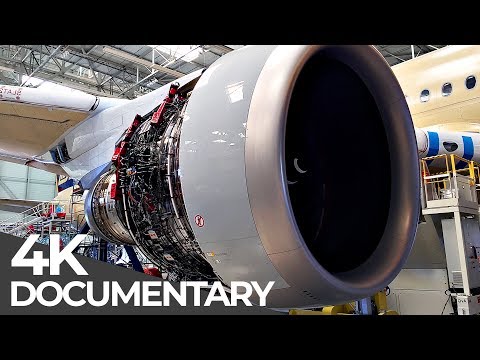
- At station 20, specialists mount two Rolls-Royce Trent XWB turbofan engines beneath the wings; each engine contains more than 20,000 components.
- Each engine costs nearly €32 million, so hydraulic lifting equipment and careful handling are essential during installation.
- The Trent XWB uses high-temperature ceramic coatings and is described as delivering about 15% lower fuel consumption than its predecessor, with reduced emissions and noise.
- After final cabin adjustments, the A350 receives five coats of polyurethane paint; the completed aircraft leaves the final assembly line after about four and a half months.
Transcript excerpt
0:03 [Music] the Airbus a350 the most advanced commercial aircraft in the world its construction nothing short of a masterpiece on the grand scale and down to the smallest detail two and a half million components 1,800 professionals for the final assembly alone together constructing an aircraft the likes of which the world has never seen before the goal minimal fuel consumption maximum range the product of precision workmanship expertise and quite simply cry and all this is only possible thanks to perfect mega manufacturing
0:52 [Music] Toulouse France the headquarters of Europe's largest aircraft manufacturer and black Airbus workers construct the most advanced passenger aircraft in the world the Airbus a350 one o'clock in the afternoon one of the fleet of beluga transport aircraft arrives for the delivery of components so-called because its shape resembles that of the white whale it is key to the construction process a 1500 cubic metre cargo compartment and a 47 metric ton payload
1:43 an entire fuselage section of the a350 fits in the belly of a single beluga or as in this case one of its wings measuring 32 metres in length it would be practically impossible to build the a350 without the Beluga fleet but tea stone a must see to it that his team unloads all the Freight within an hour every delay triggers a chain reaction disrupting construction of the world's most advanced passenger aircraft unloading the unique beluga super transporters is batiste dream job I'm very proud about Beluga fleet the
2:32 key to the entire assembly operation running smoothly I've loved planes since childhood my father and my grandfather worked at Airbus our family has always been fascinated with aviation the beluga fleet fly's wings fuselage sections cabin furnishing and vertical tail planes for the a350 from around europe to these assembly hangars in toulouse
This is the start of the transcript. Save this video free for the whole transcript, searchable and time-coded.
Summary, takeaways, and chapters were generated by AI from the video's transcript and may contain errors. The video belongs to its creator, Free Documentary.