GERO 200 f2026 Module 5 Cancer & Grief Video 2026 09 20 1
 Watch on YouTube →
Overview
John Walsh and Julia connect cancer epidemiology and prevention with practical guidance on treatment, screening, and health-care access. Julia draws on her experience as a leukemia patient diagnosed in 2013 to explain why patients should seek specialists and consider clinical trials; the lecture also covers cancer-risk reduction, HPV vaccination, tumor biology, liquid biopsies, racial disparities, and ways to approach grief.
Key takeaways
- Cancer survival estimates found online often describe outcomes from earlier treatment eras; Julia’s 2013 five-year estimate was 50%, but new treatments can change the outlook for later patients.
- Patients can improve their treatment options by seeking a specialist who sees many cases of their specific cancer and by asking about clinical trials at an academic medical center.
- Screening should reflect personal and family history: examples include earlier PSA testing for prostate-cancer family history, more frequent colonoscopies after multiple polyps, and mammogram–MRI alternation for some high-risk patients.
- HPV vaccination prevents multiple cancers in all genders; the lecture emphasizes vaccination around ages 9–12 and catch-up vaccination through age 26.
- Cancer disparities involve more than incidence: unequal access to screening, treatment, clinical trials, and medication can contribute to higher mortality, including among Black and American Indian/Alaska Native populations.
- Grief is not limited to bereavement after death and does not follow one mandatory sequence; relationship loss, addiction, illness, and unrealized plans can all warrant time and support.
Chapters
0:00
Module 5: Cancer Advocacy and Course Deadlines
- Julia introduces her perspective as a leukemia patient diagnosed in 2013 and a cancer advocate who follows new research.
- John Walsh reminds students that the Week 5 assignment deadline is September 23 and late work loses 10% per day.
- The course keeps the first three module assignments open under a grace period for students who added late.
1:25
Cancer Statistics, Treatment Options, and Choosing a Specialist
- The American Cancer Society updates its statistics annually; incidence counts new cases during a period, while prevalence includes people living with a diagnosis.
- Julia cautions that online survival estimates reflect past outcomes and may not include newer treatments; she was told her five-year survival chance was 50% after her 2013 diagnosis.
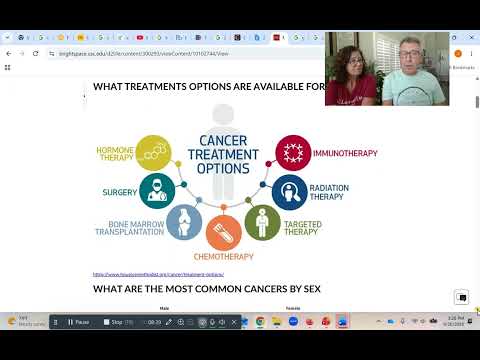
- Cancer treatment varies by diagnosis: Julia has received immunotherapy and targeted oral drugs, while John Walsh's brother has had prostate surgery, hormone therapy, and radiation.
- Julia recommends finding a specialist with substantial experience in the specific cancer, ideally at an academic medical center offering clinical trials.
8:30
Common Cancers, Screening, and Early Diagnosis
- Prostate cancer is the most common cancer in men; breast cancer is most common in women, with lung and colorectal cancers also among the leading diagnoses.
- Screening examples include annual low-dose CT scans for eligible people with a smoking history, PSA blood tests for prostate risk, mammograms, and colonoscopies.
- Julia has colonoscopies every three years because of her history, and a colon biopsy helped reveal her leukemia.
- Early diagnosis can change outcomes: the lecture cites high survival for localized prostate cancer and notes that lung cancer is often found after it has spread.
13:50
Lifestyle Risks, Tobacco Policy, and Cancer Across the Lifespan
- Risk-reduction measures include avoiding smoking, vaping, and inhaled toxins; eating a less processed, fiber-rich diet; staying active; and limiting alcohol.
- The lecture links obesity-related inflammation and low physical activity with cancer risk, and notes that exercise and healthier diets may reduce breast cancer recurrence.
- A chart comparing cigarette sales with lung-cancer mortality shows deaths declining after smoking fell, following measures such as ad bans, higher taxes, and smoke-free public spaces.
- Most cancers occur in older adults, with risk rising after age 60, though leukemia, testicular, thyroid, and uterine cancers can occur before age 50.
23:20
Racial Disparities in Cancer Incidence, Mortality, and Clinical Trials
- American Indian and Alaska Native populations have the highest cancer incidence and mortality rates in the data discussed; limited access to care may affect both detection and outcomes.
- Black Americans have higher cancer mortality than white Americans in the comparison, including higher mortality from breast and prostate cancer.
- Unequal access to screening, treatment, specialty pharmacies, and clinical trials contributes to disparities; Julia describes spending hours repeatedly resolving medication access problems.
- Julia notes that the Affordable Care Act requires coverage of qualifying clinical-trial participation, but says she had to challenge an insurer's denial to obtain coverage.
31:25
HPV Vaccination and Prevention of Multiple Cancers
- HPV vaccination helps prevent cervical, oral, throat, anal, and rectal cancers; the lecture cites Australia’s broad vaccination rollout as a model associated with sharply declining cervical cancer rates.
- About 35,000 HPV-related cancers are diagnosed annually in the United States, and roughly one-third occur in men.
- The lecture recommends routine vaccination around ages 9–12 and describes catch-up vaccination through age 26, with a doctor discussion for some adults ages 27–45.
- Because HPV is common and can persist in some people, cervical screening and HPV testing remain important even with vaccination.
35:19
How Oncogenes and Tumor-Suppressor Genes Drive Cancer
- A mutated proto-oncogene can become an oncogene, pushing cell growth like a stuck accelerator; tumor-suppressor genes normally act as brakes.
- The tumor-suppressor protein p53 can pause cell division so damaged DNA can be repaired or the cell can be eliminated.
- The lecture identifies BRCA genes as tumor suppressors associated with breast cancer and explains how mutations can weaken the cell’s safeguards.
- Immune surveillance helps remove abnormal cells, but it becomes less robust with age.
39:00
Personalized Screening and the Promise of Liquid Biopsies
- Julia encourages patients to tell doctors about family history and prior findings, such as repeated polyps, to tailor screening frequency and starting age.
- She recommends resuming screenings disrupted during the pandemic, including mammograms; high-risk patients may alternate mammograms and breast MRIs.
- Liquid biopsies use a blood draw to look for tumor-related mutations and may help guide treatment when a tumor is difficult or risky to biopsy.
- Julia used liquid-biopsy advocacy for her father, whose lung tumor was hard to reach; she describes the technology as promising, not a current replacement for standard screening.
41:53
Grief Beyond Death and Making Space for Loss
- The lecture presents Elisabeth Kübler-Ross’s five stages—denial, anger, bargaining, depression, and acceptance—as one framework, not a required sequence for everyone.
- Grief can follow a death, a loved one’s addiction, a relationship ending, job loss, a disappointing grade, or the loss of an expected opportunity.
- John Walsh and Julia advise allowing time to grieve, recognizing that family members may grieve differently, and being patient with oneself and others.
- Students who find the class discussion too personal can send a private post to Julia or request an alternative assignment.
Summary, takeaways, and chapters were generated by AI from the video's transcript and may contain errors. The video belongs to its creator, John Walsh.