fnb100f261021a
 Watch on YouTube →
Overview
Jeff Hunk reviews compound-growth calculations, including how to find the annual growth rate needed to turn $10,000 into $30,000 in five years and how quarterly compounding changes the annualized result. He then introduces logarithms as a way to solve for an unknown time exponent and explains Euler’s number e through increasingly frequent compounding, connecting continuous growth to the expression e^(r*t).
Key takeaways
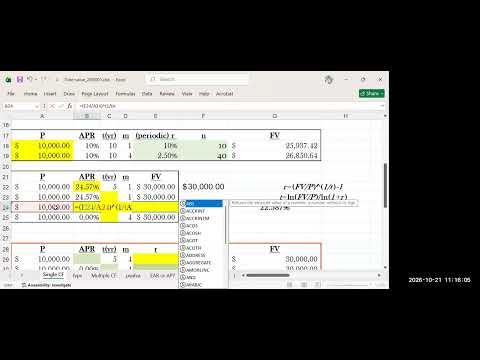
- Turning $10,000 into $30,000 in five years requires a compound annual growth rate of about 24.57%, illustrating how ambitious a threefold investment target is.
- With quarterly compounding over five years, the example’s periodic return is about 5.65%; multiplying it by four gives a 22.59% nominal annualized rate.
- The logarithm rule log(x^y) = y * log(x) converts an unknown exponent into a multiplier, making it possible to solve compound-growth equations for time.
- Repeatedly increasing compounding frequency at a 100% growth rate approaches e, approximately 2.718, as expressed by the limit of (1 + 1/n)^n.
- Continuous compounding generalizes beyond 100% growth: a rate r applied continuously for time t produces a growth factor of e^(r*t).
Chapters
0:00
Class Setup and Review of Compounding Materials
- Jeff Hunk resumes Module 3, section 5001A, and asks students to open the Excel file used in the previous class.
- The class reviews that compounding and discounting were already covered, with annualized return and the remaining exercise still ahead.
- Jeff asks students to watch the assigned course videos and keep cameras on during class.
4:25
Finding the CAGR to Triple $10,000 in Five Years
- The example sets present value at $10,000 and future value at $30,000 over five years.
- The compound annual growth rate is calculated as (future value / present value)^(1 / years) - 1, producing approximately 24.57%.
- Jeff compares this demanding return with Peter Lynch’s reported long-term performance of roughly 25% to 30% annually during his prime.
11:34
Adjusting the Return Calculation for Quarterly Compounding
- For quarterly compounding over five years, the number of periods is years multiplied by four, or 20.
- The calculation first finds the quarterly rate using the 20-period exponent, then multiplies that rate by four to report a nominal annualized figure.
- The example produces about 5.65% per quarter and 22.59% annualized, compared with 24.57% under annual compounding.
15:00
Checking Excel Results and Organizing Class Files
- Students compare their spreadsheet outputs with the 22.59% annualized result and confirm it using new green-check reactions.
- Jeff demonstrates capturing the completed worksheet with Control-Print Screen and saving the screenshot.
- For chronological sorting, he recommends filenames ordered by year, month, and day rather than day, month, and year.
21:44
Using Logarithms to Solve for the Number of Periods
- After covering future value, present value, and rate as unknowns, Jeff introduces the number of periods n as the remaining variable.
- The compound-growth equation contains an expression of the form (1 + rate)^n, so n cannot be isolated with ordinary algebra alone.
- Taking logarithms converts an exponent into a multiplier, allowing the unknown exponent to be isolated.
23:20
How Log Rules Turn Exponents into Multiplication
- Jeff illustrates powers of 10, including 10^2 = 100, 10^3 = 1,000, and 10^9 = 1 billion.
- The key rule is log(x^y) = y * log(x), which changes a power expression into a product.
- Applying the same logarithm to both sides of an equation preserves equality and makes it possible to solve for an unknown exponent.
32:14
Common, Binary, and Natural Logarithms
- A common logarithm uses base 10, while a binary logarithm uses base 2; for example, log base 2 of 8 equals 3.
- A natural logarithm uses Euler’s number e as its base and is written as ln.
- Jeff identifies e as approximately 2.718 and introduces its relationship to continuous growth.
34:44
Deriving Euler’s Number from Continuously Compounded Growth
- The embedded explanation starts with $1 doubling over one period, then compares annual growth with more frequent compounding.
- At 100% annual growth, semiannual compounding gives (1 + 1/2)^2 = $2.25, while quarterly compounding gives approximately $2.441.
- As the number of compounding periods increases toward infinity, the result approaches e, approximately 2.718, the limit of (1 + 1/n)^n.
38:25
Continuous Time, e^(r*t), and the Next Lesson
- Jeff distinguishes discrete time units such as seconds or years from continuous time, using gradual human height growth as an example.
- For continuous compounding at rate r over time t, growth is represented by e^(r*t); the lesson gives 200% growth over five periods as e^10.
- Jeff closes by assigning the remaining videos, available through October 27, and schedules the next lesson on Euler’s number and natural logarithms for Monday.
Summary, takeaways, and chapters were generated by AI from the video's transcript and may contain errors. The video belongs to its creator, Jeff Hunk.