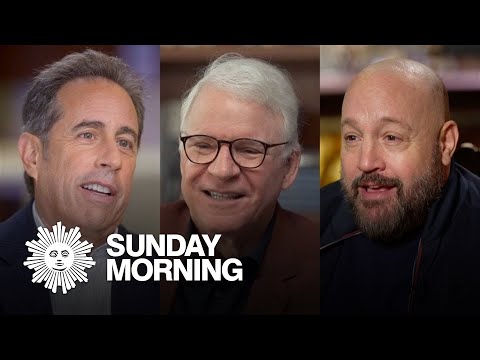
Extended interviews: Jerry Seinfeld, Steve Martin and Kevin James
 Watch on YouTube →
Overview
Jerry Seinfeld, Steve Martin, and Kevin James discuss the experiences and working habits behind their comedy careers. Seinfeld explains how childhood memories of Pop-Tarts inspired Unfrosted; Martin reflects on a two-part Apple TV+ documentary built from archival material; and James recounts his path from a back injury and failed Saturday Night Live audition to King of Queens and continued stand-up.
Key takeaways
- Seinfeld’s Unfrosted began as a stand-up bit, then grew into a feature after he bought Pop-Tarts late at night to revisit his childhood attachment to the snack.
- Unfrosted uses the real competition between Post and Kellogg’s as a jumping-off point, but its funeral for a test pastry and other plot details are intentionally invented.
- Neville’s Steve Martin documentary draws on a large personal archive, including an 11-terabyte digitized collection and about 5,000 scanned items.
- Martin left successful stand-up because touring exhausted him; film offered a more permanent performance that could be captured precisely.
- James’s failed SNL audition did not end his career: it left him free to audition for The King of Queens, which became a major career breakthrough.
- James treats stand-up as an iterative craft, testing new material against reliable jokes in live sets and continuing to revise even after a special is filmed.
Chapters
0:00
Jerry Seinfeld Turns the Pop-Tart Origin Story into Unfrosted
- Seinfeld wrote, directed, and stars in Unfrosted, a mostly fictional comedy imagining the rivalry around the invention of Pop-Tarts.
- The historical starting point is Post developing a shelf-stable fruit pastry and Kellogg's trying to catch up after hearing about it.
- Seinfeld cast comedian friends including Jim Gaffigan, Melissa McCarthy, Amy Schumer, Sarah Cooper, and Hugh Grant.
- He says serious presentation makes absurd comedy funnier, as in a mock Kellogg-style funeral featuring repeated 'full cereal honors.'
7:50
Pop-Tarts, Childhood Agency, and Seinfeld’s Comedy Process
- Seinfeld says brown sugar cinnamon was his favorite flavor and jokes that the pastries could not go stale because they were never fresh.
- A late-night supermarket trip to buy Pop-Tarts turned an existing stand-up bit into a deeper exploration of his childhood attachment to them.
- He credits the product’s two-per-pack format, packaging, toaster preparation, and memorable name with its appeal to children.
- Seinfeld connects making breakfast independently with a child’s sense of agency, and says he has never planned his career around sequels or specific projects.
12:32
Steve Martin’s Rise from Anxious Beginner to Stand-Up Superstar
- Morgan Neville’s two-part Apple TV+ documentary follows Martin from childhood through decades of comedy and film work.
- Martin says he initially lacked singing, dancing, and acting ability but had a strong love of show business.
- Neville, a fan since childhood, secured access to Martin’s performances, diaries, and other career archives for the project.
- By the late 1970s, Martin was a Saturday Night Live fixture; his stand-up album Let’s Get Small became the first comedy album to go platinum.
16:16
Why Steve Martin Left Stand-Up and How Age Changed Him
- Martin left stand-up because he was exhausted by touring and preferred making films from home, where performances could be preserved exactly.
- He recalls doubting his comedy after a journalist asked why he was no longer funny, despite later making more than 40 films.
- At 78, Martin was appearing on a hit television show and performing with Martin Short.
- Martin describes becoming friendlier with age, contrasting that change with people who grow more hostile or difficult.
20:23
Steve Martin’s Archives, Family, and Lessons from Failure
- Neville helped digitize Martin’s material into an 11-terabyte archive, including roughly 5,000 scanned items and old performance recordings.
- Martin says listening back to recordings taught him not to drink before performing, though revisiting early work remains uncomfortable.
- He discusses his father’s difficulty offering compliments and how professional success gave his father something concrete to recognize.
- Martin and Neville chose to include vulnerable moments because failures can teach lessons and may not remain failures over a lifetime.
24:52
Kevin James Turns a Football Injury and Failed SNL Audition into a Career
- A back injury ended James’s college football ambitions at SUNY Cortland; a public-speaking class helped him discover his comic ability.
- James performed his first stand-up set at Long Island’s East Side Comedy Club on July 26, 1989.
- He describes bombing his Saturday Night Live audition, but says the rejection freed him to pursue other opportunities.
- James later landed the lead in The King of Queens; his role as Doug Heffernan and the Paul Blart films made him a mainstream star.
32:00
Kevin James on Stand-Up Craft, Rewriting, and Finding a Passion
- James prefers stand-up because it lets him perform directly without a studio or network changing the act.
- He develops material onstage, trying new bits between proven jokes and continuing to revise routines even after recording a special.
- James spent years building experience through open mics and comedy clubs, with his brother urging him to attend clubs and meet local agents and bookers.
- He says profanity can produce an easy shock but wears off if it is the only tool, and encourages his daughters to seek a passionate connection in their choices.
Summary, takeaways, and chapters were generated by AI from the video's transcript and may contain errors. The video belongs to its creator, CBS Sunday Morning.