Exoplanet surprises
 Watch on YouTube →
Overview
Rebecca Dawson explains how discoveries of exoplanets overturned expectations based on our solar system, focusing on hot Jupiters, planet migration, orbital instability, and the abundance of smaller worlds. She connects radial-velocity discoveries and Kepler transit data to estimates that small planets are common, around 40 per 100 stars in some measured ranges, while giant planets orbit only about 10 to 20% of stars, and emphasizes that detection limits still obscure how typical our solar system is.
Key takeaways
- Hot Jupiters are a major exoplanet surprise: giant planets can orbit extremely close to their stars, likely after forming farther out and migrating inward or being scattered by other planets.
- Kepler’s transit method detects planets through repeated dips in stellar brightness, but occurrence rates must account for missed transits, survey sensitivity, and limited observation periods.
- Small planets are common in the ranges Kepler could measure, with estimates around 40 planets per 100 stars; giant planets are less common, at roughly 10 to 20% of stars.
- The abundance of planets between Earth and Neptune’s size exposes a central unknown: radius alone cannot tell whether a world is rocky, water-rich, or enveloped in gas.
- Gravitational instability can eject planets, tilt orbits, and drive collisions; a similar, milder rearrangement among the giant planets may have occurred in the early solar system.
- The apparent scarcity of solar-system analogues is partly a detection problem: small planets in wide orbits are harder to find than close-in planets and hot Jupiters.
Chapters
0:00
Rebecca Dawson Introduces the Solar System as a Starting Point
- Rebecca Dawson describes her work on Saturn’s rings and the Kuiper Belt before turning to planets around other stars.
- The solar system’s inner rocky planets and outer giant planets provide a familiar comparison, but discoveries show that other systems can be arranged very differently.
- Thousands of exoplanets have been found, turning the question of whether other stars host planets into an observational science.
7:30
Radial Velocity Reveals the First Hot Jupiters
- The first exoplanets around Sun-like stars were discovered in 1995 using radial velocity: astronomers measured a star’s motion caused by an orbiting planet.
- Researchers expected Jupiter-like planets in wide orbits, but instead found giant planets orbiting extremely close to their stars.
- A hot Jupiter can reach temperatures of thousands of degrees; some are inflated by stellar radiation, and some planets may be losing atmosphere.
12:00
Why Exoplanet Surveys Cannot Yet Settle Whether Our Solar System Is Rare
- Many early discoveries clustered close to their stars because close-orbiting planets are easier to detect than distant planets like Jupiter or Earth.
- The observed sample therefore does not show that solar systems like ours are rare; current surveys have limited sensitivity to long-period, small planets.
- Dawson distinguishes the clear finding that planetary systems vary widely from the still-open question of how unusual our system is.
14:00
How Giant Planets May Migrate Inward to Become Hot Jupiters
- Giant planets are thought to form where solid material can build a core that attracts gas from the young star’s disk.
- A planet may move inward through interactions with the gas disk, or through gravitational encounters with other young planets.
- Dawson’s doctoral research considered both disk-driven migration and planet–planet scattering as explanations for hot Jupiters.
19:00
Planetary Instability Can Scatter Worlds and Reshape Orbits
- Computer simulations show that tightly packed young planetary systems can become chaotic as growing planets gravitationally perturb one another.
- Scattering can send planets into eccentric orbits, drive them toward the star, cause collisions, or eject them from the system.
- A planet’s orbit may later circularize through interactions with the star, turning a distant, elongated orbit into a close-in hot Jupiter.
27:00
Misaligned Planets and Direct Images Reveal Unusual Systems
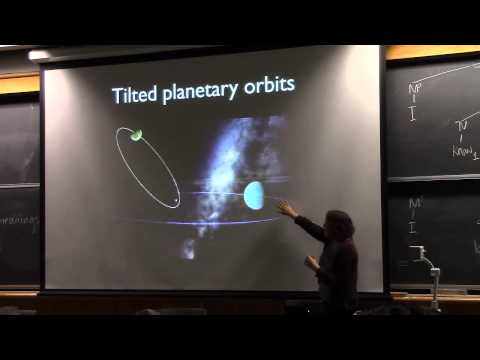
- Gravitational encounters can tilt planetary orbits out of a shared plane, unlike the nearly flat arrangement of planets in today’s solar system.
- Some directly imaged giant planets orbit far from their stars, thousands of times farther out than a hot Jupiter, and have eccentric orbits suggestive of scattering.
- Images of dusty disks show material produced by colliding asteroids; stellar radiation can push the dust and shape what telescopes observe.
31:30
Early Instability May Have Reshaped Our Own Solar System
- One proposed history has Jupiter, Saturn, Uranus, and Neptune forming closer together before an instability moved them toward their current configuration.
- The rearrangement may have stirred up asteroids and helped deliver water-bearing material to Earth during the solar system’s first hundred million years.
- Jupiter can deflect or capture some incoming objects, but its influence is not purely protective: the asteroid belt also supplies near-Earth asteroids.
37:00
Kepler Finds Planets by Measuring Stellar Transits
- NASA’s Kepler spacecraft monitored the brightness of stars for about four years, detecting a planet when it crossed in front of its star.
- Repeated dips in a star’s light reveal a planet’s orbital period; Kepler’s observations helped uncover thousands of planet candidates.
- Transit surveys miss systems whose orbital planes do not align with our line of sight, so occurrence estimates must correct for viewing geometry.
40:00
Kepler Data Show Small Planets Are Common
- Kepler and other surveys suggest roughly 40 small planets per 100 stars in some studied size and orbital ranges.
- The estimate accounts for planets that do not transit from Earth’s viewpoint and for the survey’s detection limits.
- Small stars appear especially likely to host small planets, though astronomers were still investigating the reasons for that trend.
46:00
Giant Planets Are Less Common Than Small Planets
- Ground-based radial-velocity surveys suggest that giant planets orbit roughly 10 to 20% of stars.
- By this measure, most stars do not host a giant planet, making the solar system’s Jupiter and Saturn an important but not universal feature.
- Kepler’s gallery of planetary systems illustrates varied planet sizes and orbital spacings rather than one standard solar-system layout.
49:50
Kepler’s Abundant Super-Earths and Mini-Neptunes Have Uncertain Compositions
- Kepler found many planets between Earth’s size and Neptune’s, a category with no direct counterpart among the major planets in our solar system.
- Astronomers use labels such as super-Earth, mini-Neptune, and gas-dwarf because size alone does not establish whether a planet is rocky or gas-rich.
- For a planet such as GJ 1214b, determining its atmosphere and composition is essential to resolving what kind of world it is.
55:00
TESS and Atmospheric Studies Extend Exoplanet Research
- NASA’s Transiting Exoplanet Survey Satellite (TESS) was designed to search bright stars across the sky, complementing Kepler’s focused field of view.
- Atmospheric studies compare starlight during a transit with starlight when the planet is not in front of the star; the star’s brightness makes this measurement difficult.
- Ultra-short-period planets can orbit in less than a day and, if rocky, may have surfaces hot enough to form magma oceans.
1:01:00
Questions on Planet Detection, Habitability, and Orbital Architecture
- Photon pressure can transfer momentum to dust grains, while charged particles from a star can also influence material around it.
- Kepler could detect an Earth-sized planet around a Sun-like star through transits, but the chance of a favorable alignment is small and repeated observations take time.
- The Drake Equation’s estimate of life depends on more than planet frequency: conditions suitable for life remain uncertain even as exoplanet counts improve.
- Kepler observations suggest that some planetary systems have closely spaced planets, with their spacing constrained by long-term orbital stability.
Summary, takeaways, and chapters were generated by AI from the video's transcript and may contain errors. The video belongs to its creator, Science@Cal.