ES.1802, October 5, 2026
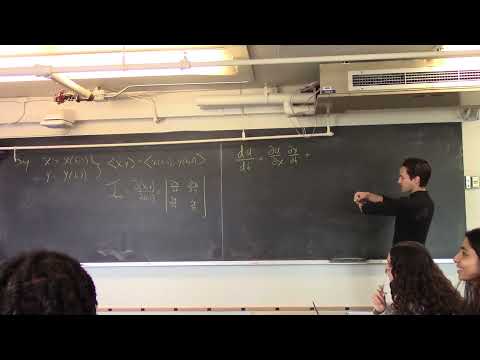 Watch on YouTube →
Overview
Christian develops the multivariable chain rule by organizing partial derivatives into Jacobian matrices and showing that matrix multiplication combines every dependency path. He then connects directional derivatives to the gradient, establishing that the gradient is perpendicular to level sets and points in the direction of steepest increase, before using gradients to express tangent planes to explicit and implicit surfaces.
Key takeaways
- A multivariable chain rule can be computed in one operation: multiply the Jacobian of the outer mapping by the Jacobian of the inner mapping, with each product entry summing the derivative contributions from every dependency path.
- For a differentiable function f and unit direction û, the directional derivative is ∇f·û, the scalar component of the gradient along that direction.
- The gradient is perpendicular to a function’s level curves or level surfaces because movement tangent to a level set leaves the function value unchanged.
- The gradient points in the direction of steepest ascent: among unit directions, aligning û with ∇f maximizes ∇f·û.
- For an implicit surface F(x,y,z)=0, the tangent plane at P is ∇F(P)·((x,y,z)−P)=0, so the gradient provides its normal vector directly.
- The parabola y=x² can be treated as the level curve f(x,y)=0 for f=x²−y; changing the level to f=c gives y=x²−c.
Chapters
0:00
Building the Jacobian from Partial Derivatives
- For a vector-valued function (u(x,y), v(x,y)), Christian arranges the partial derivatives into a 2×2 Jacobian.
- Each Jacobian row is the gradient of one output component: (uₓ, uᵧ) and (vₓ, vᵧ).
- Subscript notation, such as uₓ and vᵧ, is introduced as a compact alternative to writing derivative fractions.
4:00
Representing Nested Variables with Jacobians
- When x and y depend on t and s, their Jacobian has rows (xₜ, xₛ) and (yₜ, yₛ).
- The row-gradient convention helps keep each variable’s partial derivatives in the correct order.
- The setup describes the dependency layers (u,v) ← (x,y) ← (t,s), preparing for a multivariable chain rule.
9:00
Deriving the Multivariable Chain Rule by Matrix Multiplication
- For u(x,y) with x(t,s) and y(t,s), the derivative uₜ is uₓxₜ + uᵧyₜ; uₛ similarly combines the two paths through x and y.
- Christian draws dependency diagrams to enumerate all paths from an output such as u to an input such as t.
- Multiplying the Jacobians ∂(u,v)/∂(x,y) and ∂(x,y)/∂(t,s) produces ∂(u,v)/∂(t,s); each matrix-product entry is a sum of pathwise derivative products.
14:00
Connecting Level Curves, Directional Derivatives, and Tangent Planes
- Level curves mark points where a function of x and y has a fixed value; Christian uses contour lines on a mountain-like surface as an example.
- A directional derivative measures how much the function changes for a step in a chosen direction.
- For a surface z=f(x,y), the tangent-plane normal can be written (fₓ, fᵧ, −1), linking partial derivatives to surface geometry.
21:00
Deriving the Directional Derivative as a Gradient Dot Product
- For a unit direction û=(u₁,u₂), a step of length s from (x₀,y₀) gives x=x₀+su₁ and y=y₀+su₂.
- Applying the chain rule gives df/ds=fₓ(dx/ds)+fᵧ(dy/ds), which becomes ∇f·û because dx/ds=u₁ and dy/ds=u₂.
- The directional derivative is therefore the component of the gradient in the chosen unit direction.
30:00
Why Gradients Perpendicularly Cross Level Curves
- Moving along a level curve leaves f unchanged, so the directional derivative along that curve is zero.
- Since ∇f·û=0 for a tangent direction û, the gradient is perpendicular to the level curve.
- The dot product is maximized when û points in the gradient’s direction, making ∇f the direction of steepest ascent.
34:00
Using f(x,y)=x²−y to Interpret Level Curves
- Christian rewrites the parabola y=x² as the zero level curve of the two-variable function f(x,y)=x²−y.
- The gradient is ∇f=(2x,−1), and its direction points across level curves toward increasing function values.
- Other levels f=c satisfy y=x²−c, so changing c shifts the parabola vertically without changing its shape.
42:00
From Level Curves to the Surface z=x²+y²
- The surface z=x²+y² is represented implicitly by F(x,y,z)=x²+y²−z=0.
- A fixed value of a function of three variables defines a level surface, just as a fixed value of a function of two variables defines a level curve.
- For F=x²+y²−z, the gradient is (2x,2y,−1), normal to its level surfaces and directed toward increasing F.
47:00
Writing the Tangent Plane with an Implicit Gradient
- At a point P on an implicit surface F(x,y,z)=0, the gradient ∇F(P) supplies a normal vector to the tangent plane.
- The tangent-plane equation is ∇F(P)·((x,y,z)−P)=0, equivalently the gradient dotted with the displacement vector equals zero.
- This formulation generalizes the explicit-surface normal (fₓ,fᵧ,−1) and avoids requiring z to be isolated as a function of x and y.
Summary, takeaways, and chapters were generated by AI from the video's transcript and may contain errors. The video belongs to its creator, ChristianAltoSax.