EM test 1 review - vector calculus, Coulomb's law, superposition, E-fields, Gauss' law, symmetry,
 Watch on YouTube →
Overview
Tim Gorringe reviews the material for the first electromagnetism test, connecting vector calculus and coordinate systems to Coulomb’s law, superposition, electric fields, and Gauss’s law. He emphasizes how symmetry makes field calculations tractable, compares Coulomb-law and Gauss-law methods for standard charge distributions, and explains how divergence links local charge density to the electric field.
Key takeaways
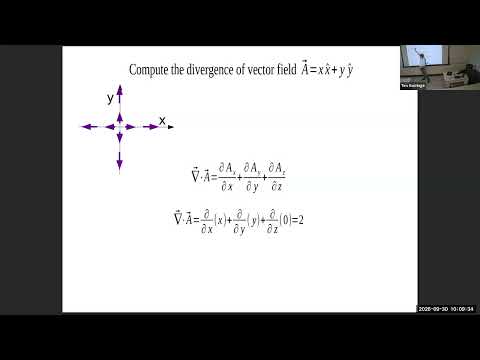
- A field with components proportional to x and y has positive constant divergence but zero curl, illustrating that sources and circulation are independent properties.
- Cylindrical and spherical coordinates simplify symmetric charge problems, but their position-dependent unit vectors and angular arc factors complicate vector calculus.
- Coulomb’s law becomes useful for extended charge distributions through superposition, which adds the contributions of point, line, surface, or volume charge elements.
- An electric dipole’s far field decreases as 1/r³, unlike the 1/r² field of an isolated point charge; this is an entry point to multipole expansions.
- Gauss’s law always relates closed-surface flux to enclosed charge, but it directly yields the electric field only when symmetry constrains the field on the chosen surface.
- The divergence of the electric field is determined by local charge density, even though the electric-field value at a point can reflect charges throughout space.
Chapters
0:00
Test 1 Scope: Vector Calculus, Coulomb’s Law, and Gauss’s Law
- The review covers rectangular, cylindrical, and spherical coordinates; vector calculus; Coulomb’s law; superposition; electric fields; and Gauss’s law.
- Fields assign quantities throughout space: temperature is a scalar-field example, while air velocity illustrates a vector field.
- The course uses gradient to describe scalar-field change and divergence and curl to describe vector-field change.
3:00
Rectangular Elements and a Field with Divergence but No Curl
- Rectangular line, surface, and volume elements are assembled from dx, dy, and dz; an x-normal surface element uses dy and dz.
- For a two-dimensional field with x- and y-components proportional to x and y, respectively, divergence is constant and positive.
- The same field has zero curl: its vectors spread outward without circulating around the origin.
10:00
Cylindrical Coordinates: Position-Dependent Unit Vectors and Arc Length
- Cylindrical coordinates are useful for charge distributions with cylindrical symmetry, such as a long charged cylinder.
- Unlike fixed rectangular unit vectors, cylindrical radial and azimuthal unit vectors change direction with φ; their derivatives with respect to φ are nonzero.
- An angular step dφ spans an arc of length ρ dφ, which enters cylindrical line, surface, and volume elements.
17:00
Spherical Coordinates: Angular Arc Factors and Changing Basis Vectors
- Spherical coordinates (r, θ, φ) suit spherically symmetric charge distributions and their electric fields.
- All three spherical unit vectors vary with position, complicating gradient, divergence, and curl compared with rectangular coordinates.
- The differential length components are dr, r dθ, and r sinθ dφ; angular factors also determine spherical surface and volume elements.
23:00
Vector Identities, Potentials, and Integral Theorems
- The identity curl(gradient V) = 0 explains why a curl-free electrostatic field can be represented through a scalar potential.
- The identity divergence(curl A) = 0 underlies representing a divergence-free magnetic field as the curl of another field.
- The divergence theorem relates surface flux to the volume integral of divergence; Stokes’ theorem relates circulation around a closed loop to curl over its enclosed surface.
- These identities and theorems let calculations switch between differential and integral forms.
30:00
Coulomb’s Law, Charge Densities, and Superposition
- Coulomb’s law specifies the inverse-square force between point charges, while superposition extends it to realistic charge distributions.
- Charge may be described as point, line, surface, or volume charge, with densities λ, σ, and ρ for the continuous cases.
- For distributions, total force or field is found by adding contributions from charge elements rather than treating the entire distribution as a point-charge pair.
33:00
Electric Fields, Local Forces, and the Dipole Far Field
- The electric-field concept replaces action at a distance with a local rule: a charge experiences force according to the field at its location.
- Field-line direction indicates the electric-field direction, while line spacing represents relative field strength.
- A dipole’s far field can be derived by decomposing its charge arrangement into simpler dipole contributions; its magnitude falls off as 1/r³ rather than 1/r².
- The dipole result previews multipole expansions, which describe fields from more complex charge arrangements.
40:00
Charged Sheets, Cylinders, and Spheres as Field Building Blocks
- An infinite uniformly charged sheet produces a uniform field independent of distance; superposing oppositely charged sheets models a parallel-plate capacitor.
- For a uniformly charged solid cylinder, the field grows linearly with radial distance inside and falls as 1/ρ outside.
- For a uniformly charged solid sphere, the field grows linearly with r inside and falls as 1/r² outside.
- Gauss’s law and symmetry explain these radial dependencies through enclosed charge and spreading electric flux.
45:00
Gauss’s Law: Flux, Symmetry, and Local Charge Density
- Integral Gauss’s law states that flux through any closed surface depends on the charge enclosed, not on the surface’s shape or the charge’s precise placement.
- A symmetric Gaussian surface can turn the flux relation into a direct field calculation when the field’s magnitude and direction are constrained by symmetry.
- Differential Gauss’s law connects the divergence of the electric field at a point to the charge density at that point.
- The field at a location can depend on charges throughout space, whereas its divergence is determined locally by charge density.
Summary, takeaways, and chapters were generated by AI from the video's transcript and may contain errors. The video belongs to its creator, tim gorringe.