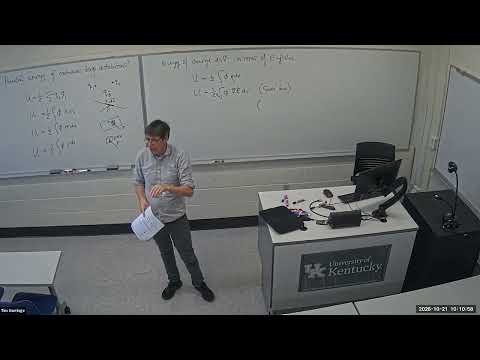
EM fields lecture 23 - energy of continuous charge distributions using potential and field
 Watch on YouTube →
Overview
Tim Gorringe derives the electric-field expression for electrostatic energy, starting from U = 1/2∫ρφ dV and using Gauss's law, the product rule, and the divergence theorem to obtain U = (ε₀/2)∫E² dV. He checks the result against potential-based calculations for a uniformly charged spherical shell and a uniformly charged solid sphere, finding energies Q²/(8π ε₀A) and 3Q²/(20π ε₀A), respectively.
Key takeaways
- For a localized electrostatic charge distribution, U = 1/2∫ρφ dV can be rewritten as U = (ε₀/2)∫E² dV by applying Gauss's law, the scalar-vector product rule, and the divergence theorem.
- The electric-field energy density is uₑ = ε₀E²/2, so regions with stronger fields contain more energy, proportional to the square of the field magnitude.
- A uniformly charged spherical shell of radius A stores U = Q²/(8π ε₀A); its field-energy integral has no interior contribution because E = 0 inside.
- A uniformly charged solid sphere with the same Q and A stores U = 3Q²/(20π ε₀A), comprising Q²/(40π ε₀A) inside and Q²/(8π ε₀A) outside.
- The solid sphere stores 20% more energy than the shell because distributing the same charge throughout the volume brings charge elements closer together on average.
Chapters
0:00
From Point-Charge Energy to Continuous Charge Distributions
- Reviews three point-charge energy methods: assembly work, distinct pairwise interactions, and charges placed in the potentials of the other charges.
- Introduces a fourth method that treats the electric field as the store of energy.
- Recasts the point-charge formula with a factor of 1/2 as integrals over line, surface, or volume charge elements.
7:00
Starting the Field-Energy Derivation with Gauss's Law
- Begins with the continuous-distribution expression U = 1/2∫ρφ dV.
- Uses Gauss's law, ∇·E = ρ/ε₀, to replace the volume charge density with the divergence of the electric field.
- Sets the goal of rewriting the energy integral so it depends on E rather than ρ and φ.
10:00
Applying the Scalar-Vector Product Rule
- Uses ∇·(φE) = φ(∇·E) + E·∇φ to transform the integrand.
- Rearranges the expression into an E·∇φ volume term and a divergence term involving φE.
- Corrects a missing minus sign during the derivation, then uses E = −∇φ so the volume term becomes E².
17:00
Removing the Boundary Term and Defining Field Energy Density
- Applies the divergence theorem to turn the integral of ∇·(φE) into a surface integral over a closed boundary.
- For localized charges, φ falls as 1/R and E as 1/R² or faster, so the boundary contribution vanishes as the surface grows without limit.
- Obtains U = (ε₀/2)∫E² dV and identifies uₑ = ε₀E²/2 as electric-field energy density in joules per cubic meter.
23:00
Setting Up the Uniformly Charged Spherical Shell
- Considers a spherical shell of radius A with uniform surface charge density σ and total charge Q = 4πA²σ.
- Uses the shell's surface potential, φ(A) = Q/(4π ε₀A), to calculate energy from charge elements in the potential.
- Notes that the field is zero inside the shell and equals Q/(4π ε₀r²) outside.
29:00
Calculating Shell Energy from Charge and Potential
- Because the potential is constant across the shell, evaluates U = 1/2∫φ dq as U = 1/2 Qφ(A).
- Finds the shell's total electrostatic energy, U = Q²/(8π ε₀A).
- Explains that the energy is positive for either sign of Q because like charges repel, and that increasing A lowers their interaction energy.
33:00
Verifying the Shell Energy with the Electric Field
- Integrates uₑ = ε₀E²/2 only from r = A to infinity because the field inside the shell is zero.
- Uses spherical layers of volume dV = 4πr²dr, where the field magnitude is constant across each thin layer.
- Recovers U = Q²/(8π ε₀A), matching the potential-based calculation.
37:00
Comparing a Solid Sphere with the Spherical Shell
- Changes the charge arrangement to a uniformly charged solid sphere of radius A and volume density ρ, with Q = (4/3)πA³ρ.
- Keeps total charge Q and radius A the same as in the shell comparison.
- Uses the interior potential φ(r) = Q(3A² − r²)/(8π ε₀A³) and interior field E(r) = Qr/(4π ε₀A³); outside, both match the point-charge forms.
42:00
Integrating the Solid Sphere's Charge in Its Potential
- Applies U = 1/2∫φ dq to volume charge elements, using spherical layers with dq = ρ(4πr²dr).
- Integrates from r = 0 to A using the solid sphere's interior potential.
- Finds U = 3Q²/(20π ε₀A), with the same Q² dependence and inverse-radius scaling as for the shell.
47:00
Adding Interior and Exterior Field Energy for the Solid Sphere
- Splits the field-energy integral into the interior region, 0 ≤ r ≤ A, and exterior region, r ≥ A.
- The interior field contributes Q²/(40π ε₀A), while the exterior field contributes Q²/(8π ε₀A).
- Their sum is 3Q²/(20π ε₀A), or 6/5 the shell's energy, because the solid sphere's charge elements are closer together on average.
Summary, takeaways, and chapters were generated by AI from the video's transcript and may contain errors. The video belongs to its creator, tim gorringe.