EM fields lecture 15 - Gauss' flux law & finding the charge distribution underlying an E-field
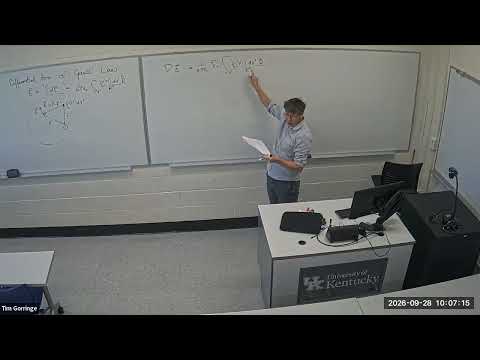 Watch on YouTube →
Overview
Tim Gorringe derives Gauss’s differential law, ∇·E = ρ/ε₀, from Coulomb’s law and superposition, showing that field divergence at a point reveals the local charge density there. He connects the differential and integral forms through the divergence theorem, then applies the method to long charged cylinders and uniformly charged spheres to recover their charge distributions from their electric fields.
Key takeaways
- Gauss’s differential law, ∇·E = ρ/ε₀, makes the divergence of the electric field a local measure of charge density.
- A charge distribution affects the electric field at distant points, but only charge at a given point determines the field’s divergence there.
- The identity ∇·(R̂/R²) = 4πδ³(R) converts the Coulomb integral into the differential law by selecting the source density at the field point.
- The divergence theorem links the differential law to the integral law: integrating ρ/ε₀ over a volume gives the enclosed charge divided by ε₀, equal to the boundary flux.
- For an infinite cylinder with linear charge density λ and radius a, an interior field proportional to cylindrical radius implies uniform volume density λ/(πa²); its exterior 1/ρ field has zero divergence.
- For a uniformly charged sphere of radius a and total charge Q, the interior field implies density 3Q/(4πa³), while the exterior 1/r² field has zero divergence.
Chapters
0:00
From Charge-to-Field Calculations to the Reverse Problem
- The integral form of Gauss’s law typically finds an electric field from a known charge arrangement.
- The differential form reverses the task: use a known electric field to identify its underlying charge density.
- The lecture plans to derive the differential law and apply it to cylindrical and spherical charge distributions.
2:00
Writing the Electric Field of a Continuous Charge Distribution
- A source element at position r′ contributes charge dq = ρ(r′) dV′ to the total field.
- The field is evaluated at a separate field point r, with separation vector R = r − r′.
- Coulomb’s law and superposition express the total field as an integral over all source elements.
6:00
Taking the Divergence Inside the Coulomb Integral
- Linearity allows the divergence of the total field to be written as an integral of the divergences of individual field contributions.
- The differential operator acts on the field-point coordinates r, not the source coordinates r′ or the volume element dV′.
- This distinction lets the source charge density be treated as constant while evaluating the divergence of the Coulomb kernel.
10:00
The Dirac Delta Function Produces Gauss’s Differential Law
- The radial Coulomb kernel satisfies ∇·(R̂/R²) = 4πδ³(R), with divergence zero away from its source.
- Integrating the delta function over source positions selects the charge density at the field point.
- The resulting local relation is ∇·E(r) = ρ(r)/ε₀; charges elsewhere affect E but not its divergence at r.
16:00
Connecting Integral and Differential Gauss’s Laws
- The divergence theorem equates the electric-field flux through a closed surface to the volume integral of ∇·E inside it.
- The integral law gives that flux as Q_enclosed/ε₀, while the differential law makes the volume integral ∫ρ/ε₀ dV.
- Since ∫ρ dV is the enclosed charge, the two forms agree for the same volume and boundary.
21:00
An Infinite Charged Cylinder: Recovering Zero Exterior Density
- For a uniformly charged infinite cylinder of radius a, the exterior field is radial and varies as 1/ρ, where ρ is distance from the axis.
- In cylindrical coordinates, only the radial-field term contributes to the divergence; the azimuthal and axial components are zero.
- The factor ρEρ is constant outside the cylinder, so ∇·E = 0 and the exterior volume charge density is zero.
28:50
The Cylinder’s Interior Field Reveals Uniform Volume Charge
- Inside the cylinder, the radial field grows in proportion to ρ and is zero at the axis by symmetry.
- Applying the cylindrical divergence expression gives a constant interior density ρcharge = λ/(πa²), where λ is charge per unit length.
- The field therefore identifies a uniform volume distribution inside the cylinder and no volume charge outside it.
36:40
A Uniformly Charged Sphere Has Zero Exterior Divergence
- Outside a uniformly charged sphere of radius a, the field has the point-charge form E = Q/(4πε₀r²) r̂.
- Spherical symmetry makes the angular field components zero, leaving only the radial contribution to the divergence.
- Because r²Er is constant for r > a, the divergence and local charge density outside the sphere are zero.
43:30
The Sphere’s Interior Field Gives Its Uniform Density
- Within a uniformly charged sphere, the radial field grows in proportion to r and vanishes at the center by symmetry.
- Taking the spherical-coordinate divergence of the interior field yields ρcharge = 3Q/(4πa³).
- The result equals Q divided by the sphere’s volume, confirming a uniform interior charge distribution.
49:00
Summary: Field Divergence Maps Local Charge
- Gauss’s differential law relates the local divergence directly to the charge density at the same point.
- Unlike the electric field, which depends on charges throughout space, divergence at a point is determined by local charge density.
- The cylinder and sphere examples show how a known field can be used to distinguish charged interiors from charge-free exteriors.
Summary, takeaways, and chapters were generated by AI from the video's transcript and may contain errors. The video belongs to its creator, tim gorringe.