EEL4514C Communication Systems and Components, Fall 2026, Lecture 21
 Watch on YouTube →
Overview
Mingyue Ji analyzes general FM bandwidth using Nyquist-rate sampling, rectangular-pulse spectra, peak frequency deviation, and Carson’s rule, then defines the FM modulation index. The lecture also derives a low-complexity FM demodulator using a differentiator and envelope detector, explains why a band-pass limiter and filter are needed, and previews phase-locked-loop demodulation.
Key takeaways
- FM resists many nonlinear-amplifier distortions better than DSB-SC because its useful information-bearing component retains constant amplitude rather than acquiring message-dependent amplitude distortion.
- An FM phase Taylor expansion contains arbitrarily high powers of the integrated message, implying infinite theoretical bandwidth even though higher-order components become small for low phase deviation.
- For a message bandwidth B and peak deviation Δf, Carson’s rule gives the practical estimate B_FM ≈ 2(Δf + B) = 2B(β + 1), where β = Δf/B.
- Narrowband FM has β ≪ 1 and therefore occupies approximately 2B, comparable to DSB-SC or AM, while larger frequency deviation increases bandwidth.
- Differentiating FM converts instantaneous frequency into an amplitude term proportional to m(t), enabling envelope detection after DC removal.
- A practical differentiator-based FM receiver uses a band-pass limiter and a carrier-centered band-pass filter before differentiation, but remains vulnerable to AM-like noise; a PLL is introduced as a stronger alternative.
Chapters
0:00
Angle Modulation Properties and FM’s Nonlinearity Advantage
- Angle-modulated signals have approximately constant power, are nonlinear, and can have wide bandwidth.
- A cubic nonlinear system distorts DSB-SC by producing an information-bearing term with roughly three times the message bandwidth.
- For FM, the corresponding useful term retains the message information with a constant amplitude factor, making FM comparatively robust to nonlinear amplification.
2:11
Taylor Expansion Reveals Infinite FM Bandwidth and Narrowband FM
- Writing FM in complex-exponential form and expanding its phase term produces components involving powers of the integrated message signal.
- If the message bandwidth is B, successive powers can occupy bandwidths of approximately 2B, 3B, and higher, so ideal FM has theoretically infinite bandwidth.
- When the phase deviation is small, higher-order terms can be neglected; narrowband FM is approximated by a carrier plus a quadrature DSB-SC component.
- The narrowband modulator integrates m(t), scales it by k_f, multiplies it by a sine carrier, and combines that term with the cosine carrier.
6:00
Approximating General FM with Nyquist-Rate Message Samples
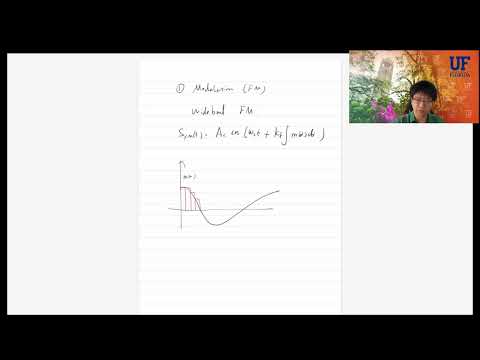
- To estimate wideband FM spectra, Ji approximates m(t) by a sequence of constant-valued rectangular sections.
- Each section has duration T = 1/(2B), corresponding to the stated Nyquist sampling interval for a message bandwidth B.
- The message amplitude is bounded between −m_p and +m_p, and each sampled value m(t_k) determines the carrier-frequency shift during its interval.
7:40
Building the Sampled FM Spectrum from Rectangular Pulses
- A single constant-valued message section produces a sinusoid at angular frequency ω_c + k_f m(t_k), windowed by a rectangle of duration T.
- The rectangular window has a sinc-shaped Fourier transform; multiplying it by the sinusoid shifts sinc lobes to positive and negative carrier frequencies.
- Adding the spectra from all message sections gives a collection of shifted sinc components, with time shifts changing phase but not the spectral magnitude envelope.
12:30
Peak Frequency Deviation Sets the First FM Bandwidth Estimate
- With message values bounded by ±m_p, the component centers span from ω_c − k_f m_p to ω_c + k_f m_p.
- The peak frequency deviation is half the total frequency swing: Δf = k_f(m_max − m_min)/2 when expressed in compatible frequency units.
- Including the approximate sinc-lobe width 1/T = 2B gives the conservative estimate 2Δf + 2B.
- The rectangular approximation has sharper transitions than a smooth message waveform, so its high-frequency tails make this estimate conservative.
17:55
Carson’s Rule and the FM Modulation Index
- Carson’s rule estimates FM bandwidth as approximately 2(Δf + B), using one message-bandwidth term rather than the conservative estimate’s 2B.
- The FM modulation index is β = Δf/B, the peak frequency deviation expressed relative to message bandwidth.
- Substitution gives B_FM ≈ 2B(β + 1); the 2B baseline matches the bandwidth of DSB-SC or conventional AM.
- For narrowband FM, β ≪ 1, so the estimated bandwidth approaches 2B; Δf itself is a deviation, not the total FM bandwidth.
25:30
FM Demodulation by Differentiation and Envelope Detection
- Differentiating the FM waveform brings the instantaneous-frequency factor ω_c + k_f m(t) into its amplitude.
- The resulting envelope contains a constant term and a term proportional to m(t), allowing an envelope detector followed by DC removal to recover the message.
- This approach is low in complexity, but an ideal differentiator is difficult to implement and the detector inherits AM-style sensitivity to amplitude noise.
32:19
Limiter–Filter–Differentiator Chain and PLL Preview
- Amplitude fluctuations can distort the differentiated signal, so a band-pass limiter clips the FM waveform to a fixed level before detection.
- Because limiting creates additional frequency components, a band-pass filter around ω_c is placed after the limiter and before the differentiator.
- The complete chain is band-pass limiter → band-pass filter → differentiator → envelope detector; its simplicity comes with noise and implementation limitations.
- Ji previews the phase-locked loop as a more effective FM demodulation method for the next lecture.
Summary, takeaways, and chapters were generated by AI from the video's transcript and may contain errors. The video belongs to its creator, Mingyue Ji.