EEL4514C Communication Systems and Components, Fall 2026, Lecture 20
 Watch on YouTube →
Overview
EEL4514C Lecture 20 develops angle modulation with emphasis on frequency modulation (FM): it relates instantaneous frequency to phase, compares how nonlinear systems affect FM and amplitude modulation, and uses a complex-exponential expansion to show why ideal FM has theoretically infinite bandwidth. Mingyue Ji derives narrowband FM as a carrier plus a 90-degree-shifted DSB-SC term when the modulation index is small, then begins a sampling-based method for analyzing wideband FM; course announcements set the midterm for Wednesday, October 21, and say it covers material through angle modulation.
Key takeaways
- FM and PM preserve an approximately constant envelope, so a cubic nonlinearity mainly changes the fundamental component's amplitude while adding a filterable component near three times the carrier frequency.
- A cubic nonlinearity can expand a DSB-SC message bandwidth from B to as much as 3B because the output contains m³(t) at the original carrier frequency.
- Expanding exp(jKfA(t)) shows FM contains modulation terms of successively higher order; since Aⁿ(t) can have bandwidth near nB, ideal FM has theoretically infinite bandwidth.
- Practical FM bandwidth is controlled by modulation depth: when the peak phase deviation Kf|A(t)| is much less than 1, higher-order spectral terms are small.
- Narrowband FM approximates the signal as a carrier plus a DSB-SC term using the integrated message A(t), shifted 90 degrees and occupying about 2B of bandwidth.
- The lecture starts wideband FM analysis by approximating a bandwidth-B message with piecewise-constant samples spaced 1/(2B) apart, simplifying the integral in the instantaneous phase.
Chapters
- The midterm is planned for Wednesday, October 21, in the evening, with a room booking around 7:30 p.m. to be confirmed.
- The exam covers all material through angle modulation, and an exercise exam from the previous year will be uploaded before the test.
- The lecture defines instantaneous angular frequency as the time derivative of phase, distinguishing frequency modulation (FM) from phase modulation (PM).
- In PM, the phase is θ(t) = ωc t + Kp m(t), where Kp is phase sensitivity measured in radians per volt.
- In FM, instantaneous angular frequency is ωi(t) = ωc + Kf m(t), with Kf measured in radians per second per volt.
- Integrating instantaneous frequency gives the transmitted FM phase; the lecture uses an integral from zero for a causal message and notes that negative infinity can be used otherwise.
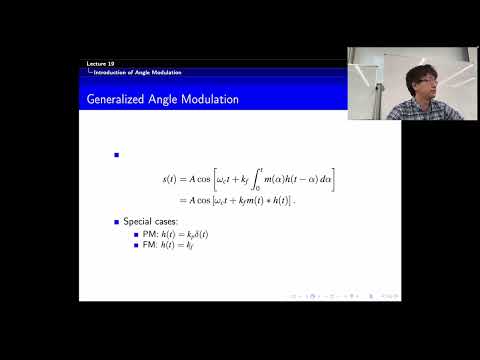
- A general angle modulator applies an LTI system to the message before using it as phase deviation; PM corresponds to an impulse response Kpδ(t), while FM uses a constant response.
- The nonlinear system y(t) = A s(t) + B s³(t) distorts DSB-SC by creating an m³(t) term at the carrier frequency.
- Because cubing a message with bandwidth B can produce bandwidth up to 3B, the DSB-SC output can occupy a wider band after nonlinear distortion.
- For an angle-modulated signal A_c cos(ωc t + ψ(t)), the cubic term produces a fundamental-frequency component with the same phase ψ(t), plus a component near three times the carrier frequency.
- Filtering out the higher-frequency component leaves a change in carrier amplitude rather than message-band expansion, making FM and PM more robust to this nonlinearity than DSB-SC.
- Bandwidth is treated as the frequency range needed to preserve most of a signal's energy, as illustrated by choosing a practical cutoff for a sinc spectrum.
- FM is difficult to analyze directly because its cosine contains the time-varying integral of the message.
- The lecture represents FM using a complex exponential and defines A(t) as the integral of m(t), preparing a series expansion for spectrum analysis.
- Euler's formula separates the carrier exponential from the modulation term exp(jKf A(t)), which is expanded as a Taylor series.
- Taking the real part produces a carrier term, a first-order term proportional to A(t) and sin(ωc t), and higher-order terms involving A²(t), A³(t), and beyond.
- The first-order term resembles DSB-SC with the integrated message A(t), while the next term uses A²(t).
- If the message bandwidth is B, powers such as Aⁿ(t) can extend to roughly nB, so the infinite series implies theoretically infinite FM bandwidth.
- Although the Taylor-series model gives infinite theoretical bandwidth, higher-order terms become small when the peak phase deviation Kf|A(t)| is much less than 1.
- The first neglected terms scale with powers such as Kf²A²(t), so small modulation depth reduces the contribution of wider-band components.
- The lecture distinguishes theoretical infinite bandwidth from practical bandwidth, which depends on how much energy in the higher-order terms can be neglected.
- For Kf|A(t)| much less than 1, the FM signal is approximated by A_c cos(ωc t) − A_c Kf A(t) sin(ωc t).
- The second term is DSB-SC with message A(t), shifted by 90 degrees relative to the carrier.
- The approximation yields bandwidth about 2B, comparable to DSB-SC, which motivates the name narrowband FM.
- A modulator can integrate m(t), scale the result by Kf, use a sine-phase DSB-SC modulator, and add the carrier.
- Wideband FM applies when KfA(t) is not small enough for the narrowband Taylor approximation.
- To simplify the phase integral, the message m(t) is approximated by piecewise-constant rectangular samples with values m(Tk).
- For a message bandwidth B, the lecture introduces sample widths of 1/(2B), invoking the Nyquist sampling criterion to preserve the message information.
- Replacing each interval's integral with its constant sample value times the interval duration makes the FM spectrum easier to analyze; the lecture ends by defining message peak amplitude as ±Mp.
- The wideband analysis is set up to continue from the sampled approximation of m(t), with each sample represented over an interval of length 1/(2B).
- The lecture notes that the maximum and minimum message amplitudes are Mp and −Mp, respectively, as a starting point for the next derivation.
- There is no live lecture the following week; a prerecorded lecture will be uploaded before the scheduled class time.
Summary, takeaways, and chapters were generated by AI from the video's transcript and may contain errors. The video belongs to its creator, Mingyue Ji.