EDF9850_Lecture5_Part2
 Watch on YouTube →
Overview
Lesa Hoffman explains how time-varying predictors combine within-person fluctuation with between-person differences, and how person-mean centering separates those effects in multilevel models. She applies the framework to psoriasis and stress data, nonlinear practice trajectories, and piecewise randomized trials, then identifies when multivariate multilevel modeling is needed for missing predictors, bidirectional effects, or predictors with their own individual change.
Key takeaways
- Person-mean centering creates separate, interpretable estimates for within-person deviations from usual and between-person differences in average levels.
- The psoriasis example found that 83% of severity variance was between people; average stress had a sizable association with average severity, while only prior-week above-usual stress predicted a small increase in severity.
- In a quadratic trajectory, the linear slope changes by twice the quadratic coefficient per unit of time, so the quadratic coefficient is half the rate of acceleration.
- Three occasions can be insufficient to estimate two random piecewise slopes while retaining realistic residual error; an unstructured covariance model can be preferable to imposing parallel change.
- Person-mean centering is not enough when a time-varying predictor has individual differences in change: modeling that predictor as an outcome in a multivariate framework avoids time-smooshed effects.
- Longitudinal models must account for the ordering of occasions: a random intercept assumes equal correlation across occasions, while observations closer together in time are often more strongly related.
Chapters
0:00
Time-Varying Predictors Have Within-Person and Between-Person Variation
- A daily stress measure captures both day-to-day fluctuation within a person and chronic differences between people.
- An empty model and intraclass correlation (ICC) can partition a predictor's variance before it is used to explain an outcome.
- If the ICC is above zero, a predictor can have a between-person effect; if it is below one, it also has within-person variation.
- When modeling change over time, residual deviations from the fitted trajectory should be uncorrelated with time.
5:33
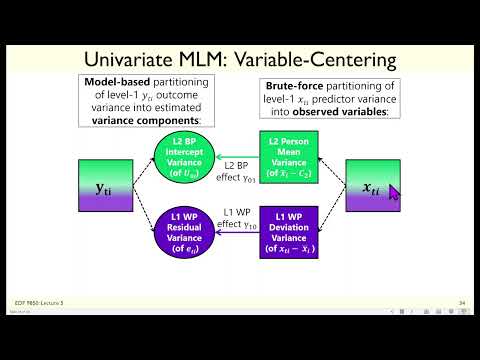
Person-Mean Centering Separates Usual Levels from Daily Deviations
- Person-mean centering subtracts each person's mean from each occasion's predictor value, creating a within-person deviation.
- The person mean, centered at a meaningful constant such as the grand mean, represents between-person differences in usual levels.
- A positive within-person value means more than usual; a positive person-mean value means more than other people on average.
- Because these components are uncorrelated by construction, their fixed effects retain distinct interpretations in the same model.
10:16
Psoriasis and Stress: Separating Chronic Associations from Lagged Effects
- An eight-week observational study measured psoriasis severity and stress; 83% of severity variance was between people, while stress was roughly half within-person and half between-person.
- The analysis used person-mean stress and within-person stress at lag zero and lag one to distinguish current from prior-week associations.
- Higher average stress predicted worse average psoriasis severity, with a between-person slope of 0.48.
- Current-week stress was not significant, but above-usual stress predicted slightly greater psoriasis severity the following week; bidirectional effects would require a multivariate model.
17:17
Choosing Nonlinear Time Functions for Longitudinal Change
- A quadratic time term allows a trajectory to bend once; a cubic term can bend twice.
- Piecewise models represent different slopes across design-defined phases, while estimating an unknown change point requires a latent-knot approach and different software.
- Log-transformed time can approximate exponential leveling, such as practice-related response-time gains that eventually taper off.
- Latent-basis models estimate time scores and can approximate nonlinearity with few occasions, though estimation can be difficult.
20:39
Practice Effects in Older Adults' Processing-Speed Scores
- A two-week measurement-burst study tracked older adults completing six sessions of a three-number comparison task, with response times recorded in milliseconds.
- Most participants became faster with practice, while the mean trajectory declined and then leveled off.
- A saturated means model treated session as a categorical factor; a quadratic model provided a compact representation of the curve.
- Declining between-person variance over sessions suggested individual differences in time slopes, rather than a constant-variance random-intercept-only model.
27:00
Quadratic Slopes, Acceleration, and the Practice Trajectory
- In a quadratic model, the instantaneous linear slope changes by twice the quadratic coefficient per unit of time.
- A positive quadratic coefficient bends the trajectory upward; whether that means acceleration or slowing depends on the sign of the linear slope.
- Random quadratic slopes require at least four occasions and retain both linear fixed and random slopes as lower-order terms.
- For the processing-speed example, reasoning predicted starting response time and moderated both linear practice gains and quadratic leveling.
34:10
Reasoning Predicts Starting Speed and How Practice Gains Taper
- At the sample-average reasoning score of 22, the reference curve began near 1,966 milliseconds and declined by about 120 milliseconds per session.
- The positive quadratic term made that decline less steep by about 26 milliseconds per session for each additional session.
- Higher reasoning was associated with faster initial responses, stronger initial improvement, and greater subsequent deceleration.
- Reasoning explained about 5% of intercept variance and 2% of quadratic-slope variance, but did not reduce level-one residual variance.
41:24
Piecewise Weight-Loss Models Compare Treatment and Maintenance
- A randomized trial followed 105 participants at baseline, post-treatment, and follow-up, comparing a new program with business-as-usual control.
- The piecewise model separated baseline-to-post change from post-to-follow-up change and estimated treatment interactions for both phases.
- The control group lost 14 pounds during treatment and regained 8; the treatment group lost an estimated 19 and regained 4.
- With only three occasions and two phase-specific slopes, Hoffman used group-specific unstructured covariance matrices rather than forcing unrealistic random-slope assumptions.
46:43
Modeling Classroom Behavior Across Four Intervention Phases
- A randomized trial of an app to reduce disruptive classroom behavior measured pre-baseline, baseline, intervention, and post-intervention phases.
- Hoffman modeled the four phases as separate but simultaneous outcomes, using phase-specific intercepts and treatment contrasts.
- Each phase received its own random intercept, with correlations estimated among the four random effects; within-phase change was checked but not supported.
- The log-transformed behavior counts showed a larger treatment-control gap during intervention, with the treatment group maintaining its lower behavior level afterward.
50:01
When Univariate Longitudinal Models Must Give Way to Multivariate Models
- Multivariate multilevel or structural equation models are useful when time-varying predictors have missing values, need latent centering, or must be predicted alongside the outcome.
- Bidirectional stress and psoriasis questions require both variables to function as outcomes; person-mean centering alone cannot model individual change in a predictor.
- If a predictor has its own person-specific time slope, person-mean centering leaves that slope variation in the residual, creating what Hoffman calls a time-smooshed effect.
- Longitudinal analysis must also address time metrics, nonlinear mean patterns, changing variances, and residual correlations between nearby occasions.
Summary, takeaways, and chapters were generated by AI from the video's transcript and may contain errors. The video belongs to its creator, Lesa Hoffman.