EDF9850_Lecture4_Part2
 Watch on YouTube →
Overview
Lesa Hoffman explains how centering choices affect random slopes and cross-level interactions in multilevel models, using verbal ability and mixed-grade schools as the running example. She shows how hybrid specifications and corresponding cluster-level terms prevent conflated effects, then discusses when cross-level interactions are defensible and how they relate to variance in slopes, intercepts, and residuals.
Key takeaways
- A random slope for a person-level predictor should multiply its cluster-mean-centered or latent-centered version; attaching it to a constant-centered predictor can smoosh slope variance and change the random-intercept interpretation.
- A hybrid model can use constant-centered verbal ability for the fixed slope and cluster-mean-centered verbal ability for the random slope, with school mean verbal ability included to estimate the contextual effect.
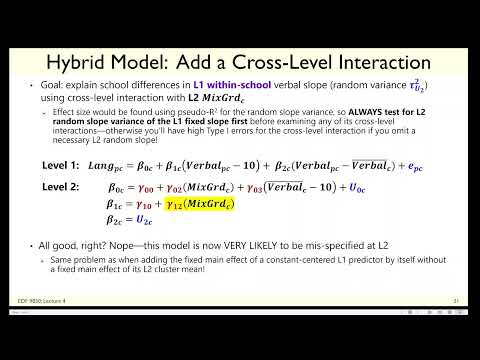
- A cross-level interaction with a constant-centered level-one predictor assumes equal moderation of within and between slopes unless the matching level-two contextual interaction is added.
- Within plus contextual equals between for main effects and interactions; alternatively, between minus within yields the contextual effect.
- When school mean verbal ability moderates the student verbal slope in a constant-centered model, a corresponding squared school-mean term separates within-slope moderation from contextual-slope moderation.
- A nonsignificant random-slope variance does not always rule out a theoretically important cross-level interaction; if moderation explains the slope pattern without remaining cluster-level variance, the slope is systematically varying rather than random.
Chapters
0:00
Why Constant-Centered Predictors Complicate Random Slopes
- A fixed slope is constant across clusters, while a random slope allows each school to have its own within-school verbal-ability slope.
- Cross-level interactions can explain random-slope variance, tested with a likelihood ratio test when nested models keep the same fixed effects.
- The lecture shifts from cluster-mean-centered predictors to constant-centered predictors, which retain both within-school and between-school variation.
3:39
Hybrid Models Separate Fixed Contextual Effects from Random Within-School Slopes
- The running language-achievement model includes mixed-grade status and school mean verbal ability alongside student verbal ability.
- The hybrid specification uses constant-centered student verbal ability for the fixed slope and cluster-mean-centered verbal ability for the random slope.
- Including school mean verbal ability as a contextual effect separates the fixed within-school slope from the between-school contribution.
- The hybrid approach can be useful when a contextual effect is the research target or when cluster-mean-centering a binary predictor is awkward.
8:00
Cluster-Mean Centering Preserves the Meaning of Random Intercepts
- A random slope attached to a constant-centered predictor is smooshed, and its model is not equivalent to one using the cluster-mean-centered predictor.
- The intercept changes meaning with the centering choice: it refers to a student at the school mean in one model and to the constant-centered zero point in the other.
- In the example, the constant-centered specification produces smaller estimated slope variance, illustrating how smooshing can distort random-effect estimates.
- With a properly centered random slope, the random intercept is conditional on student verbal ability being at the school mean.
10:30
Unsmooshing Mixed-Grade Interactions with Contextual Terms
- A cross-level interaction between mixed-grade status and constant-centered verbal ability implicitly assumes equal moderation of within-school and between-school verbal slopes.
- In the initial example, the interaction estimate is 0.37, but it is smooshed because the model does not distinguish those two forms of moderation.
- Adding a mixed-grade-by-school-mean-verbal interaction allows contextual moderation to differ from within-school moderation.
- The within slope plus the contextual slope gives the between slope; the same relationship applies to their interactions with mixed-grade status.
16:00
Equivalent Within-Between Parameterizations and Their Mixed-Grade Results
- A cluster-mean-centered fixed predictor directly estimates within effects and between effects; contextual effects can be computed as between minus within.
- The hybrid model estimates contextual terms directly, while the cluster-mean-centered version estimates between terms directly; both yield matching unsmooshed effects when corresponding terms are included.
- In the example, mixed-grade schools have a within verbal slope that is 0.336 stronger; the between slope is 0.753 stronger, but not significantly so.
- The contextual verbal slope is 0.417 stronger in mixed-grade schools, and both parameterizations retain the same variance model when their random slopes use cluster-mean centering.
22:00
Quadratic Terms Separate Within and Between Verbal Moderation
- When school mean verbal ability moderates the student-level verbal slope, constant centering again conflates within-school and between-school moderation.
- Following the rule to add a corresponding level-two term requires a school-mean-verbal squared term, written in R with I(verbal^2).
- The cross-level interaction describes moderation of the within slope, while the quadratic term describes moderation of the contextual slope; combining them gives between-slope moderation.
- The example estimates a within slope of 2.359 and a between slope of 3.2 at the reference value; interpreting a quadratic coefficient as a change in linear slope requires multiplying by two.
28:00
When Cross-Level Interactions Are Used Without Significant Random-Slope Variance
- One view is that a cross-level interaction should not predict slope variation when a random-slope variance was not detected; omitting the random effect can produce overly small standard errors and excessive Satterthwaite degrees of freedom.
- Because random-slope tests may have low power, Hoffman also considers testing a theoretically important cross-level interaction even when the initial variance test is nonsignificant.
- A slope is systematically varying when a moderator such as treatment status explains its variation, but no residual cluster-specific slope variation remains.
- If random-slope variance remains significant after moderation, the slope is still random; if the interaction is nonsignificant and no variance remains, the slope can be treated as fixed.
34:00
How Predictors Explain Multilevel Variance and the Centering Takeaway
- Fixed level-two predictors reduce random-intercept variance, while cross-level interactions with a random-sloped level-one predictor can explain that predictor's random-slope variance.
- If no random-slope variance exists, a cross-level interaction instead accounts for level-one residual variance and represents systematic variation.
- Cluster-mean-centered level-one predictors target within-cluster residual variance; constant-centered or uncentered predictors can also carry cluster variation into the model, the Trojan horse problem.
- For constant-centered predictors, add corresponding level-two main effects and interactions to separate within, contextual, and between effects; always use the cluster-mean-centered version in the random-slope term.
Summary, takeaways, and chapters were generated by AI from the video's transcript and may contain errors. The video belongs to its creator, Lesa Hoffman.