ECE 1786 - Lecture 0
Overview
Jonathan Rose introduces ECE 1786, Creative Applications of Natural Language Processing, as a course combining the mechanics of transformer-based large language models with the design of agentic applications. Students use PyTorch and Hugging Face in four software assignments, then build an approved LLM-based project in pairs; Rose emphasizes substantial machine-learning prerequisites, open-ended engineering practice, and a 40% assignments / 60% project grading split.
Key takeaways
- ECE 1786 expects students to already understand machine learning and neural-network practice, including gradient descent, CNNs, transfer learning, PyTorch or TensorFlow training loops, and model evaluation.
- The course connects two complementary skills: explaining transformer LLM mechanics and programming hybrid systems in which ordinary software coordinates LLM calls, tools, and curated context.
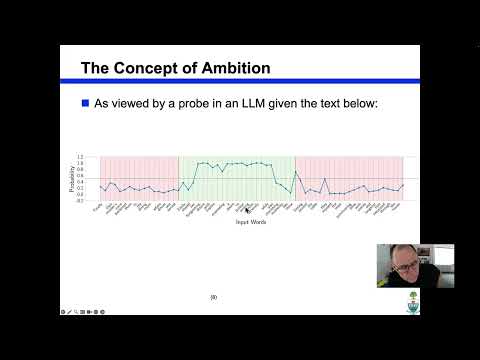
- Rose’s research applies LLMs both to smoking-cessation motivational interviewing and to probing whether models represent abstract concepts such as ambition.
- Project work makes up 60% of the grade and is designed as an open-ended, instructor-approved application built by a pair, while four software assignments make up the other 40%.
- Students must write assignment code themselves and disclose AI assistance, but may use AI coding extensively for the project as a collaborator rather than delegating the project wholesale.
- Google Colab Pro, priced at approximately $14 per month according to Rose, is his recommended computing option for most course assignments.
Chapters
- Jonathan Rose frames the course around understanding how large language models are built and how they work internally, then using them in agentic systems.
- Rose opens with a land acknowledgement recognizing Toronto as a gathering place for Indigenous peoples and immigrants.
- He connects the course to rapid changes in work, learning, teaching, and earning enabled by large language models.
- Rose’s talk-therapy research focuses on addiction, specifically smoking cessation, using motivational interviewing to help smokers consider quitting.
- His team tests chatbots with real smokers and uses an LLM to track client change talk and characterize therapist turns across a conversation.
- A second research thrust probes internal LLM representations for abstract concepts such as ambition, comparing probe outputs with the meaning of example sentences.
- Students study word embeddings, transformer blocks, attention, training, autoregressive token generation, instruction training, and chain of thought using PyTorch and Hugging Face models.
- The agentic-systems material covers prompt engineering, task decomposition, retrieval-augmented generation (RAG), Model Context Protocol, and curating context for each model call.
- Rose defines engineering as navigating open-ended problems: identify the challenge, plan and build a solution, iterate, and communicate the result.
- ECE 1786 is narrower than computational linguistics and natural language computing courses: it concentrates on transformer LLMs and their applications.
- Students are expected to arrive with machine-learning experience; Rose says the course does not introduce machine learning from scratch.
- Required concepts include classification and regression, linear neurons, activation functions such as sigmoid and ReLU, multilayer perceptrons, cross-entropy loss, softmax, and gradient descent.
- Students should know CNNs, kernels, batch normalization, transfer learning, and fine-tuning, and should have built full training and test loops in TensorFlow or PyTorch.
- The preparation also includes tensor shapes, NumPy, neural-network debugging, and evaluation measures such as sensitivity, specificity, confusion matrices, and ROC AUC.
- Rose favors depth over breadth, teaching intuition alongside implementation rather than expecting students to infer ideas from equations alone.
- He emphasizes learning by writing software, experimenting, reflecting on results, and completing open-ended engineering projects.
- The course interleaves LLM internals and agentic-system material so students can begin the project earlier, despite the less linear topic sequence.
- Assessment is 40% across four software assignments and 60% across project components, including a proposal, progress report, presentations, final report, software, and peer review.
- Pairs propose an instructor-approved application using LLMs, potentially multimodal models; projects should use an agentic system rather than a single model call.
- AI coding is restricted in assignments: students must write the code themselves and report their AI use, while project coding can use AI extensively if students remain responsible for the thinking and structure.
- Key project dates include forming pairs by September 22, submitting approval in principle by October 13, presenting the plan on October 26, and completing final presentations during the week of December 8, with the final report due December 15.
- Rose recommends Google Colab, with Colab Pro at about $14 per month as sufficient for most assignments; course communication and materials use Quercus, Piazza, and a public course website.
Transcript excerpt
0:01 Welcome to lecture zero of ECE 1786, Creative Applications of Natural Language Processing. My name is Jonathan Rose. I'm the instructor in the course. And the purpose of this lecture zero is really twofold. One is to give you a sense of what the course is about so you understand if you want to take it, but also to give you a really good sense of the needed prerequisites for the course. And I'll be describing those um later on. They should allow you to uh figure out if the course is for you. It is our tradition at uft to begin courses with a land acknowledgement. Toronto is a city of immigrants and my parents arrived here in 1952. And it's likely that you or your parents are new to this country. That's not a new feature of Toronto. For over 15,000
0:49 years, Toronto has been a gathering site for humans, including the Wendat and Patent First Nations, the Senica, and most recently, the Missosagas of the Credit First Nation. Today, Toronto is still a meeting place for indigenous people and immigrants, both new and old, and from across the world. I want to acknowledge our duty of stewardship toward this land, and I'm grateful to have the opportunity to work on it. Welcome also to ECE 1786. Large language models have led the way in the tumult that is modern AI. It's enabled incredible change in how we do everything from our work to our learning, our teaching and our earning. The purpose of this co course is really twofold in touching that world that is
1:39 changing so rapidly. The first purpose is to learn how large language models are created and how they work inside to have some deeper understanding of what for most people is a very not well
This is the start of the transcript. Save this video free for the whole transcript, searchable and time-coded.
In this course
Related notes
Summary, takeaways, and chapters were generated by AI from the video's transcript and may contain errors. The video belongs to its creator, Jonathan Rose.