ECE 1230 F26 U2 L5 Phasor Operations
 Watch on YouTube →
Overview
Professor Angela Rasmussen reviews phasor arithmetic for ECE 1230, emphasizing rectangular form for addition and subtraction and polar form for multiplication and division. She connects phasors to simpler circuit analysis, practices converting sinusoids and complex values, and recommends checking expected quadrants and using practice resources and AI-generated quizzes to reinforce understanding.
Key takeaways
- Choose the phasor form that matches the operation: rectangular components make addition and subtraction straightforward, while polar magnitudes and angles simplify multiplication and division.
- A negative sinusoid amplitude is not a negative phasor magnitude; rewrite it with a positive magnitude and a 180° phase shift.
- For a rectangular value a + bj, use √(a² + b²) for magnitude and check the signs of a and b to place the inverse-tangent angle in the correct quadrant.
- Vector sketches provide a fast correctness check: the sum of 4∠0° and 3∠90° must lie between the input directions and evaluates to 5∠36.9°.
- Phasor analysis turns sinusoidal circuit problems into complex algebra; in the frequency domain, an inductor is represented by jωL, and the inverse transform returns the time-domain signal.
- Use practice exams, textbook problems, and AI-generated quizzes to build fluency, but validate AI answers with mathematical checks, physical intuition, or circuit simulation.
Chapters
0:00
Where to Find ECE 1230 Phasor Practice Problems
- Canvas Unit 2 practice problems and the Exam 2 area provide practice sets, past exams, and solutions.
- Professor Angela Rasmussen points students to University of Utah library materials for Chapters 5 and 7, including additional problems with some solutions.
- Textbook problems marked with a star have selected answers in the appendix; Rasmussen also suggests generating problems with Google Gemini and working through them with Ubot.
5:05
Weekly Quiz Coverage: Sinusoids, Phasors, and Complex Arithmetic
- The next weekly quiz is due Friday night and can be taken at any time before the deadline.
- Quiz topics include separating DC and AC parts of a sinusoid, converting between a sinusoid and its phasor, and basic complex-number operations.
- Rasmussen says the class will return after fall break to solve repeated examples and prepare for the next exam.
8:16
Rectangular and Polar Forms Simplify Sinusoid Addition
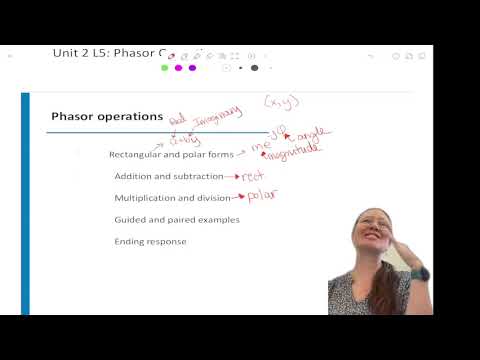
- Rectangular form writes a complex value as a real component plus an imaginary component, such as a + bj; polar form gives magnitude and phase, such as M∠θ or M e^(jθ).
- Adding sinusoids directly in the time domain requires trigonometric identities and additional amplitude-and-phase calculations.
- Converting signals to phasors, adding their rectangular components, and converting back replaces that lengthy trigonometry with algebra.
13:21
RL and RC Circuits Model Delayed Physical Responses
- An inductor models current and magnetic-field buildup in physical systems such as a doorbell chime, relay, or car-starting solenoid.
- Capacitors store charge, while inductors and capacitors capture time-dependent behavior in electrical models.
- Rasmussen also cites electronic locks, garage-door openers, motor windings, and electromagnetic scrap-metal pickup as applications of circuit models.
17:20
Phasors Move Sinusoidal Signals into an Algebra-Friendly Domain
- A phasor represents a sinusoid as a magnitude-and-phase vector on the real-imaginary plane when its frequency is known.
- The workflow is to transform a time-domain signal into a phasor, perform algebra, then apply the inverse phasor transform to recover the time-domain expression.
- Rasmussen contrasts phasors with Laplace and Fourier transforms, which students encounter in later ECE coursework and which handle broader signal conditions.
22:35
Circuit Elements Become Algebraic Impedances in the Frequency Domain
- In the next unit, students will transform circuit elements as well as signals; an inductor can be represented by the frequency-domain impedance jωL.
- Replacing a differential-equation relationship with an impedance lets students combine terms and solve circuit quantities using complex algebra.
- An inverse phasor transform then converts the calculated result back into a time-domain signal.
24:29
Convert Between Rectangular and Polar Coordinates
- For a + bj, calculate magnitude as √(a² + b²) and phase from the imaginary-to-real ratio, b/a, with the quadrant checked.
- For magnitude M and phase θ, recover rectangular components with a = M cos θ and b = M sin θ.
- Both forms describe the same vector on the real-imaginary plane; rectangular form exposes components, while polar form exposes magnitude and angle.
27:26
Predict Phasor Addition Results by Checking Vector Directions
- A magnitude cannot be negative: a negative sinusoid amplitude must be rewritten with a positive magnitude and a 180° phase shift.
- For example, 4∠0° + 3∠90° becomes 4 + 3j, then converts to magnitude 5 and phase about 36.9°.
- Before calculating, estimate the resultant direction from the input angles; the sum of vectors at 0° and 90° should lie between those angles.
37:06
Use Quadrants to Sanity-Check Sinusoid-to-Phasor Work
- Rasmussen has students predict the resultant quadrant before fully solving sums, using the vectors’ directions and relative magnitudes.
- Convert a sine term to cosine-reference phasor form with a −90° phase adjustment; for a negative amplitude, make the magnitude positive by shifting phase 180°.
- Equivalent phase descriptions such as 240° and −120° identify the same vector, so either can be used in the calculation.
54:34
Set Up Phasor Sums by Converting Every Term to Polar Form
- The worked sums begin by converting each sinusoid to a positive-amplitude cosine reference and recording its phase.
- Rasmussen sketches the resulting vectors first to estimate whether each sum should fall in Quadrant I, III, or IV.
- The sketches are qualitative checks; the exact rectangular-component calculation determines the final magnitude and phase.
1:00:51
Add Phasors in Rectangular Form and Verify the Resulting Angle
- For 20∠−30° + 16∠15°, the rectangular components sum to approximately 32.775 − 5.86j.
- Converting that result back to polar gives approximately 33.3∠−10°, consistent with the predicted Quadrant IV direction.
- For 14∠−45° + 17∠240°, the sum is approximately 1.4 − 24.62j, or 25∠−86.8°; 2 + 7j converts to about 7.28∠74°.
1:06:27
Phasor Arithmetic Rules: Rectangular for Sums, Polar for Products
- For addition and subtraction, convert to rectangular form, combine real and imaginary components separately, and convert the result if polar form is needed.
- For multiplication, multiply magnitudes and add phase angles; for division, divide magnitudes and subtract phase angles.
- Check the quadrant after inverse-tangent calculations, since the calculator’s angle may not match the signs of both rectangular components.
1:07:18
Divide Polar Phasors by Subtracting Their Angles
- The example 10∠30° divided by 2∠−20° gives magnitude 10/2 = 5.
- Division subtracts the denominator’s phase, so 30° − (−20°) = 50° and the result is 5∠50°.
- The same rule follows from moving a phase factor from the denominator to the numerator, which reverses its angle sign.
1:09:22
Divide a Sinusoidal Phasor by a Rectangular Complex Number
- For 20 cos(10t + 200°) divided by 30 − 5j, first represent the numerator as 20∠200° and convert the denominator to polar form.
- The denominator is approximately 30.4∠−9.5°; dividing gives approximately 0.66∠209.5°.
- The inverse phasor transform preserves the 10 rad/s frequency, yielding a time-domain cosine with amplitude about 0.66 and phase about 209.5°.
1:14:03
Use Ubot and AI Quizzes to Test Understanding
- Rasmussen recommends using Ubot, ChatGPT, or Google NotebookLM with lecture notes to generate quizzes and step-by-step review questions.
- A student describes using AI-generated summaries and problem-solving cues to review unfamiliar topics such as superposition.
- AI-generated explanations still need verification: compare answers with expected ranges and circuit intuition, and use a simulator when greater accuracy is needed.
Summary, takeaways, and chapters were generated by AI from the video's transcript and may contain errors. The video belongs to its creator, University of Utah: Professor Angela Rasmussen.