EAS4200 Aerospace Structures, Lecture 24, 2026 fall
 Watch on YouTube →
Overview
Ting Dong reviews fatigue analysis for EAS4200, showing how to combine bending, nonzero mean stress, and stress concentrations to identify critical locations and estimate life or allowable load. Across Homework 6 and two practice problems, the review emphasizes using the modified Goodman equation, selecting nominal dimensions according to the stress-concentration chart, and defining fatigue safety factor as fatigue strength divided by actual equivalent stress.
Key takeaways
- For nonzero-mean fatigue loading, convert mean stress and stress amplitude to an equivalent stress with the modified Goodman equation before using the S-N curve.
- A critical location must be established by comparing calculated stresses at all plausible candidates, including both fatigue stress concentration factors and geometric effects such as moment arm.
- Nominal stress dimensions must match the definition printed beside the stress-concentration chart; a different nominal area or section property requires the corresponding chart definition.
- In rotating bending combined with axial tension, bending contributes stress amplitude while tension contributes mean stress; the example expresses these as MC/I and T/A.
- Use separate fatigue stress concentration factors for tension and bending when those loading modes contribute to mean stress and amplitude, respectively.
- Fatigue safety factor is fatigue strength at the target life divided by actual equivalent stress; the endurance limit serves as the strength threshold for an infinite-life design.
Chapters
0:00
Homework 6: Nonzero Mean Stress Under Bending Loads
- The 20,000 and 60,000 force levels produce different bending moments and therefore maximum and minimum stresses.
- Find stress amplitude and mean stress from the resulting stress extremes, then use the Goodman equation before reading life from the S-N curve.
- For the discussed beam setup, each support reaction is half of the applied load, so the critical-section moment uses that half-load times its lever arm.
5:00
Compare Candidate Locations and Apply Fatigue Stress Concentration
- At a hole-and-fillet geometry, compare both candidate locations rather than guessing which is critical.
- Read theoretical stress concentration factors from the appropriate chart, then use material strength and notch radius to determine notch sensitivity and fatigue concentration factors.
- Calculate nominal stress using the cross-sectional dimensions specified by the chart; using a different area requires a different corresponding stress-concentration curve.
10:00
Select the Critical Point Before Calculating Fatigue Life
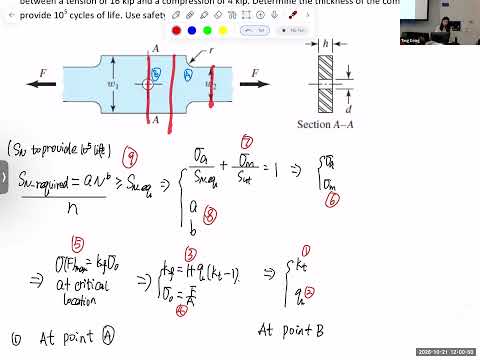
- Compare the stress at points A and B after applying each location's fatigue stress concentration factor; proceed with the higher-stress point.
- Ting Dong stresses that an unsupported guess about the critical location loses credit even if the guess is correct.
- For a target life of 10^5 cycles, use the S-N stress at that cycle count as the fatigue strength when calculating safety factor.
15:00
Fatigue Safety Factor and Combined Tension-Bending Loading
- Define safety factor as fatigue strength divided by actual maximum stress, with the fatigue strength chosen for the expected life.
- In rotating bending with an axial tensile force, bending generates stress amplitude while tension shifts the cycle and creates mean stress.
- The rotating-beam example derives mean stress as T/A and amplitude as MC/I by combining the maximum and minimum stresses.
20:00
Use Separate Fatigue Factors for Tension and Bending
- Read separate theoretical stress concentration factors from the tension and bending charts; the two loading modes do not share one factor.
- Convert each theoretical factor to a fatigue stress concentration factor using notch sensitivity, then apply the bending factor to amplitude and the tension factor to mean stress.
- Use chart-defined dimensions for nominal stress, including the specified outer-fiber distance C and the prescribed cross-sectional area.
25:00
Endurance Limit as the Infinite-Life Threshold
- For an infinite-life design, compare the Goodman-equivalent stress with the endurance limit, treated as the fatigue failure strength.
- The applied-load stress varies with the unknown tensile force T, so set fatigue strength divided by actual equivalent stress equal to the specified safety factor.
- A Goodman value below one indicates the infinite-life condition in the practice check; a value above one indicates finite life.
30:00
Practice Problems: Goodman Checks and S-N Life Estimates
- For each loading case, calculate maximum stress, minimum stress, nominal mean stress, and nominal amplitude before applying the fatigue concentration factor.
- The practice example finds case A infinite-life by the modified Goodman check, while case B exceeds the criterion and requires an S-N cycle-life estimate.
- A shared hole gives both cases the same fatigue stress concentration factor, but their different loading produces different mean and amplitude stresses.
36:00
Exam Example: A Larger Moment Arm Can Beat a Notch
- The exam-style problem compares a notched point with a farther location that has no stress concentration; their competing effects cannot be resolved by intuition alone.
- The farther point has an 8-unit moment arm, compared with 2 units at point A, and its larger nominal bending stress makes it the critical location in the worked comparison.
- For the 10^5-cycle target, use the corresponding fatigue strength and divide by the actual equivalent stress to obtain safety factor; Ting Dong also asks students to clarify alternate textbook conventions before the exam.
Summary, takeaways, and chapters were generated by AI from the video's transcript and may contain errors. The video belongs to its creator, Ting Dong.