EAS4200 Aerospace Structures, Lecture 21, 2026 fall
 Watch on YouTube →
Overview
Ting Dong compares four fatigue models for nonzero mean stress—Goodman, Soderberg, Gerber, and an elliptical criterion—then explains how to combine fatigue stress concentration with mean and alternating stress. The lecture applies the linear Miner damage rule to variable-amplitude loading and works through a block-life example using S–N data, an endurance limit of 30 ksi, and a fatigue strength fraction of 0.82.
Key takeaways
- Goodman, Soderberg, Gerber, and elliptical criteria offer different mean-stress corrections; the course uses Goodman as the required method for assessed work.
- With nonzero mean stress, the lecture applies the fatigue stress-concentration factor to both the alternating component and the mean component.
- For variable-amplitude loading, convert each stress level to its own S–N failure life Nᵢ before combining it with the actual cycles nᵢ.
- Miner’s rule predicts failure when Σ(nᵢ/Nᵢ) ≥ 1, but it ignores load sequence and therefore cannot capture all effects of applying high or low stress first.
- In the worked block-life method, stress amplitude is (σmax − σmin)/2 and mean stress is (σmax + σmin)/2; Goodman and S–N calculations are repeated for each level.
- Stress levels below the stated 30 ksi endurance limit are treated as having effectively infinite life in the example, making their Miner damage contribution negligible.
Chapters
0:00
Goodman’s Diagram for Nonzero Mean Stress
- Ting Dong recaps the Goodman equation as a common introductory method for handling fatigue when mean stress is not zero.
- The method converts a stress-amplitude/mean-stress condition into an equivalent fully reversed fatigue strength, which can be related to cycles to failure on an S–N curve.
- The static-strength intercept depends on the chosen failure criterion; the lecture uses tensile strength for the Goodman line.
1:58
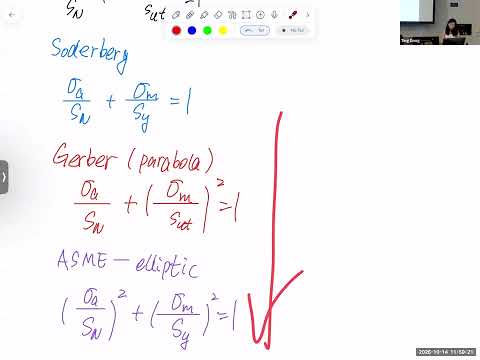
Alternative Straight-Line Criterion: Soderberg
- The Soderberg approach uses yield strength rather than tensile strength at the static-loading intercept.
- Like the Goodman line, it treats equal-life conditions as straight boundaries in mean-stress versus alternating-stress space.
- Changing the static-strength intercept changes the predicted fatigue boundary even though the calculation workflow remains similar.
6:00
Gerber Parabola and Elliptical Fatigue Criteria
- The lecture introduces a parabolic boundary, commonly known as the Gerber criterion, as an alternative to straight-line mean-stress models.
- An elliptical criterion provides another boundary shape for relating mean stress and alternating stress to fatigue life.
- Each curve represents combinations of stresses with the same predicted number of cycles to failure.
9:00
Choosing a Mean-Stress Model for S–N Life
- All four criteria estimate equivalent fully reversed fatigue strength from stress amplitude, mean stress, and material properties.
- The equivalent strength is then used with the S–N diagram to estimate cycles to failure or assess a design life.
- Goodman is the method emphasized for homework, quizzes, and exams; the other criteria are introduced as models suited to different applications.
12:00
Applying Fatigue Stress Concentration to Both Stress Components
- For nonzero mean stress with a notch or hole, Ting Dong applies the fatigue stress-concentration factor to both stress amplitude and mean stress.
- This extends the earlier fully reversed case, where the concentration factor was applied to the fatigue stress.
- Nominal stress assumes an ideal geometry; holes, fillets, and other discontinuities create local stress concentrations.
16:00
Variable-Amplitude Loading in Real Fatigue Applications
- Aircraft or engine structures can experience periods of high mean stress and amplitude, such as turbulence, mixed with longer periods of lower stress.
- A single constant stress amplitude and mean stress may therefore fail to represent an operating cycle.
- Each distinct stress level can be converted to an equivalent fully reversed strength and matched to its own S–N life.
18:30
Assigning S–N Lives to Multiple Stress Levels
- The lecture labels stress levels with S₁, S₂, and Sᵢ, and assigns each an individual failure life N₁, N₂, and Nᵢ.
- Lowercase nᵢ denotes the actual cycles accumulated at stress level i during one repeated block.
- The design question is how many such blocks can occur before the accumulated fatigue damage predicts failure.
21:00
Miner’s Rule for Cumulative Fatigue Damage
- Miner’s rule estimates cumulative damage by summing the fractions nᵢ/Nᵢ across all stress levels.
- Predicted failure occurs when the damage sum reaches or exceeds 1, representing 100% of the modeled fatigue life.
- The rule is a simplified model: it does not account for load sequence, even though high stress applied first can cause different damage than low stress applied first.
27:00
Setting Up a Four-Level Fatigue Block-Life Example
- The worked problem defines four stress levels, A through D, by their maximum and minimum stresses and the cycles applied at each level per block.
- Material inputs include 40 ksi strength, a corrected endurance limit of 30 ksi, and a fatigue strength fraction of 0.82.
- For each level, calculate mean stress as (maximum + minimum)/2 and amplitude as (maximum − minimum)/2 before applying Goodman.
34:00
Calculating Block Life with Goodman and Miner’s Rule
- For each stress level, the procedure is to calculate mean and alternating stress, find equivalent fully reversed strength with Goodman, and use the S–N relation to obtain Nᵢ.
- Substitute each block’s cycle count nᵢ and calculated life Nᵢ into Miner’s sum; solve for the number of blocks until the sum reaches 1.
- A stress level whose equivalent strength falls below the 30 ksi endurance limit is treated as having effectively infinite life, so its Miner damage term can be neglected.
Summary, takeaways, and chapters were generated by AI from the video's transcript and may contain errors. The video belongs to its creator, Ting Dong.