EAS4200 Aerospace Structures, Lecture 20, 2026 fall
 Watch on YouTube →
Overview
Ting Dong applies the Goodman mean-stress correction to a fatigue-design problem for a solid circular 4140 steel bar carrying axial loads from 80 kip tension to 30 kip compression. For a required life of 200,000 cycles, the example uses an 82.5 ksi fatigue-strength threshold and a safety factor of 2 to obtain a required area of about 1.5 in², emphasizing that fatigue safety factors compare stresses—not doubled diameters or cycle counts.
Key takeaways
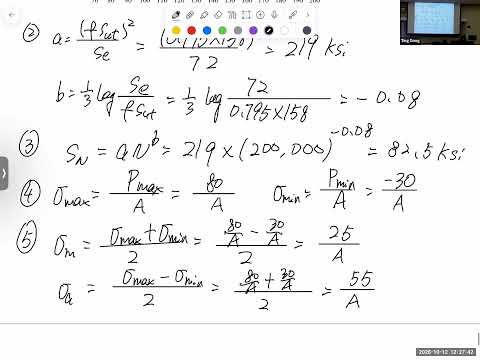
- For a 200,000-cycle target, the example treats approximately 82.5 ksi as the fatigue-strength threshold before applying the safety factor.
- Goodman correction accounts for nonzero mean stress by relating stress amplitude and mean stress to material ultimate strength; the example uses 158 ksi.
- The load range of +80 kip to −30 kip produces a 55 kip force amplitude and a 25 kip mean force, with compression represented as negative.
- A fatigue safety factor of 2 halves the allowable equivalent stress to 41.25 ksi; it does not mean doubling the bar diameter or doubling the target cycle count.
- The worked design produces a required cross-sectional area near 1.5 in², corresponding to a solid circular bar diameter of roughly 1.38 in.
Chapters
0:00
Why Nonzero Mean Stress Matters in Fatigue
- Ting Dong frames nonzero mean stress as common in fatigue loading, unlike fully reversed stress.
- The Goodman equation converts stress amplitude and mean stress into an equivalent fully reversed fatigue stress.
- The lecture moves from a given-stress example toward a practical design problem with an unknown bar diameter.
5:50
Define the 4140 Steel Bar Design Problem and Safety Factor
- The solid circular 4140 steel bar must withstand axial loading from 80 kip tension to 30 kip compression for 200,000 cycles.
- The design uses a fatigue-strength threshold derived from the S–N curve and a safety factor of 2.
- Dong explains that safety factor applies to stress: doubling diameter or designing for twice the cycle life is not generally equivalent because fatigue relationships are nonlinear.
10:30
Find the 200,000-Cycle Fatigue Stress Threshold
- The calculation reads a fatigue-strength fraction from the S–N graph, then determines the curve constants A and B.
- Using the 200,000-cycle life and the given corrected endurance limit of 72 ksi, the example obtains an allowable fatigue stress of about 82.5 ksi.
- This threshold represents the stress level associated with the target life; exceeding it implies a shorter fatigue life.
16:00
Apply Goodman Correction to Size the Bar
- With cross-sectional area A as the unknown, the maximum axial stress is +80/A ksi and the minimum is −30/A ksi; compression is negative.
- The resulting stress amplitude is 55/A ksi and mean stress is 25/A ksi; the Goodman correction uses the material ultimate strength of 158 ksi.
- Applying the safety factor of 2 limits the equivalent fatigue stress to 82.5/2 = 41.25 ksi, yielding a required area of approximately 1.5 in² and a diameter of about 1.38 in.
- Dong closes by contrasting fatigue design with a static example: safety factor is the ratio of the relevant strength limit to actual stress, so engineers must identify the appropriate quantities.
Summary, takeaways, and chapters were generated by AI from the video's transcript and may contain errors. The video belongs to its creator, Ting Dong.