EAS4200 Aerospace Structures, Lecture 19, 2026 fall
 Watch on YouTube →
Overview
Ting Dong extends fully reversed fatigue analysis to nonzero-mean-stress loading using the Goodman diagram, which relates stress amplitude and mean stress to equivalent fully reversed stress. The lecture applies the modified Goodman criterion to distinguish infinite from finite life, then works an example with an 80 ksi ultimate strength, 40 ksi endurance limit, and stresses from −20 to 60 ksi, yielding finite life of approximately 3.4 × 10^4 cycles.
Key takeaways
- Fully reversed S–N data cannot be applied directly to nonzero-mean loading; first convert the cycle to an equivalent fully reversed stress using the Goodman relation.
- For rotating bending with a constant axial preload, bending determines stress amplitude while the axial force shifts the entire stress cycle and determines mean stress.
- For maximum and minimum stresses of 60 ksi and −20 ksi, the cycle has a 20 ksi mean and 40 ksi amplitude.
- With Sut = 80 ksi and Se = 40 ksi, the modified Goodman value is 1.25, indicating finite rather than infinite life.
- The example’s equivalent fully reversed stress is 53.3 ksi, producing an estimated fatigue life of approximately 34,000 cycles.
Chapters
0:00
Fatigue Review and Aircraft Examples of Nonzero Mean Stress
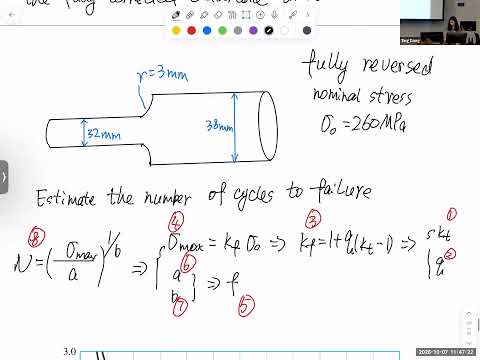
- The lecture builds on fully reversed S–N fatigue analysis and stress concentrations, topics practiced in two homework assignments.
- At an aircraft wing root, lift during flight and aircraft weight on the ground create unequal tensile and compressive bending stresses.
- Fuselage cabin pressurization creates a tensile hoop-stress cycle during flight that returns toward zero on the ground.
- Ting Dong asks students to keep laptops focused on this class because unrelated work and conversations disrupt the learning environment.
5:00
Creating Nonzero Mean Stress in a Rotating-Beam Test
- A rotating beam under four-point bending produces fully reversed stress at a material point: bending alternates between tension and compression.
- Changing the support or bending arrangement alone does not necessarily create mean stress at a given cross-section during rotation.
- Applying a constant axial tensile force while rotating the beam adds a steady tensile component to the bending cycle.
- A constant compressive preload shifts the cycle downward instead, producing a compressive mean stress.
10:00
Separating Mean Stress from Stress Amplitude
- For the combined axial-load and rotating-bending setup, the axial force contributes the mean stress, while bending contributes the alternating stress.
- The cycle is described by maximum stress, minimum stress, mean stress, and stress amplitude.
- Mean stress is σ_mean = (σ_max + σ_min)/2; stress amplitude is σ_a = (σ_max − σ_min)/2.
- Mean stress and amplitude together specify the nonzero-mean fatigue cycle used in the subsequent analysis.
15:00
Goodman Diagram: Equal-Life Lines for Mean Stress and Amplitude
- The Goodman diagram places mean stress on the horizontal axis and stress amplitude on the vertical axis.
- Experimental fatigue results are approximated by straight equal-life lines: points on a given line correspond to the same cycles to failure.
- At zero mean stress, the diagram represents fully reversed loading, so its stress values can be read from the S–N curve.
- The tensile-mean-stress line uses ultimate strength as its mean-stress intercept in the Goodman model described in class.
20:00
Reading Goodman Intercepts and the Endurance Limit
- The vertical axis represents fully reversed stress levels associated with particular lives on the S–N diagram.
- The zero-amplitude intercept represents static tensile failure under mean load alone; Ting Dong uses ultimate strength for this Goodman construction.
- At the 10^6-cycle reference point, the fully reversed stress corresponds to the endurance limit.
- Different equal-life lines connect the endurance-related and fully reversed S–N data to combinations with positive mean stress.
25:00
Using the Goodman Relation to Find Equivalent Fully Reversed Stress
- For a chosen life, the Goodman equal-life line connects the fully reversed S–N stress to the ultimate-strength intercept.
- A nonzero-mean loading point can be projected along its equal-life line to the zero-mean axis to find an equivalent fully reversed stress.
- That equivalent stress can then be used with the S–N diagram or S–N equation to obtain cycles to failure.
- For infinite-life assessment, use the modified Goodman criterion: σ_a/Se + σ_mean/Sut; a value below 1 is safe by this criterion, while a value above 1 indicates finite life.
30:00
Fatigue-Life Workflow for Nonzero Mean Stress
- The S–N diagram applies directly only to fully reversed loading; nonzero-mean conditions first require conversion to equivalent fully reversed stress.
- For a finite-life case, connect the loading point to the ultimate-strength intercept and extend the equal-life line to the zero-mean axis.
- Read the corresponding life from the S–N curve or use σ_N = A N^b, with A and b determined from material fatigue properties.
- For the 10^6-cycle check, compare the modified Goodman expression against 1 using the endurance limit.
35:00
Worked Example Setup: Steel Under 60 ksi Maximum and −20 ksi Minimum
- The example specifies steel with ultimate strength Sut = 80 ksi and a maximum stress of 60 ksi.
- The minimum stress is −20 ksi, so the problem asks whether the loading produces infinite life and, if not, how many cycles to failure.
- Ting Dong notes that broader exam or homework problems may also require calculating stresses from geometry, boundary conditions, and stress concentrations.
- The worked example isolates the nonzero-mean fatigue calculation before combining it with those other structural-analysis steps.
40:00
Modified Goodman Calculation and Estimated Cycles to Failure
- The stress mean is (60 + (−20))/2 = 20 ksi, and the amplitude is (60 − (−20))/2 = 40 ksi.
- With Se estimated as half the ultimate strength, Se = 40 ksi; the modified Goodman value is 40/40 + 20/80 = 1.25, so life is finite.
- Equivalent fully reversed stress is 40/(1 − 20/80) = 53.3 ksi; a positive mean stress should raise the equivalent stress above the 40 ksi amplitude.
- Using the material S–N relation with fatigue-strength fraction 0.9 gives an estimated life of about 3.4 × 10^4 cycles.
46:00
Student Questions on S–N Slope and Homework Dimensions
- In the closing questions, Ting Dong explains that the S–N exponent b is negative because fatigue strength decreases as cycles to failure increase.
- A student asks which radius to use for a homework torque calculation; Ting Dong directs them to the problem’s diagram and equation guidance.
- For the referenced stepped geometry, the normal-stress calculation uses the smaller diameter section identified in the problem.
- The class also briefly discusses which prior topics, including stress concentration, are included in upcoming assessments.
Summary, takeaways, and chapters were generated by AI from the video's transcript and may contain errors. The video belongs to its creator, Ting Dong.