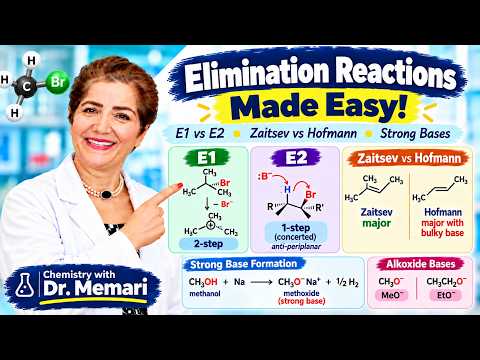
E1 vs E2 Reactions Made Easy! | Zaitsev vs Hofmann, SN1 vs E1 & Strong Bases
 Watch on YouTube →
Overview
The supplied transcript contains only the opening line, so it does not provide enough evidence to reconstruct Dr. Memari’s explanations or the actual chapter timing. The title identifies the intended topics: distinguishing E1 from E2, comparing SN1 with E1, and predicting Zaitsev versus Hofmann products, including the role of strong bases; the outline below is therefore a topic-based guide, not a verified transcript breakdown.
Key takeaways
- The transcript supplied for analysis contains only the 0:01 opening line; detailed claims about the lesson’s examples and explanations cannot be verified.
- The title identifies E1 versus E2, SN1 versus E1, Zaitsev versus Hofmann, and strong bases as the lesson’s central topics.
- In standard mechanism terminology, E1 is stepwise and forms a carbocation, while E2 removes a β-hydrogen and expels the leaving group in one concerted step.
- SN1 and E1 both involve carbocation formation before the product-forming step, though one gives substitution and the other elimination.
- Zaitsev generally describes formation of the more substituted alkene; Hofmann describes a less substituted alkene product favored in certain conditions.
Chapters
0:00
E1 and E2: The Elimination Mechanisms Named in the Opening
- The only supplied timestamped transcript text is the opening at 0:01, which introduces E1 and E2 elimination.
- The transcript does not include the promised step-by-step explanation or any reaction examples.
5:00
E1: A Two-Step Elimination Through a Carbocation
- The title identifies E1 as a topic, but the transcript does not confirm which substrates or conditions Dr. Memari discusses.
- In standard E1 chemistry, the leaving group departs before a base removes a β-hydrogen, forming an alkene through a carbocation intermediate.
10:00
E2: Concerted Elimination and the Strong-Base Connection
- The title explicitly flags strong bases as relevant to the lesson, but gives no named base or worked reaction.
- In standard E2 chemistry, a base removes a β-hydrogen as the leaving group departs in one concerted step.
15:00
E1 Versus E2: Comparing Steps, Conditions, and Intermediates
- The title promises an E1/E2 comparison; the supplied transcript does not reveal the specific comparison criteria used.
- A key general distinction is that E1 proceeds through a carbocation, whereas E2 is concerted and has no carbocation intermediate.
20:00
SN1 and E1: Shared Carbocation Chemistry
- SN1 versus E1 is named in the title, but no nucleophile, solvent, or substrate example appears in the transcript.
- Both standard mechanisms begin with leaving-group departure to form a carbocation; substitution or elimination follows.
25:00
Zaitsev and Hofmann: Predicting the Major Alkene
- The title names both Zaitsev and Hofmann product rules, but the transcript provides no structures or product predictions.
- Generally, Zaitsev elimination favors the more substituted alkene, while Hofmann outcomes favor the less substituted alkene in characteristic conditions.
30:00
Strong Bases and the Missing Worked Examples
- Strong bases are highlighted in the title, but the transcript does not identify a reagent or show how base size affects product selection.
- The supplied text ends after the opening caption, so the remaining lesson and its closing conclusions cannot be verified.
Summary, takeaways, and chapters were generated by AI from the video's transcript and may contain errors. The video belongs to its creator, Chemistry with Dr. Memari.