Dinosaurs with Feathers: The Missing Link to Birds | FULL DOC | SLICE WILD
 Watch on YouTube →
Overview
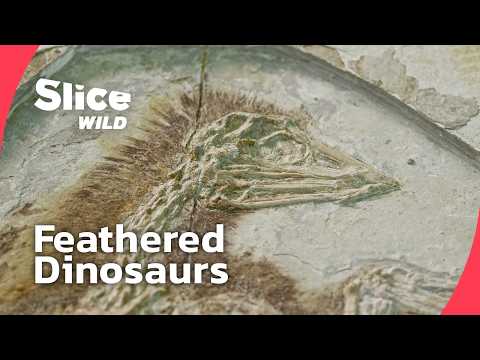
Fossils from Germany, Liaoning in China, and Siberia reveal that feathers evolved among dinosaurs before birds and served functions including insulation, display, and possibly gliding or flight. Finds such as Archaeopteryx, Sinosauropteryx, Microraptor, Anchiornis, and Kulindadromeus—studied using microscopes, tooth-enamel chemistry, and 3D scanning—reshape the timeline of bird origins and suggest feathers may have originated in a common ancestor of carnivorous and herbivorous dinosaurs.
Key takeaways
- Archaeopteryx was not the starting point for feathers: the Jurassic dinosaur Anchiornis lived around 160 million years ago, earlier than Archaeopteryx at roughly 145 million years ago.
- Feathers appeared in dinosaurs that could not fly: Sinosauropteryx had simple body filaments, while Caudipteryx had display-like feathers and was flightless.
- Microraptor’s asymmetrical feathers on both arms and legs support a four-winged gliding stage and make tree-based origins of flight plausible.
- Oxygen-isotope analysis of tooth enamel indicated cold Liaoning winters, helping explain insulation in feathered dinosaurs including the large Yutyrannus.
- Kulindadromeus was a feathered herbivore outside the theropod group, suggesting feathers may have evolved in an ancestor shared by major dinosaur lineages.
Chapters
0:00
Jurassic China: Feathered Dinosaurs Before the First Birds
- The breakup of Pangaea created a temperate peninsula spanning parts of China and Siberia during the Jurassic, 200–145 million years ago.
- Anchiornis, a pigeon-sized dinosaur, was covered in feathers and may have glided short distances to escape predators such as Guanlong.
- Even the roughly 3-meter-long, 50-kilogram Guanlong had feathers, raising questions about their functions beyond flight.
5:00
Volcanic Ash and the Fossil Record of Archaeopteryx
- Fine clay and volcanic ash in Liaoning preserved thousands of fossils, including delicate feather impressions and soft tissues.
- At Solnhofen in Germany, fine-grained limestone preserved Archaeopteryx and other Late Jurassic animals in exceptional detail.
- Paleontologist Eberhard Frey describes the limestone as layered like a book, with fossils preserved between its fine sediment sheets.
10:28
Huxley’s Archaeopteryx: A Dinosaur-Bird Transitional Fossil
- In 1868, Thomas Henry Huxley argued that Archaeopteryx was transitional between reptiles and birds.
- Its teeth, clawed wings, and long bony tail resembled carnivorous dinosaurs, while its feathers and fused collarbones supported flight.
- A specimen found in 2011 revealed a V-shaped tail-feather arrangement and feathers extending along the legs.
- The fossil initiated debate about bird-dinosaur relationships, but the theory lacked broader evidence for more than a century.
16:22
Liaoning’s Sinosauropteryx Reveals Dinosaur Feathers
- Fossil deposits near Sihetun in Liaoning produced Sinosauropteryx, the first widely recognized feathered dinosaur, announced in 1996.
- Xu Xing examined its body-covering filaments, which resembled down rather than the structured feathers of modern birds.
- Microscopic melanosomes preserved in the fossil indicated brown coloring and lighter tail stripes, helping confirm the filaments were protofeathers.
- Sinosauropteryx could not fly; its feathers may have provided insulation or served other functions.
21:32
Tooth Chemistry and Yutyrannus Reveal Cold-Climate Adaptations
- Romain Amiot’s analysis of oxygen in theropod tooth enamel estimated temperatures from water the dinosaurs drank.
- The results suggested Liaoning had a climate similar to northern France, with severe winters and possible snow.
- Yutyrannus, a roughly half-ton relative of Tyrannosaurus, had dense, long feathers despite its large body size.
- The fossils support the idea that feathers helped both small Sinosauropteryx and large Yutyrannus stay warm.
26:43
Caudipteryx Feathers: Display Before Flight
- Caudipteryx fossils from about 125 million years ago preserve large feathers attached to the arms, but the animal was too heavy to fly.
- Its symmetrical feathers let air pass through, unlike the asymmetrical feathers associated with efficient flight.
- Xu Xing and other researchers propose that Caudipteryx feathers may have been used for courtship displays, as in modern birds.
- The animal’s shortened tail supported display feathers, but it lacked the specialized flight feathers needed for powered flight.
31:12
Microraptor’s Four Wings and the Tree-Based Flight Hypothesis
- Microraptor had asymmetrical flight-like feathers on both its arms and legs, producing a distinctive four-winged body plan.
- Its climbing claws suggest it could launch or glide from trees, challenging the older idea that bird flight began with ground-running dinosaurs.
- The four-wing arrangement likely aided gliding but made movement on the ground difficult.
- Xu Xing considers Microraptor an important clue to how feathered dinosaurs experimented with aerial locomotion.
34:00
Confuciusornis Combines Bird Traits with Retained Dinosaur Features
- More than 500 Confuciusornis fossils are held in one museum collection from the Sihetun region.
- This early Cretaceous bird lacked teeth and a long bony tail but retained claws on its wings.
- Its furcula, or wishbone, provided an attachment point for wing muscles; males had elongated ornamental tail feathers.
- A reversed hallux helped it perch, while its wings likely enabled clumsy flapping flight.
38:14
Jurassic Anchiornis Pushes Feathered Dinosaurs Earlier Than Birds
- A 2009 Anchiornis fossil from rocks about 160 million years old predates Archaeopteryx, previously known from roughly 145 million years ago.
- Anchiornis had long feathers on all four limbs and likely used trees as refuge from pterosaurs and ground predators.
- Its rear-leg feathers may have aided gliding, though researchers debate whether they primarily served display or another function.
- Xu Xing used medical scanning and 3D digitization to investigate the animal’s skeleton and flight biomechanics.
43:12
Siberian Kulindadromeus Suggests Feathers Crossed Dinosaur Branches
- At the Kulinda deposit in southeastern Siberia, researchers found dinosaur filaments and scales among fragmented fossils from Jurassic rocks.
- Pascal Godefroit reanalyzed the bones and identified Kulindadromeus as a small, agile herbivore rather than a bird or crocodile.
- Its feathers place plumage on a branch separate from carnivorous theropods, suggesting feathers may have originated in a common ancestor of both groups.
- The shared ancestor could date back to the Triassic, around 220 million years ago, but has not yet been found.
Summary, takeaways, and chapters were generated by AI from the video's transcript and may contain errors. The video belongs to its creator, SLICE Wild.