CSCD 420 Oct 20 2026
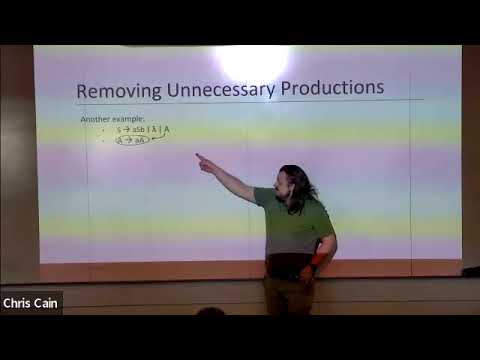 Watch on YouTube →
Overview
Chris Cain connects context-free grammar theory to programming-language syntax, then shows how grammar transformations and normal forms make membership parsing more manageable. The lecture covers useless-production removal, Chomsky Normal Form (CNF), Greibach Normal Form (GNF), and an upcoming dynamic-programming parser that stores which nonterminals can generate each substring.
Key takeaways
- Regular languages are closed under complement, which means a language is regular exactly when its complement is regular; proving one side nonregular also proves the other nonregular.
- A grammar production is useless if it is unreachable from the start symbol or cannot contribute to any terminal string, and dependency graphs help reveal both cases.
- CNF limits productions to A → BC or A → a, and any context-free grammar without lambda productions can be transformed into an equivalent grammar in this form.
- CNF conversion handles terminals in longer right-hand sides by introducing terminal-representing nonterminals, then splits longer nonterminal sequences into binary production chains.
- Dynamic programming avoids repeated parsing work by storing the nonterminals that derive each substring; membership holds when the start symbol derives the full input string.
- The Fibonacci example illustrates why storing repeated subproblem results can replace an exponentially large recursive computation with a linear sequence of calculations.
Chapters
0:00
Assignment Support and Regular-Language Complement Closure
- The pumping lemma assignment is due tomorrow night, and Chris Cain offers help after class and during the afternoons.
- Exam grading is underway, with a goal of reviewing results by Friday.
- Regular languages are closed under complement, so if a language is nonregular, its complement is also nonregular.
- The complement property can transfer a nonregularity proof from primes to composites, subject to the language's exact universe.
2:34
Why Programming-Language Syntax Uses Context-Free Grammars
- Programming-language syntax can be analyzed through grammar productions, much like spoken or written language.
- Brute-force parsing can require worst-case exponential work, motivating restrictions that preserve context-free grammar power.
- Equivalent grammars can look different while generating the same language.
6:00
Grammar Simplification by Lambda Removal and Substitution
- A new start symbol can preserve acceptance of the empty string while allowing lambda productions to be removed.
- The substitution rule replaces a nonterminal in a production with each of that nonterminal's possible right-hand sides.
- Once every occurrence is substituted, the original nonterminal production can be removed without changing the language.
9:30
Finding Useless Productions with Reachability and Termination
- A production is useless if no derivation of any language string uses it, including productions that lead only to infinite loops.
- In the example grammar for aⁿbⁿ, a recursive A production that cannot terminate contributes no accepted strings.
- A nonterminal such as B is unreachable if no path from the start symbol reaches it; a nonterminal such as C is unproductive if it cannot derive terminals.
- A dependency graph with nonterminals as vertices makes unreachable symbols and removable productions easier to identify.
17:15
Introducing Chomsky and Greibach Normal Forms
- Chomsky Normal Form and Greibach Normal Form provide standardized ways to represent context-free grammars.
- A context-free grammar without lambda productions has an equivalent grammar in CNF.
- Normal forms restrict production shapes while retaining the grammar's language, supporting later parsing and automata techniques.
19:40
CNF Rules and Valid Grammar Examples
- CNF permits exactly two nonterminals on a right-hand side, as in A → BC, or one terminal, as in A → a.
- A sample grammar uses S → AB or CD, with separate productions generating each terminal, to accept exactly AB and CD.
- Recursive productions such as S → SA can generate longer strings while still following the CNF production forms.
24:00
Converting Long Productions into Chomsky Normal Form
- Before CNF conversion, remove lambda productions and unit productions such as A → B.
- For terminals appearing in right-hand sides longer than one symbol, create nonterminals such as Tₐ → a and substitute them into those productions.
- Break each right-hand side containing more than two nonterminals into a chain of binary productions using newly introduced nonterminals.
- A rule such as S → ABCDE can be replaced by a sequence of binary rules that preserves the original derivations.
33:00
Working Through a CNF Conversion Example
- The class converts a sample grammar by first replacing terminals inside longer productions with nonterminal representatives.
- Long right-hand sides are then grouped into pairs, with new nonterminals representing blocks such as DC or CD.
- Different binary groupings, such as extracting AD instead of DC, can yield distinct but equivalent CNF grammars.
- The example also highlights that unreachable productions can be removed before conversion, though the conversion procedure does not require that cleanup.
39:00
Greibach Normal Form Starts Every Rule with a Terminal
- GNF productions have the form A → aA₁A₂…Aₖ: one terminal first, followed by zero or more nonterminals.
- This contrasts with the leftmost-nonterminal structure discussed for other grammar forms.
- Cain introduces GNF briefly and postpones its applications to later work on pushdown automata.
42:45
CNF Parsing as Dynamic Programming over Substrings
- The membership question asks whether a query string belongs to the language generated by a grammar; a Java program is one example of a string tested against a grammar.
- For a string W, the planned method records which nonterminals can derive each substring Wᵢⱼ, then checks whether the start symbol derives the entire string.
- Dynamic programming stores solutions to repeated subproblems so later computations use lookups instead of repeating derivations.
- The Fibonacci example contrasts an exponentially expanding recursive calculation with a linear sequence of stored values; the same reuse principle will support grammar parsing.
Summary, takeaways, and chapters were generated by AI from the video's transcript and may contain errors. The video belongs to its creator, Chris Cain.