CSCD 420 Oct 15 2026
 Watch on YouTube →
Overview
Chris Cain reviews regular expressions and context-free grammar construction, emphasizing how to encode exact or bounded symbol counts, inequalities between counts, language operations, and modular string lengths. The class then connects lambda-NFA subset construction with regular grammars, working through exam-oriented methods for handling lambda transitions and converting left- or right-linear productions into automata.
Key takeaways
- Exact symbol counts in regular expressions require excluding that symbol from every wildcard section; otherwise the expression may accidentally admit extra occurrences.
- Optional-symbol positions provide a direct construction for “at most k” occurrences: use k slots, each offering the symbol or λ, with other alphabet symbols between slots.
- A grammar for AⁿBᵐ with n > m can generate matched A/B pairs recursively but must terminate with at least one extra A.
- Language operations can often be simplified before constructing a grammar: L1 ∪ L2 equals L1 when L2 ⊆ L1, and L1 minus the complement of L4 equals L4 when L4 ⊆ L1.
- Lambda-NFA conversion must compute λ-reachable states both when forming the DFA’s initial state and after each consumed input symbol.
- Right-linear grammars translate to NFAs by making nonterminals states and expanding multi-symbol terminal sequences into intermediate states; left-linear grammars require reversing the construction direction.
Chapters
0:00
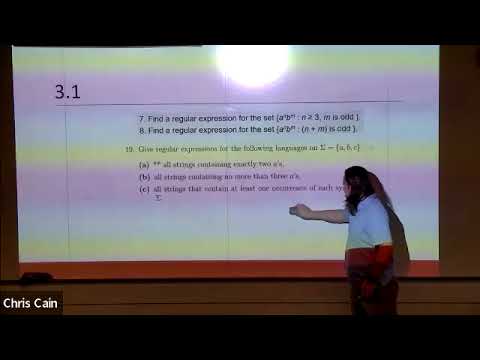
Regular Expressions for Exactly Two A’s
- For strings over {A, B, C} containing exactly two A’s, place two required A symbols in the expression.
- Use arbitrary-length repetitions of B or C before, between, and after those A’s.
- Exclude A from the surrounding repetitions so the expression cannot generate a third A.
2:00
Encoding at Most Three A’s with Optional Symbols
- Build three possible A positions, each written as A or λ, with arbitrary B/C strings between positions.
- Choosing λ in all three positions generates strings with no A’s; choosing one or more A alternatives gives up to three.
- Multiple derivations may generate the same string, but ambiguity does not change the language recognized.
5:00
Requiring A, B, and C in Any Order
- Represent arbitrary substrings over {A, B, C} with the shorthand Σ*.
- Enumerate all six possible first-occurrence orders of A, B, and C, such as A-B-C and C-B-A.
- For each order, concatenate Σ* sections around the required symbols, then union the six expressions.
8:40
Starting the Grammar Practice Set
- Cain gives students time to work through grammar-construction exercises before discussing solutions.
- The problems are general grammars, not necessarily regular grammars, matching the scope of the first assignment.
- The class shifts from regex design to identifying constraints that a grammar must enforce.
18:00
A Grammar for More A’s Than B’s
- For strings in the form AⁿBᵐ with n > m, the grammar must preserve the order of all A’s before all B’s.
- Use recursive productions that add a matched A/B pair while maintaining at least one extra A.
- A separate terminating step must produce at least one A, preventing derivations with equal counts.
23:00
Constructing Star Closure Without Invalid Derivations
- To generate L1*, allow completed L1 strings to repeat by returning to the start of the L1 construction.
- Separate the choice of producing zero repetitions (λ) from the recursive process that generates a valid L1 string.
- Putting λ directly on the count-preserving recursion can incorrectly permit equal numbers of A’s and B’s within a nonempty repetition.
29:00
Simplifying Grammar Union and Complement Expressions
- For L1 ∪ L2, create a new start symbol with alternatives to the start symbols for each language, keeping nonterminal names distinct.
- If L2 is a subset of L1, the union simplifies to L1 and a separate L2 grammar is unnecessary.
- When L4 is a subset of L1, L1 minus the complement of L4 reduces to L4, avoiding a more complicated grammar construction.
35:00
Grammar Rules for Concatenation, Powers, and Modulo Lengths
- For concatenation L1L2, use a new start production that places the L1 grammar’s start symbol before the L2 start symbol.
- For L1³, concatenate three copies of the L1 start symbol in the new start production.
- For strings of A’s whose length is nonzero modulo 3, recurse in groups of three A’s and terminate with either one or two additional A’s.
40:00
Converting a Lambda-NFA by Tracking State Sets
- In subset construction, include every state reachable through λ-transitions without consuming an input symbol.
- A λ-edge from Q0 to final state Q2 makes the DFA start state the set {Q0, Q2}, which is accepting.
- When processing an A, follow A-edges from every state in the current set and include λ-reachable states; missing transitions lead to the trap state.
46:00
Converting Linear Grammars into NFAs
- A right-linear grammar maps nonterminals to states; terminal sequences longer than one symbol are expanded into intermediate states.
- A production with a terminal followed by the same nonterminal creates a labeled self-loop, while a terminating production leads to a final state.
- For a left-linear grammar, reverse the construction direction, beginning from a final state and working back toward the start state.
- A grammar must consistently keep its nonterminal on the right or left to be linear; an inconsistent production is not a regular grammar rule.
Summary, takeaways, and chapters were generated by AI from the video's transcript and may contain errors. The video belongs to its creator, Chris Cain.