CSCD 420 Oct 14 2026
 Watch on YouTube →
Overview
Chris Cain structures the CSCD 420 exam review around practice problems, covering NFA-to-DFA subset construction, DFA minimization with distinguishability tables, and regular-expression design. He clarifies exam expectations—any correct equivalent DFA earns full credit, minimality is required only when requested—and works through parity-based expression patterns before assigning more practice for the next review session.
Key takeaways
- In subset construction, each DFA state represents a set of NFA states, and a subset is accepting exactly when it contains an accepting NFA state.
- The empty subset is a valid DFA trap state: it is nonfinal and loops to itself for every symbol in the alphabet.
- A DFA need not be minimal unless the problem asks for minimality; correctness earns full credit, while a clear process can help earn partial credit.
- The DFA distinguishability table starts by marking pairs with different finality, then propagates marks backward through transitions until a complete pass adds none.
- A pair marked on pass k requires a distinguishing string of length k; for example, Q0 and Q1 become distinguishable on pass two in the reviewed automaton.
- Regular-expression constraints can be translated into patterns: at least three A’s uses a fixed AAA prefix plus A*, while an odd number of B’s uses B(BB)*.
Chapters
0:00
Review Plan and Friday Exam Preparation
- Chris Cain recommends starting the two-day review with practice problems, then using students’ sticking points to guide questions.
- The exam is scheduled for Friday; the current homework is due tonight, and the next assignment is due the following week.
- Office hours after class are available for homework questions and follow-ups on review problems.
1:20
NFA-to-DFA Practice and Mock-Exam Strategy
- The review begins with NFA-to-DFA conversions, including one exam-length problem and a longer, harder exercise for additional practice.
- Cain asks students to treat each problem like an exam question and note where they get stuck so they can ask targeted follow-up questions.
- Drawing the NFA can help organize a conversion, but constructing the DFA directly from the transition descriptions may save exam time.
7:30
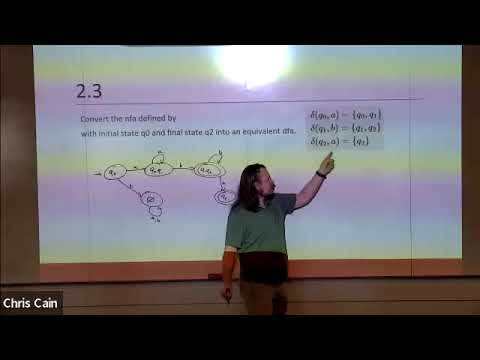
Subset Construction with Q0, Q1, Q2, and a Trap State
- The DFA’s initial state represents the NFA state set reachable without consuming input; with no λ-transitions, the initial subset is {Q0}.
- On A, {Q0} reaches {Q0,Q1}; on B, it reaches the empty set, which becomes a nonfinal trap state looping on every alphabet symbol.
- A DFA subset is final whenever it contains the NFA’s final state Q2; the construction stops once every created state has an outgoing transition for each symbol.
- Unreachable subsets such as {Q1} or {Q0,Q2} need not be added to the DFA.
13:00
DFA Correctness, Minimality, and Exam Credit
- Cain says any DFA that recognizes the correct language earns full credit, even if its construction differs from the method demonstrated.
- A DFA does not have to be minimal unless the problem explicitly requires a minimal DFA.
- When an answer is incorrect, clearly showing the process can support partial credit; a longer NFA-to-DFA exercise is offered for optional practice.
17:00
Building a Minimal DFA Before Proving It
- Students work on a DFA-minimization problem over the alphabet {A,B}, with time to compare their proposed minimal machines.
- Cain notes that a problem with an intuitively predictable minimum can help reveal mistakes in the minimization process.
- A larger exercise is recommended for at-home practice because its state count makes it too lengthy for a typical exam question.
25:19
Distinguishability Table: Pass Zero and Pass One
- On pass zero, mark every pair of states with different finality; pairs sharing final/nonfinal status remain unmarked initially.
- For an unmarked pair, follow both states on each input symbol and consult the table for the destination pair.
- If a destination pair is already distinguishable, mark the original pair on the next pass; for example, Q0 and Q2 separate because A leads to Q1 and Q3.
- Transitions that send both states to the trap state cannot establish distinguishability, though the trap still appears in the DFA table.
31:00
Passes Two and Three Reveal Longer Distinguishing Strings
- The pass number records the length of a string needed to distinguish a pair: Q0 and Q1 become distinguishable on pass two after following A to Q1 and Q2.
- Q0 and Q5 are marked on pass three when their A-transitions lead to the already distinguishable pair Q1 and Q5.
- Continue filling the table until a full pass makes no new marks; pairs left unmarked can be merged in the minimal DFA.
- A linear-looking DFA is not automatically minimal: if its states have identical future acceptance behavior, they may still be merged.
36:00
When a Logical Minimality Argument Can Replace the Table
- Cain says a sound structural argument may establish minimality on homework, but an exam may require the distinguishability table explicitly.
- If the exam specifies a proof method, such as drawing the minimality table, students must follow that instruction.
- The instructor expects exam minimization problems to be shorter than the classroom example while still requiring a genuine proof.
37:26
Regular-Expression Practice and Structural Design
- Students begin a set of regular-expression problems and are encouraged to solve as many as possible before the next class.
- Equivalent expressions are acceptable as long as they describe the required language; a long expression is not inherently wrong.
- Cain emphasizes recognizing language structure and combining cases, while noting that one especially large expression problem is unsuitable for an exam.
46:20
Regular Expressions for Odd Counts and Review Follow-Up
- For strings with at least three A’s followed by an odd number of B’s, the construction uses three required A’s, optional additional A’s, and an odd-B pattern such as B(BB)*.
- The parity discussion for AⁿBᵐ uses even-count blocks such as (AA)* and (BB)*, with a middle A or B to make the combined count odd.
- Cain says exam coverage extends through regular expressions; regular grammars may appear as extra credit or overlap with the next exam.
- Students should review the released slides before tomorrow, identify which problems they can solve, and bring questions; the class ends with problem 19 left for the next session.
Summary, takeaways, and chapters were generated by AI from the video's transcript and may contain errors. The video belongs to its creator, Chris Cain.