CSCD 420 Oct 13 2026
 Watch on YouTube →
Overview
The CSCD 420 lecture develops context-free grammar ambiguity, parse trees, and the challenge of deciding whether a string belongs to a grammar. It shows why brute-force parsing can fail to terminate or grow exponentially, introduces simple grammars with unique nonterminal–terminal pairs as a useful restricted form, and closes by revisiting how ambiguous grammars can yield multiple parse trees.
Key takeaways
- Leftmost and rightmost derivations prescribe which nonterminal to expand next, but neither guarantees that a grammar has only one derivation for each string.
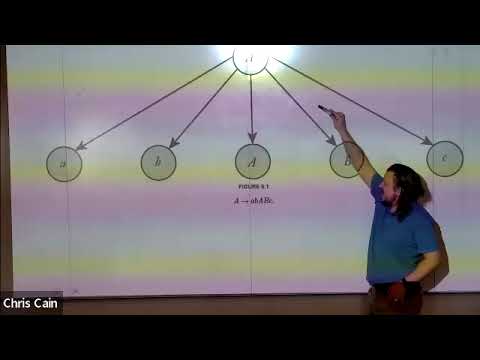
- A parse tree records which productions were used but not their application order; reading terminal leaves left to right recovers the generated string.
- Unrestricted brute-force parsing may run forever on strings outside the language when productions can erase symbols, such as a nonterminal deriving λ.
- Even with a derivation-depth bound, branching over production choices makes brute-force parsing exponential in input length and unusable for ordinary programs with hundreds of tokens.
- A simple grammar uses productions A → aB₁…Bₖ and permits each nonterminal–initial-terminal pair at most once, enabling more efficient parsing techniques.
- Programming-language ambiguity can cause a single source string to have distinct parse trees and interpretations, so compiler grammars must be designed or rewritten to provide a unique parse.
Chapters
0:00
Homework, AI Disclosure, and Friday’s Exam
- Homework 1 grades were available, while Homework 2 was being graded and expected back before the exam.
- Two class sessions—Wednesday and Thursday—were reserved for review before Friday’s exam.
- Homework 3 was due the following night; students using AI were required to submit disclosures and prompt histories.
2:57
Leftmost and Rightmost Derivations Do Not Guarantee Unambiguity
- A leftmost derivation always replaces the leftmost nonterminal; a rightmost derivation always replaces the rightmost one.
- The class traces derivations of the string “abb” and identifies multiple production paths in the example grammar.
- Fixing derivation order does not remove grammar ambiguity: a string may still have multiple leftmost derivations or multiple rightmost derivations.
9:16
Parse Trees Encode Productions and Generate Strings
- Each parse-tree node is a nonterminal expanded into the symbols on the right-hand side of one grammar production.
- A completed tree has terminals at its leaves; the empty string, λ, can also appear as a leaf.
- Reading terminal leaves from left to right produces the represented string, using a depth-first traversal that visits children in order.
16:55
Parsing Asks Whether a String Belongs to a Grammar
- A compiler’s parsing stage must decide whether an input program string can be derived from the grammar.
- One direct approach is to generate possible derivations and check whether any produces the query string.
- Generating every possible leftmost derivation provides a brute-force starting point, but requires a principled way to reject impossible branches.
18:40
Brute-Force Parsing Can Fail to Terminate
- If a target string is not in the language, unrestricted derivation search may never establish that fact.
- Productions such as a nonterminal deriving λ can shrink a partial derivation, so derivation depth does not provide a reliable stopping bound.
- The search can be pruned when a partial derivation cannot produce the target, but this does not solve the general termination problem.
23:34
Derivation Bounds Still Leave Exponential Parsing Cost
- The lecture proposes excluding nonterminal-to-λ and nonterminal-to-nonterminal productions so every production yields at least one terminal.
- With that restriction, the lecture gives a bound of at most twice the query-string length on leftmost derivation steps, allowing a negative answer eventually.
- Branching over productions at each step still creates exponential work; even a 500-token program makes brute-force search computationally infeasible.
28:53
Simple Grammars Restrict Productions for Efficient Parsing
- A simple grammar production has the form A → aB₁…Bₖ: exactly one terminal followed by zero or more nonterminals.
- Each pair consisting of a left-side nonterminal and its first terminal may occur at most once in the grammar.
- The restriction gives each production a predictable terminal contribution and supports more efficient parsing rules for common programming-language constructs.
36:34
Multiple Parse Trees Reveal Grammar Ambiguity
- A grammar is ambiguous if at least one string has multiple distinct parse trees, not merely different orders of applying the same productions.
- Productions involving S → SS and S → λ can create arbitrarily many derivations of the same string, making the example infinitely ambiguous.
- Ambiguity is common in natural language but problematic for programming-language syntax; the lecture previews rewriting an ambiguous grammar to remove ambiguity.
Summary, takeaways, and chapters were generated by AI from the video's transcript and may contain errors. The video belongs to its creator, Chris Cain.