CS2050 L10 Metamathematics
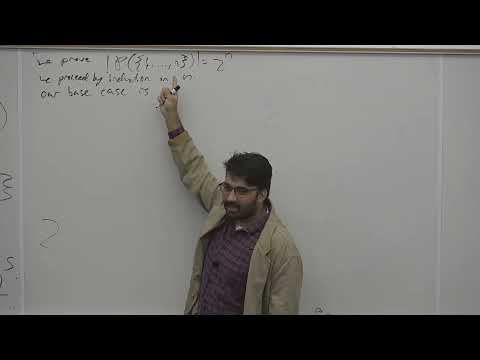 Watch on YouTube →
Overview
Abrahim Ladha connects finite set cardinality, power sets, and induction to the foundations of mathematics, showing how the well-ordering principle justifies induction and how set theory can encode the natural numbers. He builds the von Neumann naturals from the empty set using the successor rule n ∪ {n}, then derives recursive addition and multiplication from axioms rather than relying on numerical intuition.
Key takeaways
- For a finite set S, |P(S)| = 2^|S| because every element independently has two membership choices; induction formalizes the doubling that occurs whenever one element is added.
- The well-ordering principle proves induction by ruling out a least counterexample: its predecessor must satisfy the predicate, so the induction step contradicts the counterexample.
- Von Neumann naturals encode 0 as ∅ and define S(n) = n ∪ {n}; each natural is the set of all earlier naturals, making its cardinality equal to its ordinal value.
- Recursive definitions derive arithmetic from zero and successor: a + 0 = a, a + S(b) = S(a + b), and a × S(b) = (a × b) + a.
- A model such as a rock–paper–scissors successor cycle illustrates how omitting a Peano condition can admit structures that satisfy some numerical rules but are not the natural numbers.
Chapters
0:00
Finite Cardinality and the Inclusion–Exclusion Principle
- For finite sets, A ⊆ B implies |A| ≤ |B|, and |A ∩ B| cannot exceed |A|.
- The union formula is |A ∪ B| = |A| + |B| − |A ∩ B|.
- The dot-counting argument explains why the overlap must be subtracted once; the formula is not applied to infinite sets here.
4:35
Power Sets and Their Elements
- The power set P(S) contains every subset of S, including ∅ and S itself.
- For S = {1, 2}, P(S) has four elements: ∅, {1}, {2}, and {1, 2}.
- P(∅) = {∅}, a one-element set distinct from the empty set; P(ℕ) also includes infinite subsets such as the evens and primes.
8:00
Why a Set of n Elements Has 2ⁿ Subsets
- The finite power-set formula is |P(S)| = 2^|S|; each element can independently be included or excluded from a subset.
- Ladha proves the formula by induction, beginning with |P(∅)| = 1 = 2⁰.
- For the inductive step, subsets of a k+1-element set split into those containing the new element and those not containing it; both groups correspond in size to P of the first k elements.
- Thus each added element doubles the number of subsets, yielding 2^k + 2^k = 2^(k+1).
15:00
The Well-Ordering Principle as a Foundation for Induction
- Induction asserts that P(0) and P(k) ⇒ P(k+1) for every natural k together imply P(n) for all naturals n.
- The well-ordering principle states that every nonempty subset of ℕ has a least element.
- A set is well-ordered only when every subset has a least element; the nonnegative reals fail this test because subsets can have no minimum.
- Ladha presents induction and well-ordering for ℕ as equivalent principles, with well-ordering used to justify induction.
22:00
Proving Induction by Choosing the Least Counterexample
- Assume P(0) and P(k) ⇒ P(k+1), but suppose P fails for at least one natural; collect all counterexamples into a nonempty set S.
- By well-ordering, S has a least element L; since P(0) is true, L is not zero.
- P(L−1) must be true, or L−1 would be an earlier member of S.
- The induction step then gives P(L), contradicting that L is a counterexample; therefore P holds for every natural.
28:40
Why Mathematics Uses Set Theory as a Common Foundation
- Ladha contrasts mathematical objects such as circles, functions, numbers, and vector spaces with set theory as a proposed shared foundation.
- Mathematical objects are conceptual rather than material, while precise definitions let people reason about them unambiguously.
- The foundational program aims to encode structures such as numbers and functions using sets, so their properties can be derived within one framework.
- The discussion distinguishes an object’s formal relations from informal interpretations, such as describing a circle as a familiar round shape.
33:40
Set-Theoretic Axioms and the ZFC Framework
- In a pure set theory, sets contain only sets; membership is the basic relation, rather than a separate primitive notion of numbers or geometric objects.
- Extensionality identifies sets with the same members, while comprehension-style principles describe forming sets by predicates; standard ZFC restricts comprehension through separation schemas.
- Other ZFC axioms include pairing and union, and the axiom of foundation rules out infinitely descending membership chains.
- Axioms are kept precise and minimal to constrain problematic constructions without introducing unnecessary assumptions.
38:00
Constructing Zero and the Successor Operation
- The natural numbers can be characterized using a starting element, zero, and a successor operation that maps each natural to the next.
- Set theory supplies zero as the empty set, ∅.
- The construction must avoid circular reasoning: numbers cannot be assumed while proving that numbers can be built from sets.
- Ladha identifies reference—naming or describing an object—as a resource available before numerical notions are established.
42:40
Building the Von Neumann Naturals from the Empty Set
- The construction represents 0 as ∅ and 1 as {∅}; each natural is represented by a set of its predecessors.
- The resulting sequence begins 0 = ∅, 1 = {∅}, 2 = {∅, {∅}}, and continues by adding the previous ordinal.
- For any set n representing a natural, define its successor as n ∪ {n}; this adds n as one new member.
- This construction uses sets and references alone, without presuming numbers or addition already exist.
48:30
Ordinals Encode Natural-Number Equality and Order
- The von Neumann ordinal for n has exactly n elements, so its finite cardinality matches the number it represents.
- Equality of natural numbers can be defined as equality of their representing sets, relying on set extensionality.
- The successor construction gathers the earlier ordinals and adds a new one, giving a set-theoretic account of the natural ordering.
- These representations let set-theoretic membership and equality express familiar numerical relations.
53:20
Peano Axioms and the Need for Each Successor Rule
- The natural-number axioms include existence of zero, equality properties, closure under equality, injectivity of successor, and the induction principle.
- Two further structural requirements are that zero is not a successor and that every natural’s successor is also natural.
- Ladha argues that equality properties follow from extensionality, while the remaining properties can be established from the set construction and other set-theoretic axioms.
- A model with rock, paper, and scissors in a successor cycle shows why a rule excluding zero as a successor matters: without it, a finite cycle can mimic some successor properties.
1:03:30
Formal Proofs Separate Axioms from Intuition
- Ladha distinguishes a mathematical object’s formal definition from an interpretation such as saying that one represents a quantity of one.
- A proof must follow from stated axioms rather than visual intuition; geometric intuition, for example, must be captured by geometric axioms.
- The successor rule is formally defined in set-theoretic terms, while interpreting it as “plus one” is an additional informal reading.
1:06:00
Recursive Addition and an Inductive Associativity Proof
- Addition is defined recursively on the second operand: a + 0 = a and a + S(b) = S(a + b).
- With 1 defined as S(0), the identity S(a) = a + 1 follows by applying the addition rules.
- Associativity, (a + b) + c = a + (b + c), is proved by induction on c.
- The base case uses a + 0 = a; the inductive step applies the successor rule and the induction hypothesis to transform both sides.
1:11:00
Recursive Multiplication Completes the Arithmetic Construction
- Multiplication is defined recursively with a × 0 = 0 and a × S(b) = (a × b) + a.
- The successor case reflects repeated addition while using the previously defined addition operation.
- Ladha notes that commutativity of addition and multiplication can also be proved from the axioms, though each proof requires substantial inductive work.
- The construction builds arithmetic step by step from set-theoretic definitions rather than presupposing familiar numerical operations.
Summary, takeaways, and chapters were generated by AI from the video's transcript and may contain errors. The video belongs to its creator, Abrahim Ladha.