CS110A Week 10 Day 1 lesson on 10/20/2026
 Watch on YouTube →
Overview
Indika Walimuni works through a clock-face programming problem, deriving the minute-hand angle as 12 × (α mod 30), then demonstrates the formula with several inputs and stresses testing whether a solution generalizes. The lesson also surveys Lawrence Livermore National Laboratory internships, SQL and Jupyter notebooks, image compression and raster-versus-vector graphics, before outlining upcoming Python modules and ways to catch up on coursework.
Key takeaways
- For an hour-hand angle α measured from midnight, the minute-hand angle since the current hour began is 12 × (α mod 30) degrees.
- Clock geometry supplies the conversion factor: the hour hand moves 30° per hour while the minute hand moves 360°, so the minute hand moves 12° per degree of hour-hand movement.
- A working example is not enough to establish a general solution: test multiple inputs, including exact hour marks and intermediate angles, and check the full valid input range.
- Jupyter notebooks combine executable Python, plots, and written analysis, making them useful for creating reproducible data reports.
- Raster images use a finite pixel grid and can pixelate when enlarged; vector graphics recalculate shapes from mathematical descriptions but are less suited to complex imagery.
- Students can approach overdue coursework by getting help from tutors and completing one problem in a focused 30-minute session rather than postponing everything until the semester's final week.
Chapters
- The problem gives α, the hour hand's angle measured from midnight, as its input.
- The required output is the minute hand's angle turned since the start of the current hour.
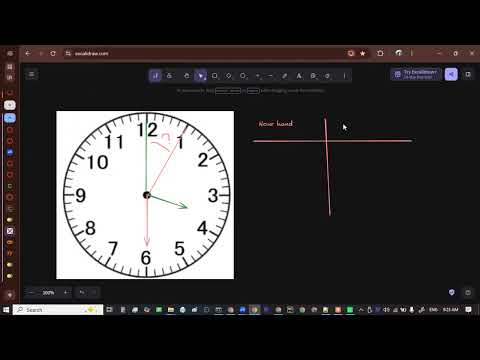
- Indika Walimuni recommends drawing a clock face to make the relationships easier to reason through.
- At 3:00, the hour hand has moved 90° clockwise from midnight, while the minute hand is at 12.
- At 3:30, the hour hand lies halfway between the 3 and 4 marks, illustrating why a diagram helps.
- A clock face has 12 equal hour intervals, so each interval represents 360° ÷ 12 = 30°.
- The hour hand moves 30° in one hour, while the minute hand completes 360° in that time.
- The minute hand therefore moves 12° for every 1° of hour-hand movement.
- Because the movement ratio is constant, a residual hour-hand angle β corresponds to 12β degrees of minute-hand movement.
- For the 3:30 example, α is 105°: 90° to reach 3 o'clock plus 15° beyond it.
- Computing 105 modulo 30 gives a remainder of 15°, the hour hand's position within the current 30° interval.
- The remainder operator isolates the angle left after counting complete 30° hour intervals.
- The problem asks for minute-hand movement since the current hour began, so the desired result uses the minute hand's full turn from 12.
- For α = 105°, the residual hour-hand angle is 15°; multiplying by 12 gives a 180° minute-hand angle.
- The corrected interpretation matches the 3:30 clock position, where the minute hand points to 6.
- The function first finds the hour-hand remainder with α modulo 30.
- It returns 12 × (α modulo 30), converting the remainder into the minute-hand angle.
- Walimuni emphasizes that a short implementation still requires working through the geometry and documenting the general rule.
- For α = 120°, corresponding to 4:00, the remainder is 0 and the minute-hand angle is 0°.
- For α = 115°, the remainder is 25° and the formula returns 300°.
- Walimuni advises checking at least three inputs and asking whether the method works across the entire allowed input range.
- Walimuni presents academic internships as an accessible alternative to highly competitive industry internships.
- He estimates that applying to five or six academic programs can offer better odds than applying to large technology companies, where he describes the competition as roughly one in 300.
- He mentions a planned Research Internship Club that would connect students with principal investigators through Zoom.
- A Lawrence Livermore National Laboratory segment describes more than 700 interns working across engineering, physics, operations, and business.
- Interns discuss learning alongside scientists, exploring fields such as cybersecurity and software development, and gaining mentors and career connections.
- The segment presents research internships as opportunities to discover work beyond students' initial assumptions about national laboratories.
- SQL means Structured Query Language, and database products implement different versions of the standard.
- Examples discussed include MySQL, SQLite, Oracle Database, Microsoft Access, and PostgreSQL.
- Walimuni recommends CS 160, Database Management Systems, for studying SQL and nonrelational databases such as MongoDB.
- SQL basics and introductory data science are presented as conceptual material students can review independently.
- After learning Python types and lists, students will use California population data for a plotting exercise.
- The planned exercise uses template Python code that students modify and submit, demonstrating data analysis without relying on Excel.
- Google Colab is described as Google's implementation of the Jupyter notebook environment, also associated with the name IPython Notebook.
- A notebook can combine Python code, visualized plots, and written explanations in one document.
- Walimuni recommends installing Python and Jupyter locally, pointing students to installation instructions from week four.
- Motion pictures create the appearance of movement by displaying a sequence of still images quickly.
- Raster formats such as JPEG and PNG store image information on a two-dimensional pixel grid.
- At sufficient zoom, raster images reveal individual square pixels, a visible effect of their finite resolution.
- The lesson identifies bitmap images as uncompressed and contrasts them with compressed formats such as PNG, GIF, JPEG, and TIFF.
- Huffman coding and LZW are cited as lossless techniques, while JPEG can use lossy compression.
- One simplified lossy example removes low-order pixel-value information and estimates it during decompression, producing a small difference that may be difficult to notice.
- An RGB pixel has red, green, and blue component values in the range 0 to 255.
- Reducing stored precision can shrink an image, but decompression cannot recover information that lossy compression discarded.
- Walimuni distinguishes compression artifacts from raster pixelation, which occurs when zooming exposes the grid's limited resolution.
- Vector graphics encode shapes through mathematical descriptions and can redraw them at different scales without the same pixel-grid limitation as raster images.
- The lesson names nearest-neighbor, linear, and quadratic interpolation as methods that estimate pixels when enlarging raster images.
- Vector formats are well suited to scalable graphics but are less convenient for representing highly complex images.
- The remaining technical topics include Python types, if/else branching, loops, and the second functions module; later internet, security, and AI material is described as conceptual.
- Walimuni warns students not to postpone submissions until the semester's final week and recommends completing one problem at a time.
- Students are encouraged to spend 30 minutes with tutors Cody or Jolian after class and can submit a recorded presentation if useful.
- Walimuni introduces a minimum-index problem as the next exercise and says it is easier than the clock-face problem.
- The clock-face exercise is described as a useful match for the upcoming type lesson.
- He says he needs to adjust the new problem's due date before students work on it.
Transcript excerpt
0:00 Good morning guys. Yeah. So this is our agenda today. Okay. So going to go to the uh clock face problem. Um so let's take a look. All right. Um, let me open that page. Okay. So, here's the problem. Okay.
0:54 Um, so let me actually copy paste this. Okay. Um so so what is the input here? So let's start with that and I'm going to go draw a diagram. Okay. Input. What is input?
1:48 Yeah. The alpha, right? So alpha is the input. Okay. And then in this particular one, it doesn't say like there's no um there's no vocabulary like word identifying like there's no word like J right provider right it just state that but you know it's you you by experience now you should be able to know okay so it's something given to us right so it says that right so but there's no particular word like given or provide or thing but it's say okay so this that is known as alpha right so that's an input so there's a good chance that's an input and in fact it is an input okay so alpha is one all right so um what is output basically we want to find the minute
2:39 angle right right so the meat angle um yeah all All right. What is it? >> The clock. >> Yeah, the clock problem. We are solving that. Yeah. Okay. All right. Um Okay. So, um one one thing we can we can do in here is like we have to uh we have to um do a um good workout. I mean this is a problem that really complete but really concise as well. So you you got to actually work out and in fact I recommend draw the clock face and then
This is the start of the transcript. Save this video free for the whole transcript, searchable and time-coded.
Related notes
Summary, takeaways, and chapters were generated by AI from the video's transcript and may contain errors. The video belongs to its creator, indika walimuni.