CS 238 Week 9 Lecture
 Watch on YouTube →
Overview
James Andro-Vasko introduces recursion in Python as a function calling itself with a changing parameter until it reaches a base case, then returning results through the call stack. Using factorials and lists, he compares recursive solutions with loops and demonstrates Python’s default recursion limit of 1,000, including how `sys.setrecursionlimit` can raise it.
Key takeaways
- Every recursive function needs a base case and a recursive step that changes its input toward that case; without either, calls can continue until Python reports a recursion-depth error.
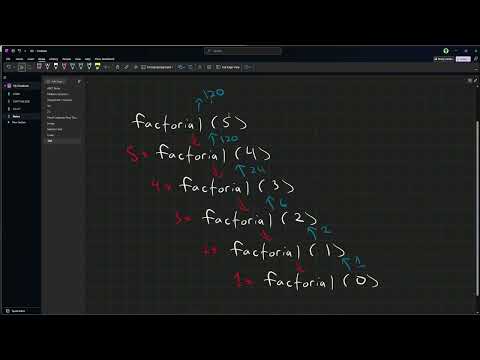
- In recursive factorial, calls descend from factorial(5) to factorial(0), then unwind to calculate 5 × 4 × 3 × 2 × 1 = 120.
- Python’s default recursion limit is 1,000, and `sys.getrecursionlimit()` and `sys.setrecursionlimit()` inspect and adjust that limit.
- Recursive list summation combines the current element with the sum of the remaining elements, using 0 as the sum of an empty remainder.
- Recursive list construction can generate a range by prepending each current value to the recursively constructed remainder, stopping when the counter equals the endpoint.
Chapters
0:00
Recursion Basics and Iterative Factorial
- Recursion uses a function that calls itself to perform repetition, and is useful for tree and graph traversal, maze paths, and backtracking.
- The iterative factorial function multiplies values from 1 through n; for 5!, the loop returns 120.
- The factorial definition uses 0! = 1 as its stopping point.
3:23
Recursive Factorial and the Call Stack
- The recursive rule computes n! as n multiplied by (n - 1)!, reducing the input toward the base case.
- For factorial(5), calls descend through 5, 4, 3, 2, 1, and 0, then return upward to produce 120.
- Each function call waits for its recursive result before multiplying by its own n.
10:23
Recursion Errors and Python’s 1,000-Call Limit
- A recursive call that repeats the same input, such as factorial(n) calling factorial(n), never approaches a base case and triggers a recursion-depth error.
- Omitting the base case also causes calls to continue until Python raises a maximum recursion depth error.
- Python’s default recursion limit is 1,000; `sys.getrecursionlimit()` checks it, and `sys.setrecursionlimit(1100)` allows the factorial of 1,050 to run in the demonstrated example.
14:15
Recursive List Sum and List Construction
- A recursive `list_sum` function uses an index as a counter, adds the current element to the sum from index + 1, and returns 0 when the index is out of bounds.
- Applying `list_sum` to [3, 2, 1, 6, 5] returns 17.
- A recursive list constructor returns an empty list when its counter reaches n; otherwise, it prepends the current value to the list built from the next value.
- Calling the constructor with 0 and 10 builds [0, 1, 2, 3, 4, 5, 6, 7, 8, 9], while starting at 5 builds [5, 6, 7, 8, 9].
Summary, takeaways, and chapters were generated by AI from the video's transcript and may contain errors. The video belongs to its creator, James Andro-Vasko.