CPBS 7620 - Lecture 18 - Convex Optimization
 Watch on YouTube →
Overview
Nicholas Dwork introduces convex sets, convex functions, and convex optimization, then explains disciplined convex programming (DCP) as a rule-based way to build problems that solvers can verify and solve. He demonstrates CVX and CVXPY workflows, including status checks, a LASSO objective, and reformulations that make otherwise unrecognized or nonconvex-looking expressions DCP-compliant.
Key takeaways
- A convex optimization problem combines a convex objective with convex inequality constraints and affine equalities, so every local minimum is also a global minimum.
- The epigraph criterion connects function convexity to set convexity: a function is convex exactly when the region above its graph is a convex set.
- DCP rules let CVXPY verify convexity compositionally, but an equivalent expression may be accepted or rejected depending on whether it uses recognized atoms.
- The expression sqrt(1 + z^2) is not recognized directly in the example, but rewriting it as the norm of [1, z] makes its convex structure recognizable to DCP.
- Algebraic substitutions can expose convex structure: for positive x and y, xy ≥ 4 is equivalent to 4/x ≤ y.
- Introducing t as a reciprocal denominator and variables y₁ = tx₁ and y₂ = tx₂ can linearize a fractional objective and convert its constraints into a DCP-compliant form.
Chapters
0:00
Convex Sets, Functions, and Optimization Problem Definitions
- A set is convex when every line segment between two of its points stays inside it; intersections of any number of convex sets remain convex.
- A function is convex when its epigraph, the set of points above its graph, is convex; sums, pointwise maxima, and positive scalar multiples preserve convexity.
- Dwork defines convex optimization using a convex objective, convex inequality constraints, and affine equalities, then distinguishes the feasible set from the optimal set.
- Examples include the squared L2 residual plus an L1 penalty used in LASSO, and the perspective and indicator-function constructions.
5:18
DCP Composition Rules and CVXPY Solver Workflows
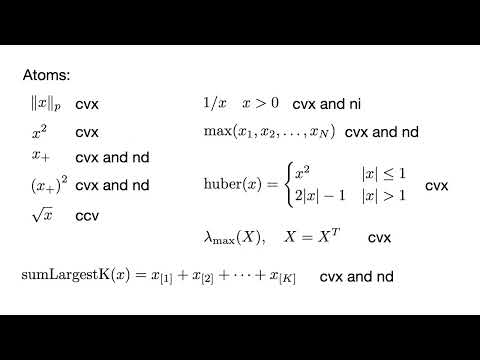
- Disciplined convex programming builds problems from recognized function atoms using composition rules, and Dwork identifies CVX for MATLAB and CVXPY for Python as implementations.
- For convex outer function H, composition with affine G is convex; composition also works when H is nonincreasing and G concave, or H is nondecreasing and G convex.
- In CVXPY, minimizing (x - 3)^2 subject to x ≥ 5 returns the optimal point x = 5 and objective value 4.
- CVXPY reports optimal, optimal inaccurate, infeasible, or unbounded; DCP recognition is sufficient but not necessary, as sqrt(1 + z^2) is accepted when rewritten as the norm of [1, z].
9:58
Reformulating LASSO and Difficult Constraints for CVXPY
- The LASSO example minimizes a squared L2 residual plus λ times an L1 norm, and a loop can solve the problem repeatedly for different λ values.
- For positive x and y, the constraint xy ≥ 4 can be rewritten as 4/x ≤ y; the inverse-positive function is a recognized convex atom in CVXPY.
- A fractional objective can be made linear by introducing t as the reciprocal of its denominator and substituting y₁ = tx₁ and y₂ = tx₂.
- The substitutions transform the original constraints into convex inequalities and an affine equality involving t, y₁, and y₂, producing a DCP-compliant problem.
Summary, takeaways, and chapters were generated by AI from the video's transcript and may contain errors. The video belongs to its creator, Nicholas Dwork.