CPBS 7620 - Lecture 16 - Differential Equations
 Watch on YouTube →
Overview
Nicholas Dwork introduces ordinary differential equations (ODEs) and numerical methods for solving them, using a rainwater basin with initial height h(0) = 1 to illustrate time-stepping. He compares forward and backward Euler, central differences and leapfrog, then develops RK2 and RK4 as more accurate methods that trade additional function evaluations for improved estimates. Finally, he shows how to rewrite a higher-order ODE as a first-order system by collecting the unknown function and its derivatives into a vector.
Key takeaways
- Forward Euler advances an ODE solution using the derivative at the current point, while backward Euler depends on the next point and may require solving an implicit equation.
- Backward Euler can remain close to an exact solution in a case where forward Euler becomes unstable, illustrating that solver stability can matter more than update simplicity.
- Central differences can give a better derivative estimate than one-sided differences, but the leapfrog update needs two prior time values and can develop divergent oscillations.
- RK2 estimates the slope at a half-step and uses it for the full update, requiring two evaluations of F while basing the next result on the current state.
- RK4 combines four slope estimates—one at the start, two at the midpoint, and one at the endpoint—for a more accurate update at the cost of three additional evaluations of F compared with forward Euler.
- An nth-order ODE can be converted into a first-order vector system by making the function and its first n − 1 derivatives the components of the state.
Chapters
0:00
ODEs, the Rainwater Basin, and Euler Time-Stepping
- An ODE contains derivatives; solving one means finding a function that satisfies the equation, either in closed form or numerically.
- A retention basin's water height changes with rainfall inflow and drain outflow; the example starts from h(0) = 1.
- Forward Euler approximates the derivative with a forward difference and uses the current height and time step Δt to calculate the next height.
- Backward Euler uses a backward difference, making the next height appear on both sides of the update; the example can be rearranged as a quadratic using z = √hₙ₊₁.
4:44
Difference Accuracy, Leapfrog, and Runge–Kutta Methods
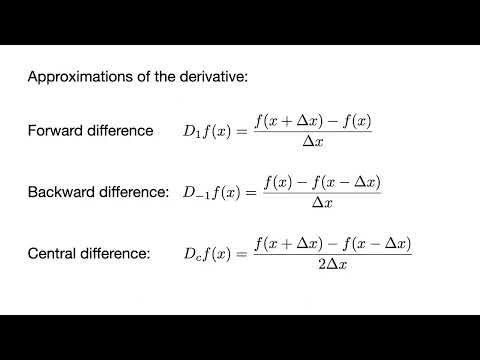
- Forward, backward, and central differences approximate derivatives; for a twice-differentiable function whose second derivative changes slowly, central difference is more accurate.
- Leapfrog applies a central-difference estimate but needs two previous values, h(t) and h(t − Δt); their oscillations can diverge, making the method unsuitable in some cases.
- RK2 takes a half-step with forward Euler, evaluates F at the estimated midpoint, and uses that slope for a full update based only on the current point.
- RK4 estimates slopes at the beginning, twice at the midpoint, and at the endpoint, then combines the four slopes in a weighted average; it uses three more F evaluations per update than forward Euler.
8:17
Turning Higher-Order ODEs into First-Order Systems
- Forward Euler, backward Euler, and Runge–Kutta methods are presented for first-order equations of the form y′(t) = f(t, y(t)).
- For an nth-order ODE, define x₁ = y, x₂ = y′, and continue through xₙ = y⁽ⁿ⁻¹⁾.
- Stack x₁ through xₙ into a vector X; the resulting equation for X′(t) is a first-order system that can be solved with the methods already described.
- The derivative of the vector-valued state X is treated as a Fréchet derivative.
Summary, takeaways, and chapters were generated by AI from the video's transcript and may contain errors. The video belongs to its creator, Nicholas Dwork.