"Class Follow Up", BIO105 Introductory Biology, David Champlin, USM
 Watch on YouTube →
Overview
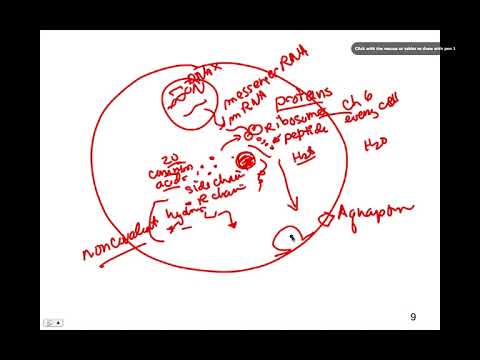
David Champlin reviews eukaryotic protein synthesis: DNA is transcribed into messenger RNA, ribosomes use that code to join 20 common amino acids, and chemical interactions guide each chain to fold into a functional shape. He follows four examples—aquaporin, insulin, a lysosomal proton pump, and hemoglobin—to show how signal sequences route some proteins through the rough ER and Golgi while others remain in the cytoplasm, and connects failed protein function or delivery to disease.
Key takeaways
- Messenger RNA carries a gene's protein-coding information from the nucleus to ribosomes, where amino acids are joined into a chain by peptide bonds.
- A protein's amino-acid sequence shapes its folding and function because side chains have different chemical properties, including hydrophobicity, hydrophilicity, and charge.
- Signal sequences can direct newly made proteins to the rough ER, after which the Golgi and transport vesicles help deliver them to the cell surface or lysosome.
- Aquaporin, secreted insulin, and the lysosomal proton pump share a trafficking route, but their destinations and roles differ: membrane transport, extracellular signaling, and lysosome acidification.
- Protein-related disease can result from faulty delivery as well as faulty protein activity; Champlin uses cystic fibrosis and lysosomal storage diseases to illustrate both kinds of disruption.
- Hemoglobin is synthesized directly for the cytoplasm because its RNA lacks the signal sequence that would target translation to the rough ER.
Chapters
0:00
DNA-to-Protein Synthesis and Folding from 20 Amino Acids
- In a eukaryotic cell, DNA genes are copied into messenger RNA, which exits the nucleus and serves as a template for ribosomes.
- Ribosomes join 20 common amino acids by forming peptide bonds; the order of amino acids, including their distinct side-chain chemistry, determines protein properties.
- Flexible protein chains fold spontaneously through noncovalent interactions in a watery environment, often placing hydrophobic amino acids inside and hydrophilic ones outside.
4:20
Rough ER and Golgi Route Aquaporin, Insulin, and Lysosomal Pumps
- Aquaporin becomes a cell-membrane protein, while insulin enters the rough ER lumen and is later released outside the cell by exocytosis.
- A signal sequence redirects a ribosome to the rough ER; vesicles then carry proteins through the Golgi complex for modification and onward delivery.
- The lysosomal proton pump follows this ER-to-Golgi route and is delivered to the lysosome, where it moves hydrogen ions into the lumen to create a low-pH environment.
8:15
Protein Delivery Errors, Lysosomal Disease, and Cytoplasmic Hemoglobin
- Champlin describes lysosomal storage diseases as disorders in which impaired lysosomal breakdown can cause material to accumulate; defects may affect the proton pump or proteins responsible for trafficking.
- Some cystic fibrosis mutations affect the cell-surface ion channel itself, while others disrupt delivery of the protein to the membrane.
- Hemoglobin illustrates the contrasting pathway: without an ER-targeting signal sequence, ribosomes synthesize it for release into the cytoplasm.
Summary, takeaways, and chapters were generated by AI from the video's transcript and may contain errors. The video belongs to its creator, The New Evolution for Everyone.