CHEM 119 Fall 2026 - Chapter 7 (10142026)
 Watch on YouTube →
Overview
Alicia Altemose connects Bohr-model energy transitions to emitted and absorbed photon wavelengths, then introduces de Broglie matter waves, electron probability, and quantum numbers. She shows how to compare transition energies and wavelengths, explains why the Rydberg equation applies to hydrogen-like one-electron systems, and uses electron microscopy and a baseball calculation to illustrate when particle wavelengths matter.
Key takeaways
- Emission is a downward electron transition, and the photon with the longest wavelength comes from the smallest energy drop because photon energy and wavelength are inversely related.
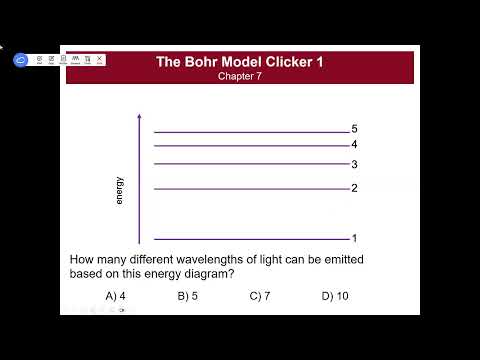
- A five-level Bohr diagram contains 10 possible downward transitions, each producing a distinct photon wavelength even when some lines are outside visible light.
- The Rydberg equation is restricted to one-electron systems such as hydrogen and He⁺; for a transition between nonadjacent levels, subtract energies rather than wavelengths.
- The de Broglie wavelength λ = h/(mv) makes electron waves relevant at atomic scales: an electron at 9.38 × 10⁶ m/s has a wavelength near 7.76 × 10⁻¹¹ m.
- A baseball's matter-wave wavelength is roughly 10⁻³⁵ m, while electron position and momentum have fundamental simultaneous uncertainty that is important for light particles.
- Orbitals describe probability distributions rather than exact electron paths; n indicates shell size and energy, while l distinguishes shapes such as s, p, and d.
Chapters
0:00
Exam 2 Scope, Study Resources, and Course Updates
- Exam 2 covers Chapter 4, Chapter 7, and as much of Chapter 8 as the class reaches; Chapter 4 stoichiometry and solution concentration remain useful beyond Exam 1.
- A mock exam and practice quiz are due to be posted on Canvas, and the Exam 2 preview page lists learning objectives, formulas, and constants.
- The posted midterm grade reflects lecture but does not yet include the lab grade; Exam 1 reflection extra credit is a Canvas participation quiz.
5:57
Bohr Model: Why Energy Levels Converge
- In the Bohr model, electrons farther from the positively charged nucleus feel less attraction, so less additional energy is needed to move them farther away.
- Energy levels become closer together as the principal quantum number increases; adding energy moves an electron to a higher level.
- Altemose previews emission and absorption transitions and wave-like behavior of particles as the next topics.
12:17
Emission Transitions and Photon Wavelengths
- Emission occurs when an electron drops to a lower energy level and releases the energy difference as a photon; absorption is an upward transition.
- Photon energy and wavelength are inversely related, so the longest-wavelength emitted photon corresponds to the smallest downward energy gap.
- Different transitions generally produce distinct wavelengths, including wavelengths outside the visible range.
16:37
Counting the Possible Emission Lines
- For the diagram with energy levels 1 through 5, every possible downward transition produces a distinct emitted wavelength.
- Drawing all downward arrows gives 10 transitions: 5 to 4, 3, 2, and 1; 4 to 3, 2, and 1; 3 to 2 and 1; and 2 to 1.
- Only some hydrogen emission lines are visible; other transitions can be detected with instruments such as spectrometers.
20:14
Absorption and the Shortest-Wavelength Photon
- Absorption corresponds to an upward arrow between energy levels, while emission corresponds to a downward arrow.
- The shortest-wavelength photon has the greatest energy, so the correct absorption transition is the upward arrow with the largest energy gap.
- Because energy levels crowd closer together at higher n, the diagram must be drawn or recalled accurately to compare transition gaps.
25:46
Rydberg Equation, Hydrogen Energies, and Spectral Lines
- The Rydberg equation describes hydrogen energy levels and applies to one-electron systems such as hydrogen and the helium ion He⁺, but not directly to multi-electron atoms.
- Hydrogen electron potential energies are negative and approach zero as the electron moves away from the nucleus; photon energy equals the magnitude of the electron's energy change.
- Hydrogen's four visible Balmer-series lines end at n = 2; the red line has the longest wavelength and smallest energy gap, corresponding to the 3-to-2 transition.
- To find the wavelength for a transition such as 4-to-2, subtract transition energies rather than wavelengths, then use E = hc/λ.
30:24
De Broglie Wavelength and Matter-Wave Duality
- The de Broglie relation is λ = h/(mv), with mass in kilograms, velocity in meters per second, and wavelength in meters.
- Altemose connects quantized electron energies to wave behavior: only waves that fit the allowed electron states are consistent with discrete energy levels.
- Planck's constant is approximately 6.626 × 10⁻³⁴ J·s, equivalently kg·m²/s.
33:53
Electron Microscopy Uses Electron Wavelengths
- Electron microscopes direct an electron beam at a sample to form magnified images; scanning electron microscopy (SEM) and transmission electron microscopy (TEM) are examples.
- For an electron moving at 9.38 × 10⁶ m/s, the de Broglie wavelength is about 7.76 × 10⁻¹¹ m, close to an atom's approximate 10⁻¹⁰ m scale.
- A wavelength comparable to atomic dimensions helps make electrons useful for imaging small structures; X-ray diffraction is another technique for investigating materials.
37:31
Macroscopic Wavelengths and the Uncertainty Principle
- A 0.2 kg baseball moving at 60 m/s has a de Broglie wavelength on the order of 10⁻³⁵ m, far too small to matter in ordinary observations.
- The position and momentum of an electron cannot both be determined simultaneously with arbitrary precision.
- Position uncertainty is significant for very light particles but negligible for everyday objects such as people and baseballs.
44:03
Electron Density, Orbitals, and the First Quantum Numbers
- A wave function predicts electron behavior; its square gives the probability of finding an electron in a region, described as electron density.
- An orbital is a probability-based model of an electron's likely location, not a literal path or physical sphere; the 1s orbital is the lowest-energy state and is spherical.
- The principal quantum number n is a positive whole number that indicates shell size and energy, while the angular momentum quantum number l describes orbital shape.
- The common orbital shapes introduced are s (sphere), p (dumbbell), and d (usually clover-shaped); the magnetic quantum number and spin quantum number are introduced as additional labels.
Summary, takeaways, and chapters were generated by AI from the video's transcript and may contain errors. The video belongs to its creator, Alicia Altemose.