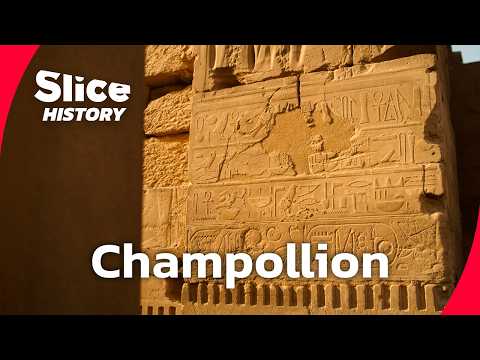
Champollion and the Secret Behind the Decoding of Hieroglyphs I SLICE HISTORY | FULL DOCUMENTARY
 Watch on YouTube →
Overview
Jean-François Champollion combined Coptic language knowledge, comparisons of royal names, and analysis of the Rosetta Stone to show that Egyptian hieroglyphs used both phonetic signs and symbols for ideas. After identifying Greek rulers’ names and then testing his method on earlier pharaohs’ cartouches, he validated his decipherment at Abu Simbel and helped establish Egyptology as a historical science.
Key takeaways
- Champollion used Coptic as a bridge to ancient Egyptian, treating it as a surviving linguistic resource rather than relying on visual guesses about hieroglyphs.
- The Rosetta Stone’s roughly 1,419 hieroglyphs and 86 Greek words challenged the idea that each sign represented a single idea; Champollion concluded the system mixed phonetic and ideographic functions.
- Ptolemy and Cleopatra provided test cases because their Greek names could be rendered by sound in Egyptian cartouches, allowing Champollion to build a set of phonetic sign values.
- Champollion’s reading of Ramses and Thutmose at Abu Simbel helped demonstrate that the phonetic method applied to Egyptian rulers predating the Greek dynasties.
- Jacques-Joseph’s role extended beyond mentorship: he gathered research materials, tested his brother’s ideas through correspondence, and preserved Champollion’s grammar and papers after his death.
- The Rosetta Stone was discovered by Pierre-François Bouchard in 1799 and taken to Britain in 1801 after the French surrender, becoming a key comparative source for European decipherment efforts.
Chapters
0:00
Figeac to Grenoble: Champollion’s Early Education and Joseph Fourier
- In 1801, 11-year-old Jean-François Champollion left Figeac for Grenoble to join his older brother, Jacques-Joseph, who became his strict guardian and teacher.
- Jacques-Joseph’s private library introduced Jean-François to classical works and languages of the East, subjects he pursued far more intensely than his school curriculum.
- A meeting with scholar Joseph Fourier in 1802 brought the brothers into contact with Egyptology and the unresolved problem of reading hieroglyphs.
4:51
Napoleon’s Egyptian Expedition and Champollion’s Paris Language Studies
- Fourier joined Napoleon Bonaparte’s 1798 Egyptian expedition, which included 167 scholars and scientists who documented Egypt’s history, natural world, and monuments.
- The expedition expanded European interest in Egypt, but its scholars could not read the ancient inscriptions.
- Champollion arrived in Paris in 1807, aged 17, and studied languages including Persian, Hebrew, Syriac, Chaldean, and Arabic at the Collège de France.
9:46
Jacques-Joseph’s Research Plan and Champollion’s Study of Coptic
- The Champollion brothers planned their research together: Jacques-Joseph gathered materials and helped test Jean-François’s hypotheses through their correspondence.
- From 1809, Jean-François studied Coptic, a language preserved in the liturgy of Egyptian Christians, and aimed to speak it fluently.
- He treated Coptic as a surviving form of ancient Egyptian that could help him interpret Egyptian words and inscriptions.
13:17
Hieroglyphic, Hieratic, and Demotic: Three Egyptian Writing Systems
- Hieroglyphs served as formal monumental and religious writing, while hieratic was a faster handwritten form used for everyday documents.
- Demotic, a third script that developed from hieratic, appeared around the 7th century BCE.
- Champollion and other researchers initially lacked a clear account of how these three scripts related to one another.
16:29
Thomas Young, the Rosetta Stone, and the Limits of a Bilingual Key
- British scholar Thomas Young investigated demotic, while Champollion and other European researchers competed to decipher Egyptian writing.
- Pierre-François Bouchard discovered the Rosetta Stone in 1799; its decree appeared in Greek, demotic, and hieroglyphs.
- Written in 196 BCE under Ptolemy V, the decree offered a known Greek text for comparison, but scholars initially failed to match it directly to the hieroglyphic version.
- British forces took the stone to London in 1801 after the French surrender in Egypt; its three scripts reflected the country’s Greek and Egyptian language communities.
22:47
Counting Signs and Decoding the Names of Ptolemy and Cleopatra
- In 1822, Champollion counted about 1,419 hieroglyphs on the Rosetta Stone against 86 Greek words, evidence that the signs could not each represent a separate idea.
- He concluded that Egyptian writing combined phonetic signs with ideographic signs, rather than functioning as a purely pictorial or alphabetic system.
- Because Ptolemaic rulers had Greek names, Champollion used their cartouches to match hieroglyphic signs to sounds, starting with Ptolemy and extending the comparisons to Cleopatra.
- His notebook records a growing sound-sign alphabet built from royal names including Alexander, Nero, and Cleopatra.
30:01
Coptic and the Ramses Cartouche: Champollion’s Breakthrough
- Sketches from Abu Simbel gave Champollion inscriptions from a period before the Greek rulers, allowing him to test his method on older Egyptian royal names.
- He read the sun sign as Ra using Coptic, then used the surrounding signs and Coptic vocabulary to identify the name Ramses.
- A second cartouche, read as Thutmose, supported the approach and showed that phonetic readings could work beyond Greek names.
- Champollion’s 1822 breakthrough was quickly reported across Europe, but he still needed evidence that the method applied across Egyptian periods and texts.
35:38
Champollion’s 1828 Expedition: Reading the Temples of Thebes
- Champollion joined the Franco-Tuscan expedition to Egypt in 1828, giving himself about 17 months to inspect monuments and test his decipherment in situ.
- At Thebes, he examined the temples of Luxor and Karnak, where readable royal names made inscriptions into historical records.
- His readings prompted him to reconsider the chronology of Egyptian dynasties, including the 18th and 20th dynasties.
- Letters to Jacques-Joseph combined travel observations with research notes on inscriptions and the succession of pharaohs.
40:37
Abu Simbel and the Test of Champollion’s Decipherment
- At Abu Simbel, Champollion entered a temple whose entrance was partly buried in sand and found inscriptions associated with Ramses II.
- He studied the temple’s royal cartouches and the long inscription known as the Treaty of Kadesh, using repeated names and surrounding text to identify words.
- The readings provided a demanding test of his system on extensive Egyptian inscriptions rather than a handful of foreign rulers’ names.
- The expedition’s findings gave Champollion evidence to support his decipherment and to reconstruct parts of pharaonic history.
45:34
Champollion’s Death and Jacques-Joseph’s Work to Preserve His Legacy
- Champollion returned to Paris in 1830 exhausted after the expedition and faced a substantial body of work to complete.
- He suffered a severe stroke in 1832 and died at age 41; accounts from his family associate his final days with his Egyptian notebooks and travel clothing.
- Jacques-Joseph preserved his brother’s work, including a roughly 500-page Egyptian grammar manuscript, and devoted himself to safeguarding his memory.
- Champollion’s decipherment established a foundation for Egyptology, though his early death left colleagues and family to continue publishing and developing his research.
Summary, takeaways, and chapters were generated by AI from the video's transcript and may contain errors. The video belongs to its creator, SLICE History.