Ch 2,3,4 Atoms, BIO105 Introductory Biology, David Champlin, USM
 Watch on YouTube →
Overview
David Champlin introduces the chemistry behind BIO105 by connecting atoms and molecules to cell structure, then explains protons, neutrons, electrons, isotopes, ions, and covalent bonds. A scale analogy treats a typical 30-micrometer eukaryotic cell as 30 miles across, while the lecture shows how electron shells and electronegativity shape molecules and prepare students to study water.
Key takeaways
- A typical eukaryotic cell is about 30 micrometers across; scaling it to 30 miles helps compare bacteria, proteins, and water by relative size.
- Atomic number equals proton count and uniquely defines an element, while mass number counts protons plus neutrons.
- Ionic charge follows the balance of protons and electrons: sodium loses one electron to become Na⁺, and chlorine gains it to become Cl⁻.
- Valence electrons help predict bonding: hydrogen usually forms one covalent bond, carbon four, nitrogen three, and oxygen two.
- Atoms connected by covalent bonds can rotate around those bonds, giving large proteins flexibility even though the bonds themselves remain stable.
- Oxygen attracts shared electrons more strongly than hydrogen, making water’s covalent bonds polar and creating attractions between water molecules.
Chapters
0:00
Biological Chemistry as Building Blocks for Cells
- Chapters 2, 3, and 4 move from biological chemistry to water and other biological molecules.
- Champlin compares atoms and molecules to LEGO blocks whose combinations create biological diversity.
- Cells share a water-based interior and a cell membrane; proteins act as tools with different structures and functions.
- Eukaryotes include plants, animals, and single-celled organisms such as yeast, while bacteria are prokaryotes.
5:54
Scaling Cells, Bacteria, Proteins, and Water
- A typical eukaryotic cell is about 30 micrometers across, roughly 30 millionths of a meter.
- In Champlin’s scale analogy, a cell becomes 30 miles across, a bacterium is about the size of a school, and a protein is about the size of a truck.
- A millimeter could fit roughly 30 cells across; cells vary in size by cell type.
- A cell contains many copies of proteins, such as tens or hundreds of thousands of hemoglobin molecules in a red blood cell, surrounded by abundant water.
11:33
Reductionism and the Atomic Parts of Matter
- Chapter 2 uses reductionism: examine the smallest components of a cell to understand how the larger system is built.
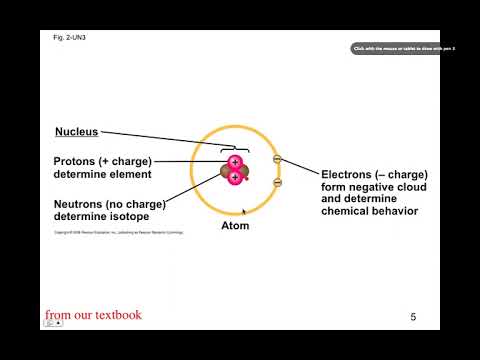
- All matter, including living organisms, is made of atoms, which have protons, neutrons, and electrons.
- Biology focuses on a subset of the periodic table, with a handful of elements especially abundant in life.
14:00
Protons, Atomic Number, and Element Identity
- Protons carry positive charge and sit in the nucleus; an element’s atomic number is its proton count.
- Changing the proton count changes the element, so hydrogen always has one proton and carbon has six.
- Different proton counts give elements different chemical behaviors; the periodic table’s atomic number identifies each element.
- In sodium chloride, chlorine’s strong attraction for an electron helps explain why dissolved salt separates into ions.
19:28
Mass Number, Neutrons, and Radioactive Isotopes
- Mass number is the total number of protons and neutrons; electrons contribute very little mass.
- Oxygen has eight protons and a mass number of 16, so it has eight neutrons.
- Isotopes of an element have different neutron counts; radioactive phosphorus-32 can decay into phosphorus-31.
- Biologists use radioactive isotopes to track molecules and for techniques such as carbon dating.
22:45
Electrons, Ionic Charges, and Salt Dissolving in Water
- Electrons carry negative charge and can move between atoms, unlike the element-defining proton count.
- A sodium ion has 11 protons and 10 electrons, giving it a plus-one charge; a magnesium ion with 12 protons and 10 electrons has a plus-two charge.
- A chloride ion has 17 protons and 18 electrons, giving it a minus-one charge after gaining an electron from sodium.
- Dissolved ions change water chemistry, including the difference between salt water and fresh water.
27:00
Electron Shells, Valence Electrons, and Covalent Bonds
- Periodic-table rows correspond to electron shells, which fill in sequence around the nucleus.
- Valence electrons occupy the outer shell; sodium has one, while chlorine has seven, helping explain their electron transfer.
- Full outer shells make noble gases relatively unreactive, while atoms with incomplete shells can share electrons.
- Hydrogen typically forms one covalent bond, carbon four, nitrogen three, and oxygen two; water forms when oxygen shares electrons with two hydrogen atoms.
34:30
Molecular Shape, Electronegativity, and Polar Water
- Covalent bonds hold atoms at a consistent distance and do not bend, but atoms can rotate around the bond; this rotation gives large molecules such as proteins flexibility.
- Methane, methanol, ethanol, and molecular oxygen illustrate how atoms form molecules; oxygen gas contains a double bond.
- Electronegativity describes an atom’s pull on shared electrons; it generally increases across a period and decreases down a group, with fluorine the strongest and oxygen also highly electronegative.
- Water’s oxygen pulls shared electrons more strongly than hydrogen, creating partial charges and polar covalent bonds; attractions between water molecules lead into Chapter 3.
Summary, takeaways, and chapters were generated by AI from the video's transcript and may contain errors. The video belongs to its creator, The New Evolution for Everyone.