CE 312 Lecture 26: Beam/Frame Deflections IV, Virtual Work Tips/Tricks (2026.10.19)
 Watch on YouTube →
Overview
Gregory Michaelson presents four ways to simplify virtual-work calculations for beam and frame deflections: exploit symmetry, place coordinates at free ends, cut sections toward the coordinate origin, and use integrals with a zero lower bound. He demonstrates the methods with a symmetric variable-stiffness beam and a full example that finds 0.419 in downward deflection at C and 0.141° counterclockwise rotation at E.
Key takeaways
- For a symmetric beam, symmetry can halve the integration work only when geometry, loading and boundary conditions, flexural stiffness, and the point of interest are all symmetric.
- Placing the coordinate origin at a cantilever's free end can eliminate fixed-support reactions from section equations and simplify moment functions.
- A section cut toward the coordinate origin generally avoids distant loads and reactions, reducing polynomial expansion while preserving the same internal moment.
- Using a separate coordinate system for each integration region can replace nonzero lower bounds with zero, simplifying hand evaluation of polynomial antiderivatives.
- Virtual-work unit conversions differ by response: use 1728 for deflection when moments use feet and EI uses inches, and use 144 × 180/π for rotation in degrees.
- The full example combines these techniques to calculate 0.419 in downward deflection at C and 0.141° counterclockwise rotation at E.
Chapters
0:00
Course Updates: Homework 6, MASTAN2, and Exam Preparation
- Attendance grades are current and homework has been graded through 6.1; homework 6.2 is due Wednesday, while 6.3 and 6.4 are due Friday.
- Homework 6.3 requires a screenshot showing MASTAN2 installed, and unusually large deflection or rotation results on 6.2 may be correct.
- The second exam is scheduled for Monday; the class plan is virtual-work tips, frame deflections, shear deformation, and a Friday review.
1:45
Virtual Work Setup and Four Strategies for Easier Beam Calculations
- Beam and frame deflections use integrals of the real and virtual moment functions, M and m, divided by flexural rigidity EI.
- When moment functions use feet and EI uses inches, apply a factor of 1728 for deflection; rotation uses 144 and 180/π to convert radians to degrees.
- Michaelson's four strategies are exploiting symmetry, locating the coordinate origin at a free end, cutting sections toward the origin, and using zero lower integration bounds.
5:13
Exploit Symmetry to Reduce Virtual-Work Integrals
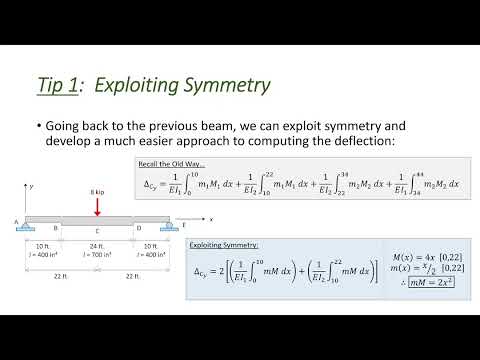
- The example is a simply supported beam with an 8 kip midspan load and variable moment of inertia, so both moment functions and EI change across the span.
- Without symmetry, the calculation requires four integrals to account for different moment-function and EI regions.
- When geometry, loading, flexural stiffness, and the point of interest are symmetric, calculate the two integrals on one half of the beam and double their sum.
- The symmetry method reduces repeated algebra and integration, especially for real structures such as bridges with variable depth.
13:11
Place the Coordinate Origin at a Cantilever's Free End
- For a 15 ft cantilever carrying 2.5 kip/ft, placing the origin at the free end gives compact moment functions: M = -1.25x² and m = -x for the tip-deflection calculation.
- With the origin at the fixed end, section equations must include support reactions and produce longer polynomial expressions.
- Both coordinate choices yield the same physical answer, but the free-end origin makes the virtual-work algebra substantially simpler.
18:11
Cut Sections Toward the Coordinate Origin to Simplify Equilibrium
- For the same 15 ft cantilever, a section cut looking toward the origin requires only the nearby distributed load and gives a compact moment equation.
- Looking away from the origin introduces the fixed-end reactions and terms involving 15 − x, creating additional polynomial expansion.
- Either side of a section cut gives the same internal moment; deriving both can serve as a check, but the origin-facing side usually requires less algebra.
24:13
Use Multiple Coordinate Systems for Zero-Bound Integrals
- For an overhanging beam with a pin and an inset roller support, separate integration regions are unavoidable, but each region can use its own coordinate origin.
- Integrating a polynomial from 0 to a distance avoids evaluating the antiderivative at a nonzero lower bound.
- A 46 ft beam with a support 30 ft from one end can use ranges 0 to 30 and 0 to 16 instead of 0 to 30 and 30 to 46.
- When a coordinate axis is flipped, a point-slope equation retains the slope magnitude but reverses its sign.
29:40
Complete Example: Deflection at C and Rotation at E
- The example uses three real-moment regions, A to B, B to D, and E to D; coordinates start at free ends A and E to simplify the equations and integration bounds.
- For vertical deflection at C, a unit load produces two nonzero virtual-moment regions in the middle; the end regions contribute zero, giving 0.419 in downward.
- For rotation at E, a unit moment produces zero moment from A to B, a linear function from B to D, and a constant unit moment from E to D.
- The rotation calculation uses 144 × 180/π with the summed integrals and gives 0.141° counterclockwise.
Summary, takeaways, and chapters were generated by AI from the video's transcript and may contain errors. The video belongs to its creator, Gregory Michaelson.