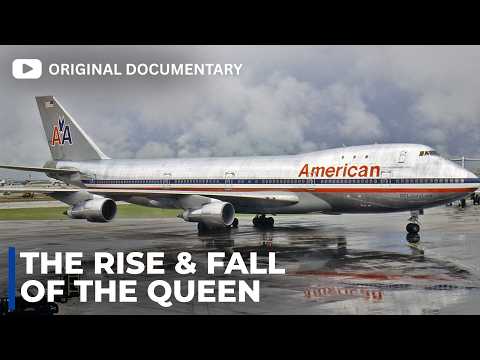
Boeing 747: The Plane That Nearly Destroyed Its Maker - Full Documentary
 Watch on YouTube →
Overview
Juan Trippe’s demand for a 400-seat transatlantic aircraft pushed Boeing into a company-threatening gamble: Joe Sutter’s team adapted large-aircraft research, developed new systems and engines, and built the Everett factory before the 747’s design was complete. Across 1,574 aircraft and multiple variants, the 747 expanded mass-market travel and global air freight, but twin-engine aircraft such as the 777 and advances in ETOPS eventually made four-engine passenger jets uneconomical.
Key takeaways
- Boeing built the Everett assembly plant while the 747 was still being designed, making the program a simultaneous gamble on an aircraft, a factory, and demand for mass air travel.
- The 747’s cargo nose door helped the program endure the early-1970s downturn: airlines could carry freight or use passenger-and-cargo combi layouts when passenger demand was weak.
- The 747-400 combined winglets, digital avionics, and a two-pilot cockpit, and its 694 deliveries made it the most commercially successful 747 variant.
- The Boeing 777 and expanded ETOPS rules undermined the economic case for four engines by allowing twin-engine aircraft to serve long oceanic routes at lower operating cost.
- The 747’s influence extended beyond passenger aviation: freighters supported global supply chains, while modified aircraft served as presidential transports, airborne command posts, and NASA shuttle carriers.
Chapters
0:00
Juan Trippe’s 400-Passenger Challenge and the 747’s Cargo-Door Hump
- In 1965, Pan Am CEO Juan Trippe asked Boeing for an aircraft carrying about 400 passengers across the Atlantic nonstop, far beyond the capacity of the roughly 140-seat Boeing 707.
- Boeing adapted research from its unsuccessful competition for the U.S. Air Force’s C-5 transport program rather than starting large-aircraft design from scratch.
- A nose-loading cargo concept required moving the cockpit above the main deck, creating the 747’s distinctive upper-deck hump.
4:51
Everett, Joe Sutter, and the 747’s Unprecedented Engineering Scale
- In 1966, Boeing committed to the program and built its Everett, Washington, assembly plant while engineers were still finalizing the aircraft.
- Engineer Joe Sutter led the team nicknamed the “Incredibles”; Boeing promised Pan Am deliveries by 1969 while taking on enormous development costs.
- The 747 combined a wide twin-aisle fuselage, swept wings with high-lift slats and flaps, four high-bypass engines, and landing gear with 18 wheels.
- Pratt & Whitney developed the JT9D turbofan for the aircraft, while complex fuel, hydraulic, electrical, and pressurization systems had to function reliably at altitude.
9:41
First Flight, Stress Tests, and Pan Am’s 1970 Jumbo Debut
- Test pilot Jack Waddell flew the first 747 on February 9, 1969; Boeing tested the wings to failure at 150% of design limit load.
- High-speed taxi tests exposed nose-gear shimmy, and flight testing led to tail-structure changes before the FAA granted certification in December 1969.
- Pan Am’s first commercial 747 flight departed New York for London on January 22, 1970, with Juan Trippe aboard.
- Early JT9D reliability problems, airport equipment upgrades, fuel-price shocks, and weak demand strained airlines and pushed Boeing toward financial peril.
14:50
747 Variants, Cargo Resilience, and the Rise of Twin-Engine Rivals
- The 747-200 added range and payload; the shortened 747SP targeted ultra-long routes, while the 747-300 extended the upper deck.
- The 747-400 introduced digital avionics, winglets, and a two-pilot cockpit; its 694 deliveries made it the best-selling 747 variant.
- The final 747-8 used GEnx-2B engines, but only 155 were built as airlines increasingly favored more economical twin-engine aircraft.
- The DC-10, L-1011, A340, and A380 challenged the jumbo in different ways, but the Boeing 777’s range, capacity, and operating economics proved the more lasting replacement.
22:00
How the 747 Reshaped Airline Routes and Global Hubs
- The 747’s capacity and range made nonstop ocean crossings and additional long-haul routes commercially viable, helping airlines expand beyond traditional stopover networks.
- Pan Am used 747s to connect cities across the Atlantic and Pacific, but aggressive expansion and intensified competition contributed to its 1991 collapse.
- Japan Airlines and All Nippon Airways used high-capacity 747s on dense domestic routes; Japan Airlines operated more than 80 at its peak.
- Qantas developed long-haul operations with the 747, while British Airways built a fleet of more than 50 and strengthened Heathrow’s role as a global hub.
25:34
The Upper-Deck Experience and the 747’s Nose-Loading Freighters
- Early 747 upper decks offered lounges and bars; as airlines prioritized seats, the space became more associated with premium cabins.
- The original cockpit required a flight engineer, but the 747-400’s glass cockpit allowed two-pilot operation.
- The freighter’s hinged nose door lets cargo crews load pallets directly along the main deck; passenger 747s can also be converted by reinforcing the floor and installing cargo doors.
- Operators including UPS, Atlas Air, Cargolux, and Cathay Pacific Cargo use 747 freighters for time-sensitive international freight.
30:33
Tourism, Supply Chains, and Special-Purpose 747 Missions
- Higher passenger capacity helped make overseas holidays accessible to more travelers and supported tourism growth in destinations including Spain, Greece, and Thailand.
- Freighter networks moved electronics, pharmaceuticals, and automotive components quickly between continents, supporting just-in-time supply chains.
- The U.S. presidential VC-25A fleet consists of modified 747-200B aircraft; the E-4B is a 747-based airborne command post.
- NASA used modified 747 Shuttle Carrier Aircraft to transport orbiters, and Boeing’s Everett factory and supplier network became lasting industrial legacies of the program.
34:11
747 Records, Production’s End, and the Jumbo’s Lasting Legacy
- During Operation Solomon in 1991, an El Al 747 evacuated 1,088 Ethiopian Jews from Addis Ababa to Tel Aviv, including two babies born during the flight.
- The final 747, a 747-8F for Atlas Air, left production in December 2022 and was delivered in January 2023; Boeing built 1,574 aircraft over 54 years.
- Improved engine reliability and ETOPS rules enabled twin-engine aircraft to fly routes once associated with four-engine jets, while lower fuel and operating costs accelerated passenger 747 retirements.
- Freighters are expected to outlast passenger versions, but Boeing has no planned successor; the 747’s enduring legacy is making large-scale global passenger travel and air freight commercially practical.
Summary, takeaways, and chapters were generated by AI from the video's transcript and may contain errors. The video belongs to its creator, Plane Curious.