Black Holes: The First Image of the Unseen | Galaxy | Free Documentary Space
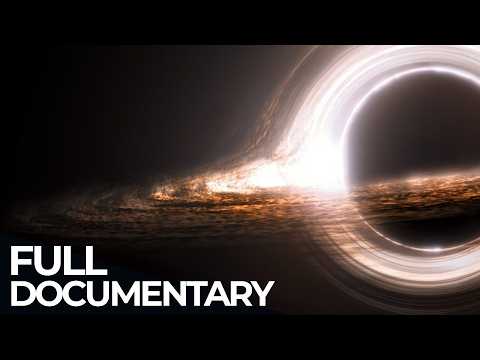 Watch on YouTube →
Overview
The Event Horizon Telescope (EHT) combined eight radio observatories in 2017 to capture the first image of the supermassive black hole in galaxy M87, 55 million light-years away; its 2019 image showed a bright ring surrounding the black hole’s shadow. The account traces the evidence behind black holes—from Reinhard Genzel’s measurements of stars orbiting the Milky Way’s center to the EHT’s 1.3 mm observations, petabyte-scale data processing, and later work on magnetic fields and gravitational waves.
Key takeaways
- Tracking the 16-year orbit of S2 around the Milky Way’s center let Reinhard Genzel’s team measure an unseen compact mass and test general relativity through gravitational redshift.
- The EHT’s 2017 image depended on very-long-baseline interferometry: eight geographically separated observatories recorded 1.3 mm signals that were later synchronized and combined.
- Phased ALMA increased the EHT’s sensitivity tenfold, while the full array collected about four petabytes over five observing nights.
- The orange ring in the M87 image represents radio emission from hot orbiting gas; gravitational lensing reveals light from around the black hole, while the dark center is its shadow.
- Independent imaging by four teams helped guard against bias when algorithms filled gaps in the telescope data, and the reconstructed ring matched simulations based on general relativity.
- EHT polarization measurements can map magnetic fields in M87’s accretion flow, offering clues to how active black holes launch relativistic plasma jets.
Chapters
0:00
From Einstein’s Relativity to Evidence for the Milky Way’s Black Hole
- Einstein’s 1915 general relativity equations describe how mass curves space-time and bends light; Karl Schwarzschild’s solution implied an object from which light cannot escape.
- Radio discoveries including quasars and pulsars revived interest in black holes, while active galactic nuclei revealed energetic matter accreting around supermassive black holes.
- Beginning in 1992, Reinhard Genzel’s team tracked 28 stars near the Milky Way’s center; the 16-year orbit of S2 around an unseen mass provided strong evidence for a massive black hole.
- During S2’s 2018 close approach, the star reached nearly 3% of light speed and its light showed the gravitational redshift predicted by general relativity.
6:00
Why the EHT Targeted the Active Black Hole in M87
- Shep Doeleman’s international team chose M87’s active galactic nucleus, where hot, magnetized gas in an accretion disk emits detectable radiation around the black hole.
- The black hole’s gravity bends light through gravitational lensing, allowing light from behind it to appear around the dark central shadow.
- The EHT linked widely separated radio telescopes as a global interferometer to achieve the angular resolution needed to distinguish a black hole tens of millions of light-years away.
- The collaboration observed at 1.3 mm, a radio wavelength that can pass through much of the gas and dust between M87 and Earth.
13:00
Phasing ALMA and Building the EHT’s Data Infrastructure
- ALMA’s 64 dishes had to be phased to operate as one EHT station; its participation increased the array’s sensitivity by a factor of 10.
- The Max Planck Institute and Haystack Observatory operated correlator centers that combined telescope signals, while hydrogen masers supplied precise timestamps.
- Remote high-altitude sites required high-speed recorders and helium-filled drives; each telescope could generate about half a petabyte during a 10-hour observing session.
- The project aimed to test gravity in extreme conditions, where black-hole observations could eventually help probe how general relativity relates to quantum physics.
19:00
Global Observatory Network and the April 2017 Campaign
- The network included facilities such as the South Pole Telescope, the IRAM 30-m dish in Spain, Mexico’s Large Millimeter Telescope, and observatories on Mauna Kea.
- High, dry sites improved millimeter-wave observations; ALMA served as a sensitive anchor station, while the telescopes’ global spread increased angular resolution.
- The team coordinated observing windows from Harvard and began the campaign on April 5, 2017, checking weather and atmospheric opacity before each go/no-go decision.
- Across five nights, favorable conditions let the eight telescopes collect roughly four petabytes of data while observing the same point in M87.
26:00
Correlating Petabytes and Independently Reconstructing the Image
- Data from seven sites went to correlators in Bonn and Westford; South Pole drives had to wait until the Antarctic winter ended before shipment.
- Correlators aligned telescope timestamps and reduced atmospheric and electronic noise, shrinking the dataset by a factor of one million without producing an image by itself.
- Four imaging teams worked independently to limit human bias, using different methods to fill gaps in the data and compare observations with simulations.
- In 2019, the collaboration released an image of a bright, asymmetric ring around a dark center after extensive checks; the result matched the expected black-hole appearance.
32:00
What the M87 Image Reveals—and What Its Colors Mean
- The 2019 image shows radio emission from matter orbiting M87’s black hole, with the brighter side reflecting effects that include the gas’s relativistic motion.
- The apparent ring is shaped by gravitational lensing, including light from the far side of the accretion flow; the dark central region is the black-hole shadow, not a direct view of the singularity.
- Orange was chosen to represent heat in a visualization of radio waves, which are invisible to human eyes.
- M87’s black hole has a mass of about 6.5 billion Suns, and its event-horizon scale is comparable to the orbit of Pluto around the Sun.
36:00
EHT Expansion, Magnetic Fields, and Black-Hole Jets
- The EHT later added the Greenland Telescope, a station at Kitt Peak in Arizona, and France’s NOEMA phased array to improve geographic coverage and image resolution.
- Weather disrupted the 2019 campaign, and COVID-19 canceled the 2020 observing run; researchers later reprocessed existing data to reveal polarization and magnetic structure in M87’s ring.
- M87 is actively consuming nearby matter and launching plasma jets; magnetic fields around the spinning black hole are a leading explanation for how material is accelerated outward.
- The collaboration aims to obtain sharper images and moving sequences, while the comparatively inactive black hole in the Milky Way remains harder to image because it lacks a prominent accretion ring.
40:00
Stellar Black Holes, Neutron Stars, and Gravitational-Wave Discoveries
- A star in the Vela constellation was found orbiting an unseen object every 167 days, revealing a stellar-mass black hole about four times the mass of the Sun.
- Massive stars can collapse into black holes after supernovae or hypernovae; less massive remnants may instead become neutron stars, sometimes observed as precisely timed pulsars.
- LIGO and Virgo detect gravitational waves with laser interferometers; a 2015 signal came from two merging black holes of roughly 30 solar masses each.
- In 2017, detectors recorded merging neutron stars, and follow-up observations across the electromagnetic spectrum located the source; continued EHT work seeks sharper images and movies of supermassive black holes.
Summary, takeaways, and chapters were generated by AI from the video's transcript and may contain errors. The video belongs to its creator, Free Documentary - Space.