BIOL 105 Lecture 22 10/16/26
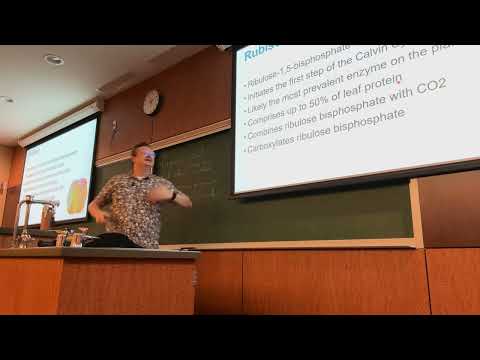 Watch on YouTube →
Overview
Jonathan Montgomery reviews photosynthetic electron flow, the Calvin cycle, Rubisco’s oxygenase activity and the plant adaptations that reduce photorespiration, including C4 and CAM pathways. He then introduces cell communication, explaining receptor specificity, signal transduction, G-protein-coupled receptors, and how phosphorylation cascades amplify cellular responses, while highlighting material relevant to the upcoming exam.
Key takeaways
- In linear photosynthetic electron flow, electrons move from water through Photosystem II and an ATP-generating electron transport chain, are re-excited in Photosystem I, and reduce NADP+ to NADPH.
- Rubisco can fix either CO2 or O2 onto RuBP; oxygen fixation drives photorespiration, which wastes ATP and NADPH and can lose previously fixed carbon.
- C4 plants separate initial CO2 fixation into mesophyll cells and the Calvin cycle into bundle sheath cells, whereas CAM plants fix CO2 at night and release it during the day.
- A cell’s response to a signaling molecule depends on whether it expresses the matching receptor; cells without that receptor do not detect the signal.
- Hydrophobic steroid hormones can enter cells and bind intracellular receptors that act as transcription factors, directly changing gene expression.
- GTP is required for the described GPCR pathway to activate its G protein, while kinase cascades amplify signals by activating successive groups of target molecules.
Chapters
0:00
Lab Midterm Deadline and Monday’s Exam Two
- The online lab midterm is due by the end of Sunday, with no late submissions; after the deadline, correct answers become available.
- Use the midterm as a check on whether lab notebook notes and course knowledge are enough for the in-person lab final.
- Exam Two is scheduled for Monday, uses a Scantron, and covers topics listed in the Week Nine study guide.
3:45
Photosynthetic Electron Flow from Water to NADPH
- Photosystem II’s oxidized P680+ extracts electrons from water, releasing the oxygen produced during photosynthesis.
- Light raises electron energy in Photosystem II; electrons then pass through an electron transport chain that builds a proton gradient used to make ATP by chemiosmosis.
- Photosystem I re-excites the electrons, which ultimately reduce NADP+ to NADPH; cyclic electron flow through Photosystem I produces ATP only.
6:25
Rubisco’s Role and the Energy Cost of Photorespiration
- The Calvin cycle uses ATP and NADPH to convert CO2 into high-energy organic molecules; its direct carbohydrate product is G3P, which can be used to build glucose and other compounds.
- Rubisco—ribulose-1,5-bisphosphate carboxylase/oxygenase—normally attaches CO2 to RuBP to initiate carbon fixation.
- Rubisco can also attach O2 to RuBP; photorespiration wastes previously invested ATP and NADPH and can release fixed carbon as CO2.
- Rubisco makes up a substantial share of leaf protein, and its competing oxygenase activity reflects an evolutionary trade-off rather than a perfectly optimized enzyme.
13:00
How C4 and CAM Plants Limit Photorespiration
- High temperatures increase Rubisco’s oxygenase activity, while opening stomata to acquire CO2 increases water loss.
- C4 plants use PEP carboxylase to fix CO2 into a four-carbon compound in mesophyll cells, then deliver it to bundle sheath cells near the Calvin cycle.
- CAM plants open stomata at night, temporarily fix CO2, and release it during the day while stomata remain closed.
- Both strategies raise CO2 concentration around Rubisco, reducing photorespiration; Montgomery notes that these adaptations are not required exam material.
17:45
Photosynthesis Flowchart: Light Reactions to G3P
- Photosynthesis converts solar energy into chemical energy through the light reactions and Calvin cycle.
- In the thylakoid membrane, light-driven water splitting releases O2, and excited electrons help generate ATP and NADPH.
- The Calvin cycle fixes CO2 to RuBP and uses ATP and NADPH to produce G3P, the immediate product often simplified as glucose in introductory explanations.
20:05
Cell Communication Depends on Receptors and Cellular Responses
- Signaling molecules coordinate cell activity by changing protein abundance or activity, including by inducing gene expression or regulating enzymes.
- Large or hydrophilic signals generally cannot cross the phospholipid bilayer and must bind cell-surface receptors; small hydrophobic signals can reach intracellular receptors.
- Cells respond differently to the same signal when they have different receptor sets; without the matching receptor, a cell cannot detect that signal.
- Cell signaling supports processes ranging from immune recognition to embryonic patterning, including development-associated signaling such as Sonic hedgehog.
26:15
Gap Junction, Autocrine, Paracrine, Endocrine, and Synaptic Signaling
- Gap junctions connect neighboring animal cells through protein channels, allowing signals to pass directly between cells.
- Autocrine signaling acts on the releasing cell, while paracrine signaling affects nearby cells; bacterial quorum sensing uses signal accumulation to indicate population density.
- Endocrine signals travel through the bloodstream for long-distance coordination, such as hormone responses to a perceived threat.
- Synaptic signaling releases neurotransmitters from a neuron across a synapse to a target cell, enabling rapid, targeted communication.
32:15
Signal Transduction Converts and Amplifies External Signals
- Signal transduction changes a signal’s form: a cell-surface receptor detects an external ligand and activates intracellular relay molecules such as cyclic AMP.
- The three broad stages are reception, transduction, and cellular response, which may include activating an enzyme or producing a new one.
- Intracellular relay steps can amplify a signal, allowing one external ligand to trigger multiple downstream responses.
- Receptor–ligand binding is reversible; drugs can mimic a ligand or prolong its effects by slowing its reuptake or degradation.
40:15
Steroid Hormones Activate Intracellular Receptors and Gene Expression
- Hydrophobic steroid hormones can diffuse across the cell membrane and nuclear envelope, both phospholipid bilayers.
- In the described pathway, a steroid binds an intracellular receptor, and the activated receptor acts as a transcription factor.
- The receptor can activate transcription of previously inactive genes, changing RNA and protein production as a cellular response.
43:00
GPCR Signaling and Kinase-Driven Phosphorylation Cascades
- A G-protein-coupled receptor activates its associated G protein by promoting GTP binding; without GTP, the G protein cannot relay the signal.
- Activated G proteins commonly regulate downstream enzymes, converting an external ligand signal into an intracellular response.
- Kinases transfer phosphate groups from ATP onto target molecules, while phosphatases remove them; phosphorylation often changes protein activity.
- In a phosphorylation cascade, each activated kinase can activate many downstream molecules, amplifying one initiating signal into a large cellular response.
Summary, takeaways, and chapters were generated by AI from the video's transcript and may contain errors. The video belongs to its creator, Jonathan Montgomery.